

High refractive index aromatic-based siloxane difunctional macromonomers
a macromonomer and aromatic-based technology, applied in the field of macromonomers, can solve the problems of less popularization of more rigid iol implants in the market, increased incidence of postoperative complications, and less desirable than other materials with respect to minimal incision size, and achieves ideal physical properties, high refractive index, and high elongation polymer compositions.
- Summary
- Abstract
- Description
- Claims
- Application Information
AI Technical Summary
Benefits of technology
Problems solved by technology
Method used
Image

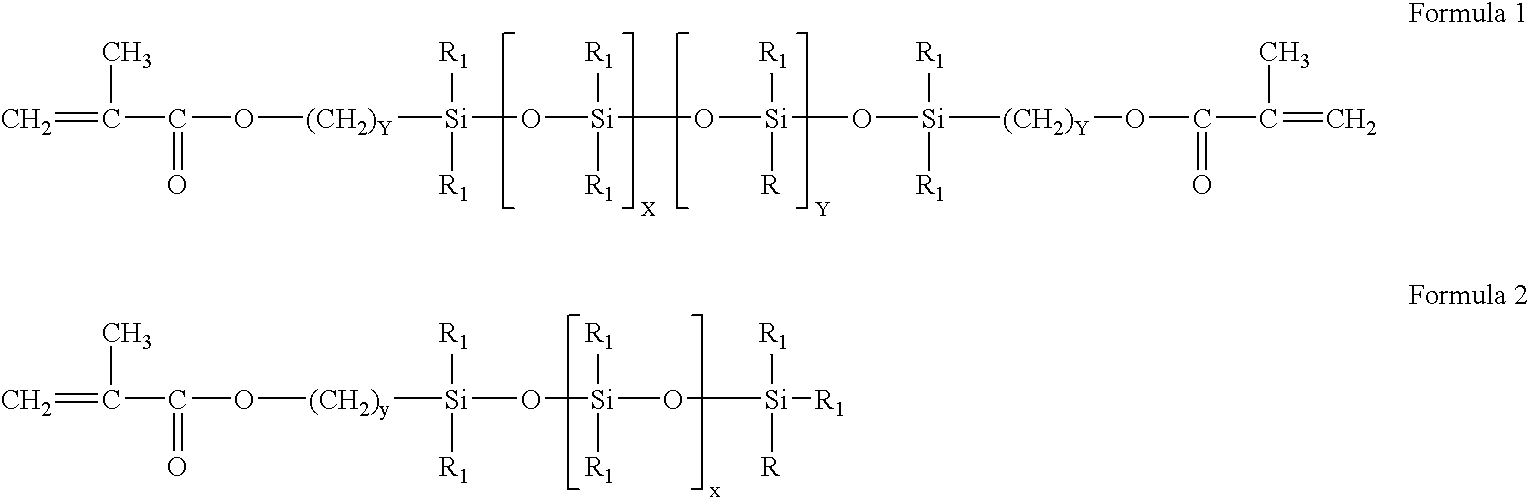
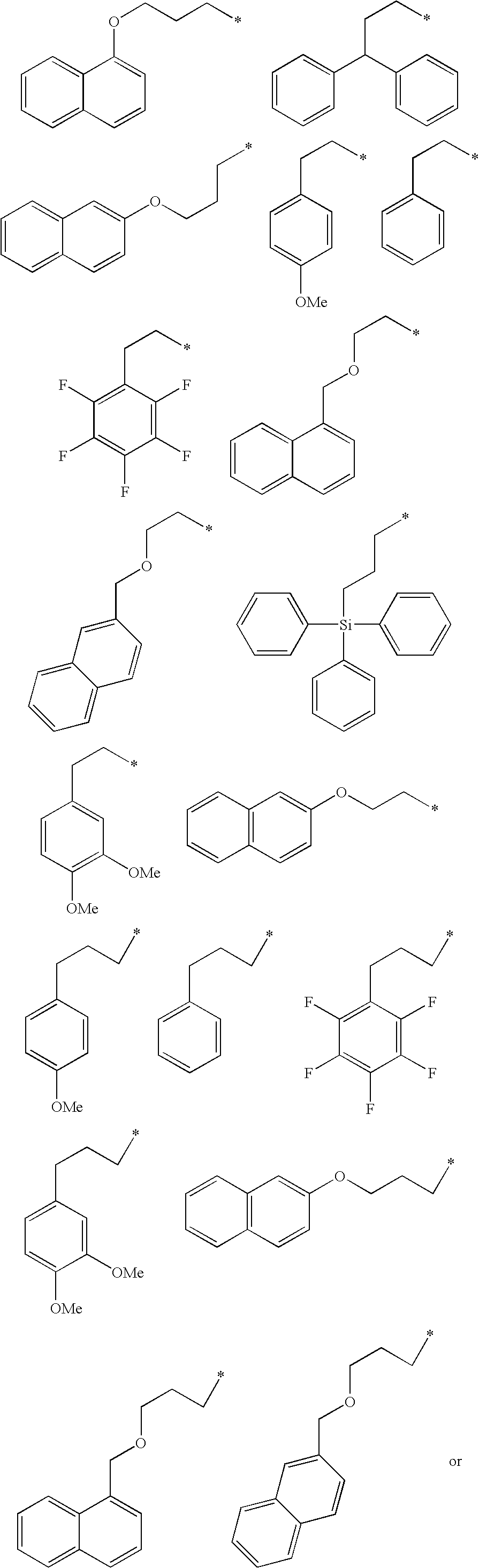
Examples
example 1
Synthesis of Macromonomer (Two-Part Synthetic Scheme)
Part A: Methacrylate End-Capped Hydride Functionalized Macromonomer Synthesis
[0028] To a 1000 ml round bottom flask under dry nitrogen was added D4-(octamethylcyclotetrasiloxane), D4H (tetramethylcyclotetrasiloxane) and M2 (1,3-bis(4-methacryloyloxybutyl)tetramethyidisiloxane (molar ratio of each component dependent on desired chain length and mole % hydride substitution). Trifluoromethanesulfonic acid (0.25%) was added as initiator. The reaction mixture was stirred 24 hours with vigorous stirring at room temperature. Sodium bicarbonate was then added and the reaction mixture was again stirred for 24 hours. The resultant solution was filtered through a 0.3 μTeflon®) (E. I. du Pont de Nemours and Company, Wilmington, Del.) filter. The filtered solution was vacuum stripped and placed under vacuum (>0.1 mm Hg) at 50° C. to remove the unreacted silicone cyclics. The resulting silicone hydride functionalized siloxane was a viscous, ...
example 2
[0030] To 80 parts of a 13 / 13 [Si(NEM)] macromonomer was added 20 parts of naphthylethyl methacrylate and 0.5% of Irgacure™ 819 (Ciba-Geigy, Basel, Switzerland) as the UV photoinitiator and 0.25% of a commercial triazole UV blocker (Aldrich Chemical Co). The clear solution was sandwiched between two silanized glass plates using metal gaskets and exposed to UV radiation for two hours. The resultant films were released and extracted in isopropanol (IPA) for four hours, followed by air-drying and a 30 mm vacuum to remove the IPA. The clear tack-free films possessed a modulus of 222 g / mm2, tear strength of 29 g / mm, recovery of 80% and a refractive index of 1.563. Commercial grade silicone rubber exhibits a modulus of 300 g / mm2, a tear of 50 g / mm, recovery of 81% and a refractive index of only 1.43.
example 3
[0031] To 80 parts of a 13 / 13 [Si(NEM)] macromonomer was added 20 parts of methyl methacrylate and 0.5% of Irgacure™ 819 as the UV photoinitiator and 0.25% of a commercial triazole UV blocker (Aldrich Chemical Co). The clear solution was sandwiched between two silanized glass plates using metal gaskets and exposed to UV radiation for two hours. The resultant films were released and extracted in IPA for four hours, followed by air-drying and a 30 mm vacuum to remove the IPA. The clear tack-free films possessed a modulus of 1123 g / mm2, a tear strength of 93 g / mm, recovery of 60% and a refractive index of 1.538.
PUM
| Property | Measurement | Unit |
|---|---|---|
| elongation | aaaaa | aaaaa |
| refractive index | aaaaa | aaaaa |
| refractive index | aaaaa | aaaaa |
Abstract
Description
Claims
Application Information
 Login to View More