

Device and method for producing a three-dimensionally perceived planar tactile illusion
a three-dimensional perception and tactile illusion technology, applied in the field of creating an illusory perception for a person, can solve the problems of not being able to produce a 3-d illusion of depth contour and shape, unable to produce a device or method that is able to produce the non-veridical illusion of three-dimensional contour on the surface of the body, and interfere with the training task
- Summary
- Abstract
- Description
- Claims
- Application Information
AI Technical Summary
Benefits of technology
Problems solved by technology
Method used
Image

Examples
Embodiment Construction
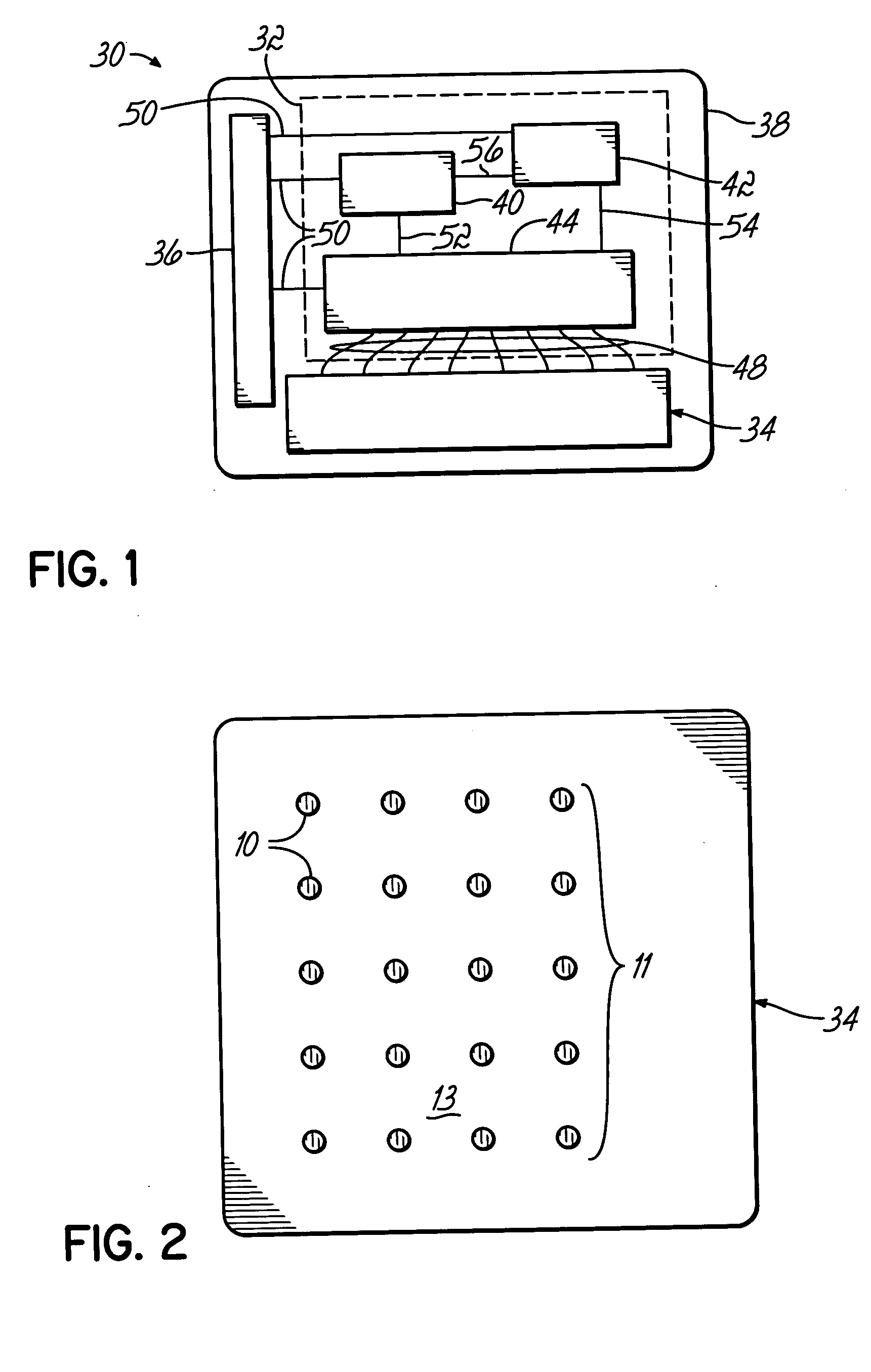
[0021]FIG. 1 depicts one form of a tactile communication device for realizing the present invention. The device 30 is not limiting with respect to the inventive method or device for controlling an array to affect the results of the invention. FIG. 1 depicts an embodiment of the present invention as a tactile communication device 30 that includes a control module 32, an actuator or stimulator array 34, a power source 36, and an appropriate housing 38 or support for array 34 and supporting components. Tactile communication device 30 is an electromechanical device capable of receiving input signals transmitted to tactile communication device 30 from a remote device and then delivering the input to the user of tactile communication device 30, such as a human sensing surface 39, to create a tactually sensed non-veridical perception of the three-dimensional surface 33.
[0022] Control module 32 of FIG. 1 may include a data receiver 40, a memory module 42 and a conversion module 44. Data re...
PUM
 Login to View More
 Abstract
Description
Claims
Application Information
 Login to View More