

Self-centering skate holder
a self-centering, skate technology, applied in the field of skate holders, can solve the problems of large and bulky apparatus, large and bulky design, and the location of the pivot axis,
- Summary
- Abstract
- Description
- Claims
- Application Information
AI Technical Summary
Benefits of technology
Problems solved by technology
Method used
Image

Examples
Embodiment Construction
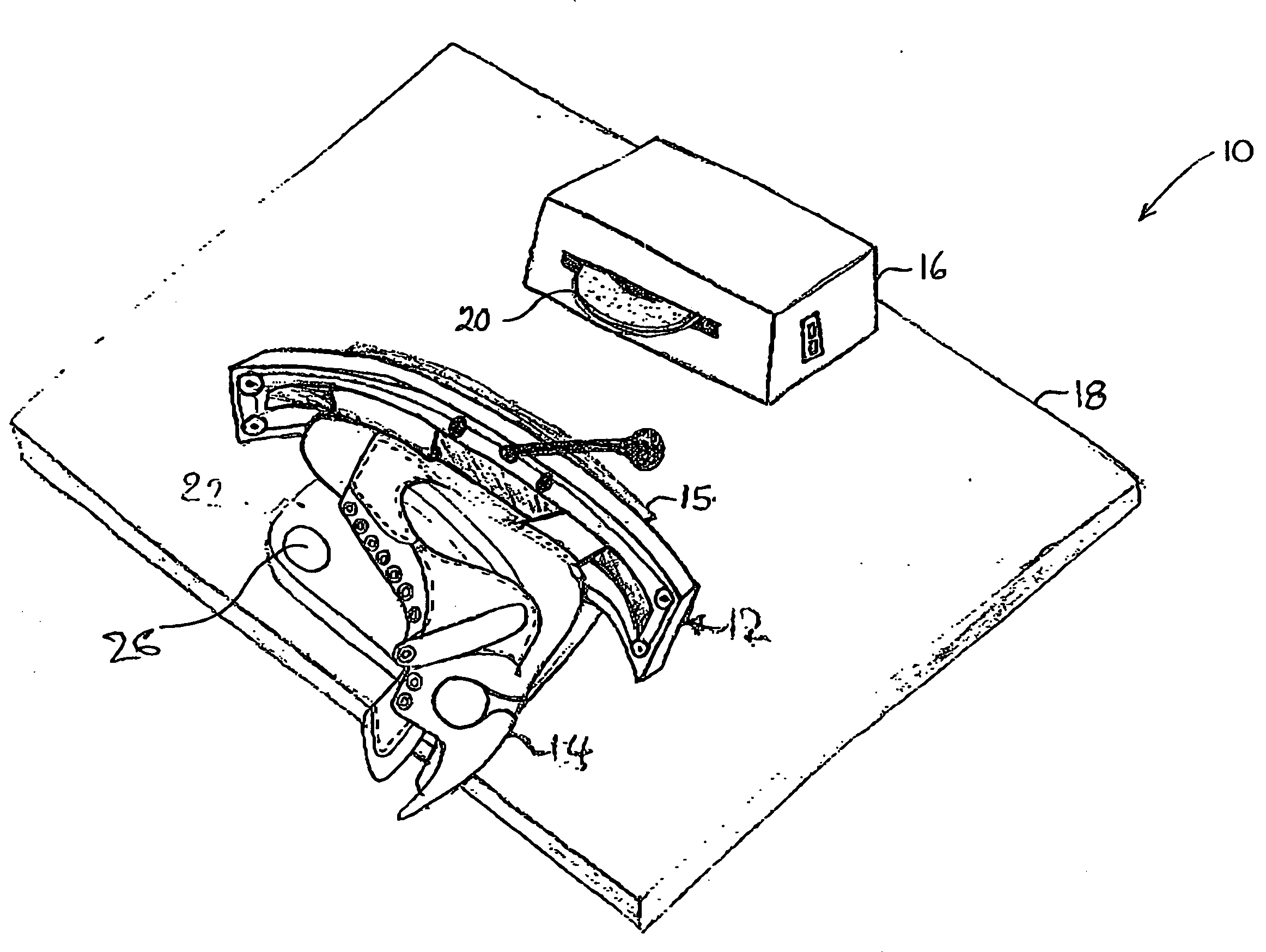
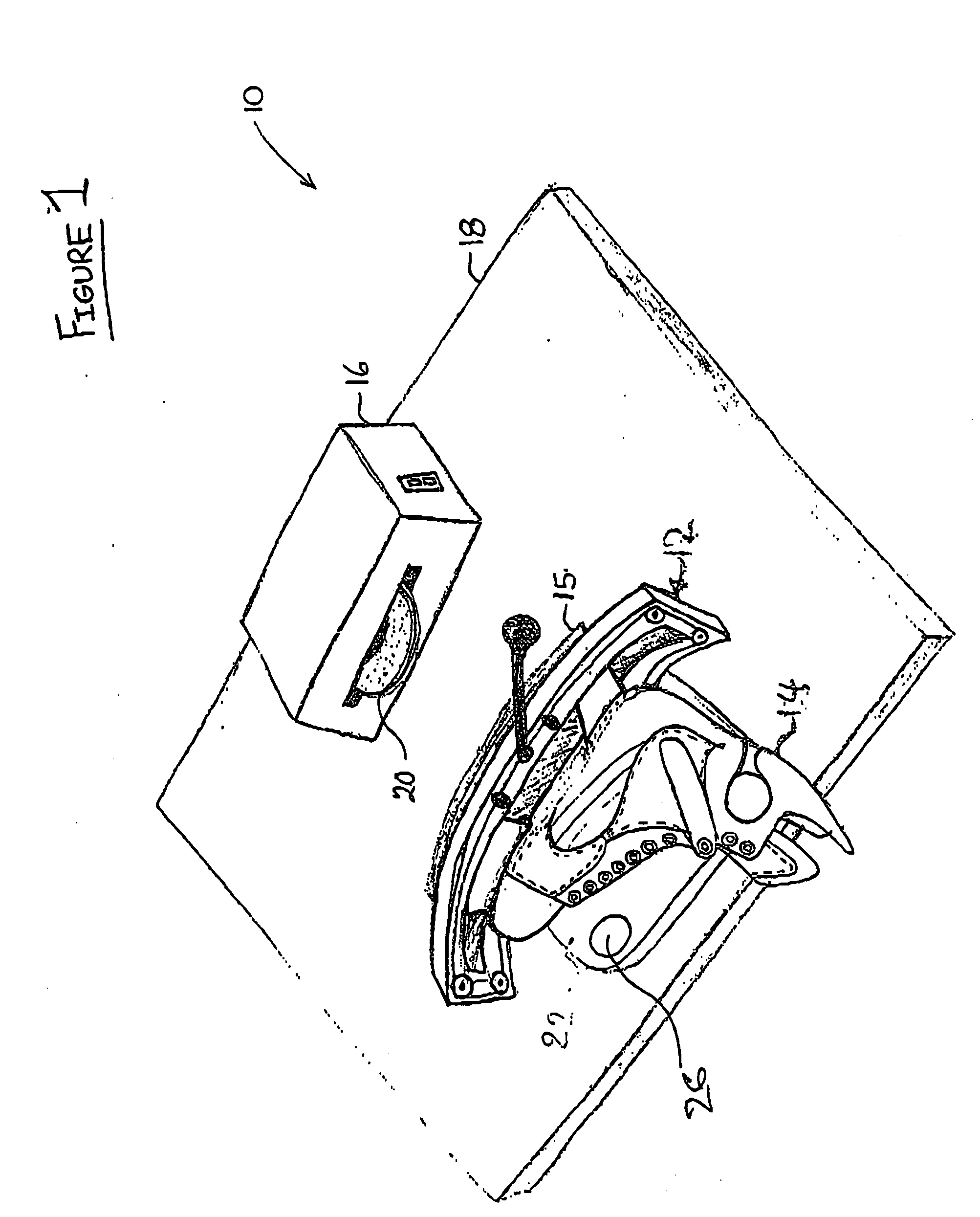
[0026] Referring therefore to FIG. 1, a skate sharpening apparatus 10 includes a skate holder 12 that supports a skate 14 having a skate blade 15. The holder 12 is slideable on a work surface 18 so as to be manoeuvrable past a grinder 16 having a grinding wheel 20. The grinding wheel 20 is positioned to rotate about a vertical axis in a horizontal plane and, upon engagement with the blade 15, to grind the requisite profile.
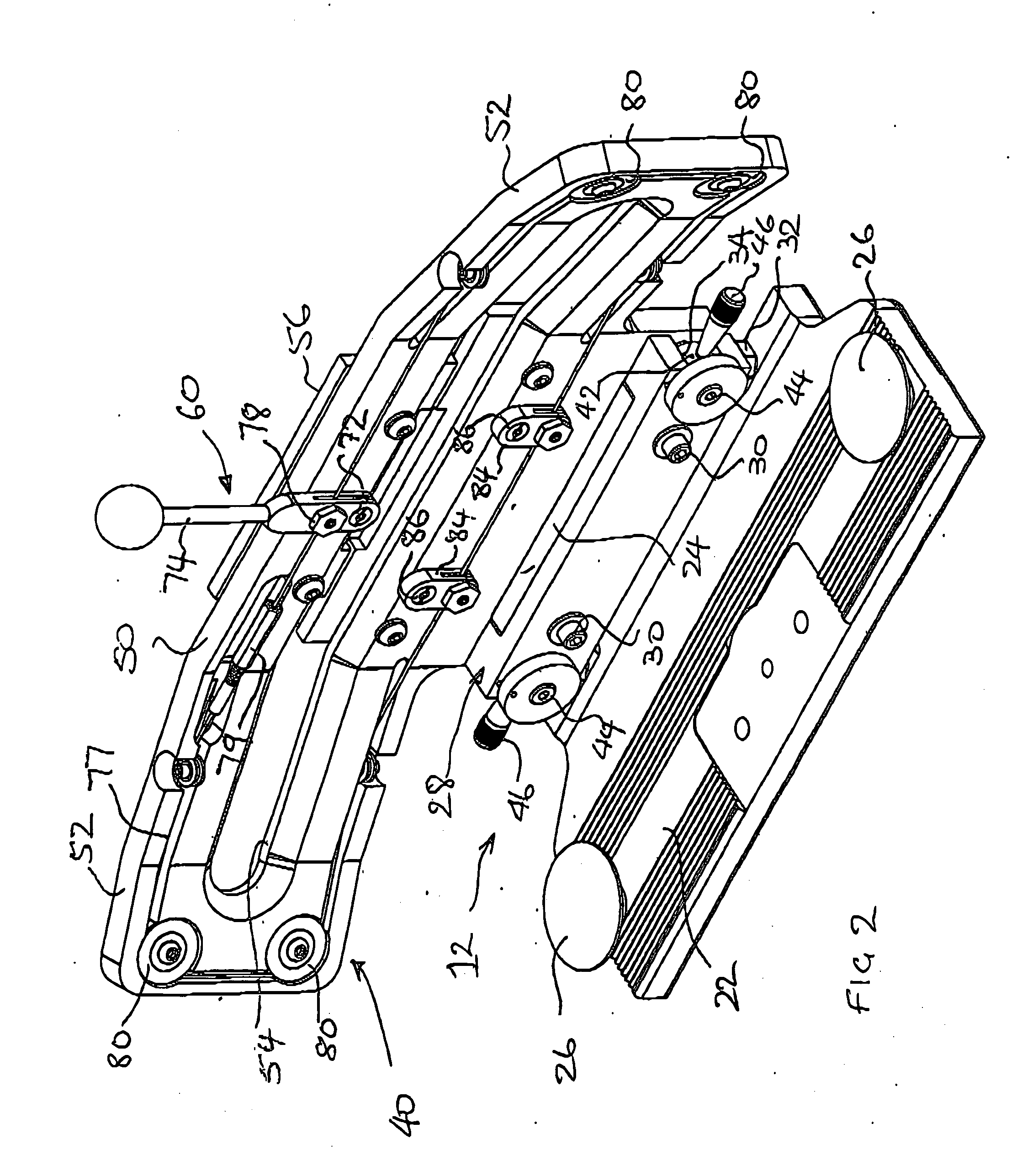
[0027] The details of the holder 15 can be seen in more detail in FIGS. 2 through 7. The holder 12 has a base 22. A pair of handles 26 are provided on the base 22 to facilitate manipulation of the holder 12 on the worktop 18. A mounting block 28 is secured to an upturned lip 24 of the base 22 by bolts 30. The position of the mounting block 28 relative to the base is adjusted by means of set screws 32 which are threaded into the base 22 and bear against the underside of the mounting block 28. The set screws 32 provide a nominal or coarse adjustment for the disposi...
PUM
| Property | Measurement | Unit |
|---|---|---|
| flexible | aaaaa | aaaaa |
| movement | aaaaa | aaaaa |
| tensile | aaaaa | aaaaa |
Abstract
Description
Claims
Application Information
 Login to View More