

Method for estimating porosity and saturation in a subsurface reservoir
a reservoir and porosity technology, applied in the field of methods for estimating subsurface reservoir properties, can solve problems such as inaccurate estimates of porosity and saturation
- Summary
- Abstract
- Description
- Claims
- Application Information
AI Technical Summary
Problems solved by technology
Method used
Image

Examples
Embodiment Construction
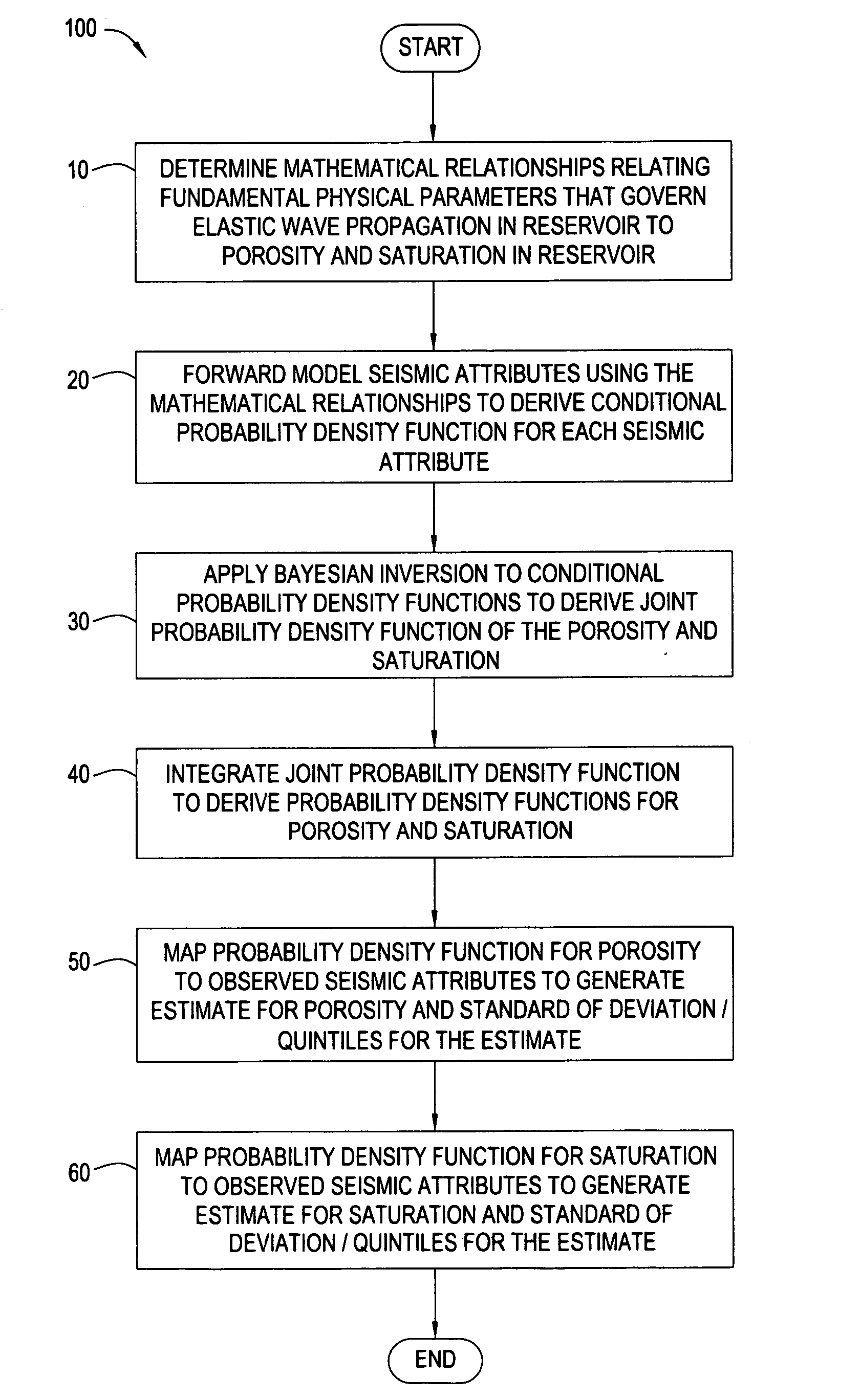
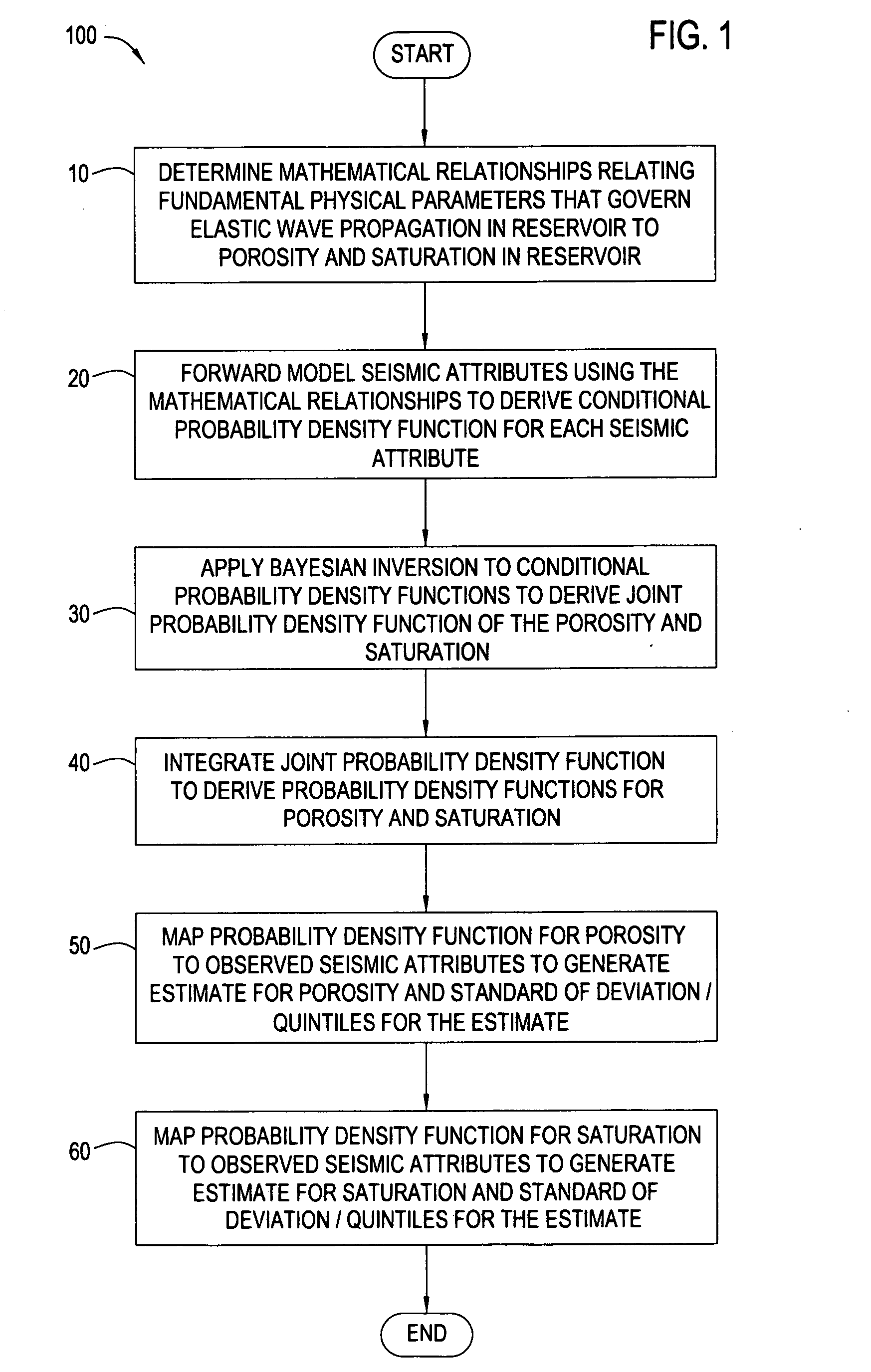
[0016]FIG. 1 illustrates a flow diagram of a method 100 for estimating reservoir porosity and hydrocarbon saturation in a subsurface reservoir in accordance with one embodiment of the invention. At step 10, mathematical relationships relating the fundamental physical parameters that govern the elastic wave propagation in the subsurface reservoir to the porosity and the saturation in the subsurface reservoir are determined. For a linear isotropic subsurface reservoir, the fundamental physical parameters are the bulk modulus (K), the shear modulus (G) and the bulk density (ρ). As such, the bulk modulus (K) is a function of the porosity and the saturation, the shear modulus G is a function of the porosity, and the bulk density (ρ) is a function of the porosity and the saturation. In one embodiment, the mathematical relationships are determined using rock physics relations, including Biot-Gassmann relations. Other types of media may require mathematical relationships relating other fund...
PUM
 Login to View More
 Abstract
Description
Claims
Application Information
 Login to View More