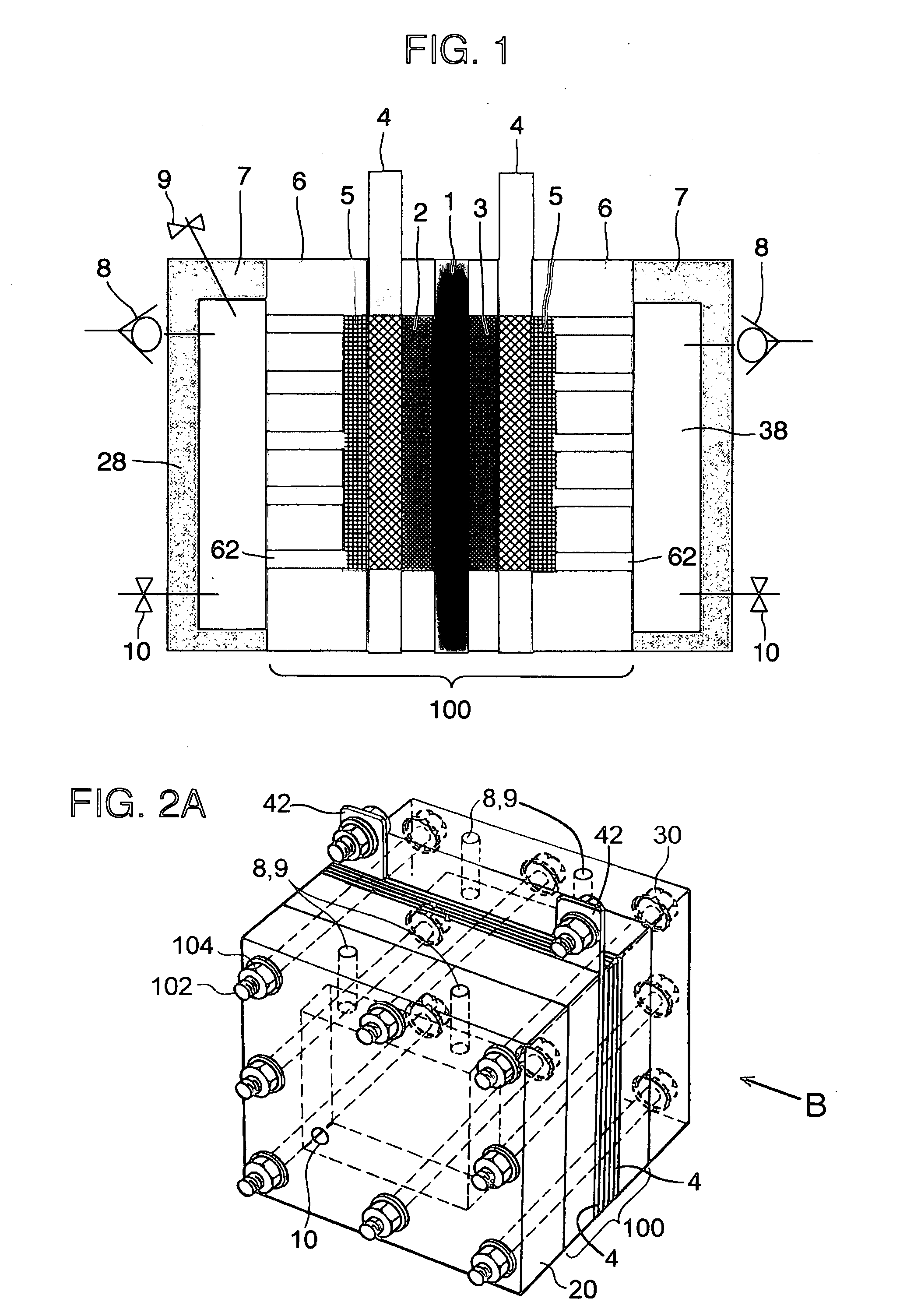
[0009] The present invention has been accomplished with the above problems in view, and it is an object of the present invention to provide a solid polymer membrane-type water-electrolysis apparatus, wherein tanks for storage of oxygen and hydrogen gasses produced are formed integrally to provide a compact structure for the entire apparatus, thereby facilitating the transportation or storage of the apparatus.
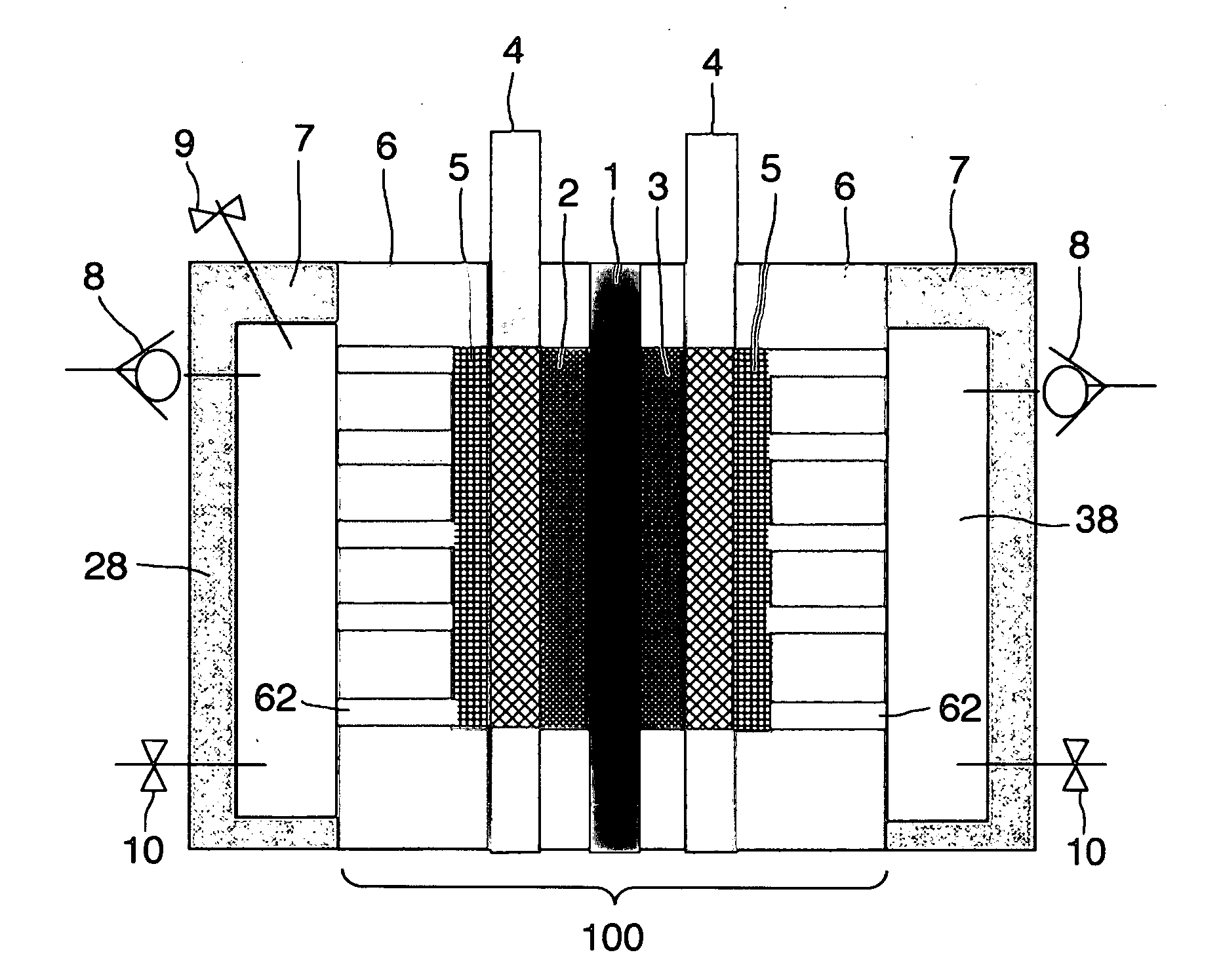
[0021] The solid polymer membrane-type water-electrolysis apparatus as described above according to the present invention comprises the solid polymer electrolyte membrane, the oxygen electrode mounted in contact with one side of the solid polymer electrolyte membrane, the hydrogen electrode mounted in contact with the other side of the solid polymer electrolyte membrane, the separator plates mounted adjacent the outsides of the oxygen electrode and the hydrogen electrode and serving as
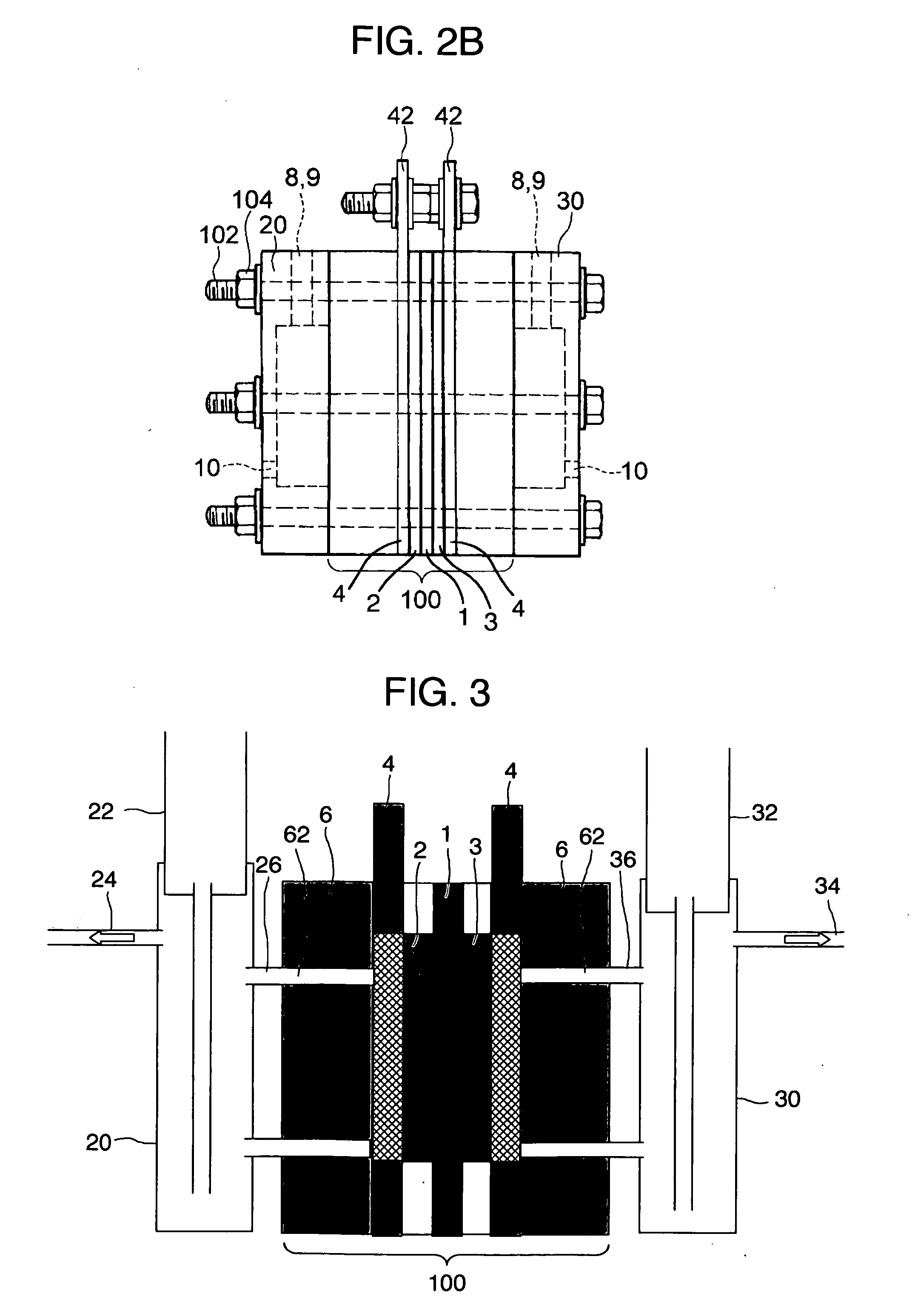
current collector plates having passages for water and generated gasses, the fixing plates disposed outside the separator plates and made of the non-conductive material, and the reservoirs disposed outside the fixing plates for storing water and the generated gasses, wherein the fixing plates include pressing members build therein for pressing the oxygen electrode and the hydrogen electrode against the solid polymer electrolyte membrane, the flow passages being included in the pressing members, and further, the reservoirs are fixed integrally by tie bolts by clamping the solid polymer electrolyte membrane, the oxygen electrode, the hydrogen electrode, the separator plates and the fixing plates together from outside the fixing plates. Therefore, the tanks of a pressure-resistant structure for storing oxygen and hydrogen can be mounted, thereby providing the water-electrolysis apparatus having a compact entire structure and convenient for movement and preservation.
[0022] In addition, the oxygen electrode and the hydrogen electrode are mounted in an opposed relation to and on the opposite sides solid polymer electrolyte membrane. The separator plates and the fixing plates are disposed in piles outside the oxygen electrode and the hydrogen electrode, and further, the reservoirs are fixed integrally outside the fixing plates by the tie bolts passed through these members. Therefore, the
close contact of the separator plates to the oxygen electrode and the hydrogen electrode can be enhanced to ensure the efficient electrolysis. Despite this
close contact, the generated oxygen and hydrogen gasses can be passed through the passages in the pressing members and hence, the supplying of the generated gasses can be conducted as needed. Further, the reservoirs have the
water supply bores provided at the locations higher in level than the position of the water-electrolysis level, and the
discharge bores for discharging the generated gasses. Therefore, if the
water supply bores and the gas
discharge bores are
cut off, the generated gasses can be stored in the reservoirs under a pressure equal to or higher than the
atmospheric pressure depending on the
pressure resistance of the reservoirs, and the gasses having an increased pressure can be supplied to a place far away from the apparatus.
[0024] In addition, in the solid polymer membrane-type water-electrolysis apparatus constructed as described above, each of the separator plates is formed from the
metal plate material coated with Pt or Au and provided with the plurality of through-bores and hence, the produced
oxygen gas and hydrogen gas can be passed through the through-bores into the reservoirs without any problem.
[0025] Additionally, in the solid polymer membrane-type water-electrolysis apparatus constructed as described above, the separator plates are pressed against the oxygen electrode and the hydrogen electrode by the pressing members which are made from the porous plastic material having the elasticity and which are build in the separators at the their sections having the through-bores, whereby a close
contact force can be applied to these members, but also the flowing of the gasses can be achieved.
[0026] Yet additionally, in the solid polymer membrane-type water-electrolysis apparatus, the fixing plates are provided with the through-bores serving as the flow passages for the water or the generated gasses, and further, the reservoirs have the maintenance bores for drainage of water provided in their bottoms or in near their bottoms, in addition to the water supply bores and the passages for the generated gasses, and the through-bores serving as the gas flow passages are also provided in the fixing plates requiring the rigidity, and therefore, it is possible to achieve the smooth flowing of the generated gasses to the reservoirs. Moreover, the reservoirs have the water-draining bores and hence, the inside of each of the reservoirs can be easily washed.


 Login to View More