Functionalization of porous materials by vacuum deposition of polymers

a technology of polymerization and porous materials, applied in the field of material surface functionalization, can solve the problems of low durability, poor resistance to abrasion, and essentially unaffected porous substrate, and achieve the effects of low durability, poor resistance to abrasion, and increased reflectivity

Inactive Publication Date: 2007-03-01
SIGMA LAB OF ARIZONA LLC
View PDF0 Cites 13 Cited by
  • Summary
  • Abstract
  • Description
  • Claims
  • Application Information

AI Technical Summary

Benefits of technology

The process effectively functionalizes porous substrates without affecting their porosity or mechanical properties, enabling durable and wash-resistant coatings that maintain breathability and can be combined with metal or ceramic layers for enhanced performance.

Problems solved by technology

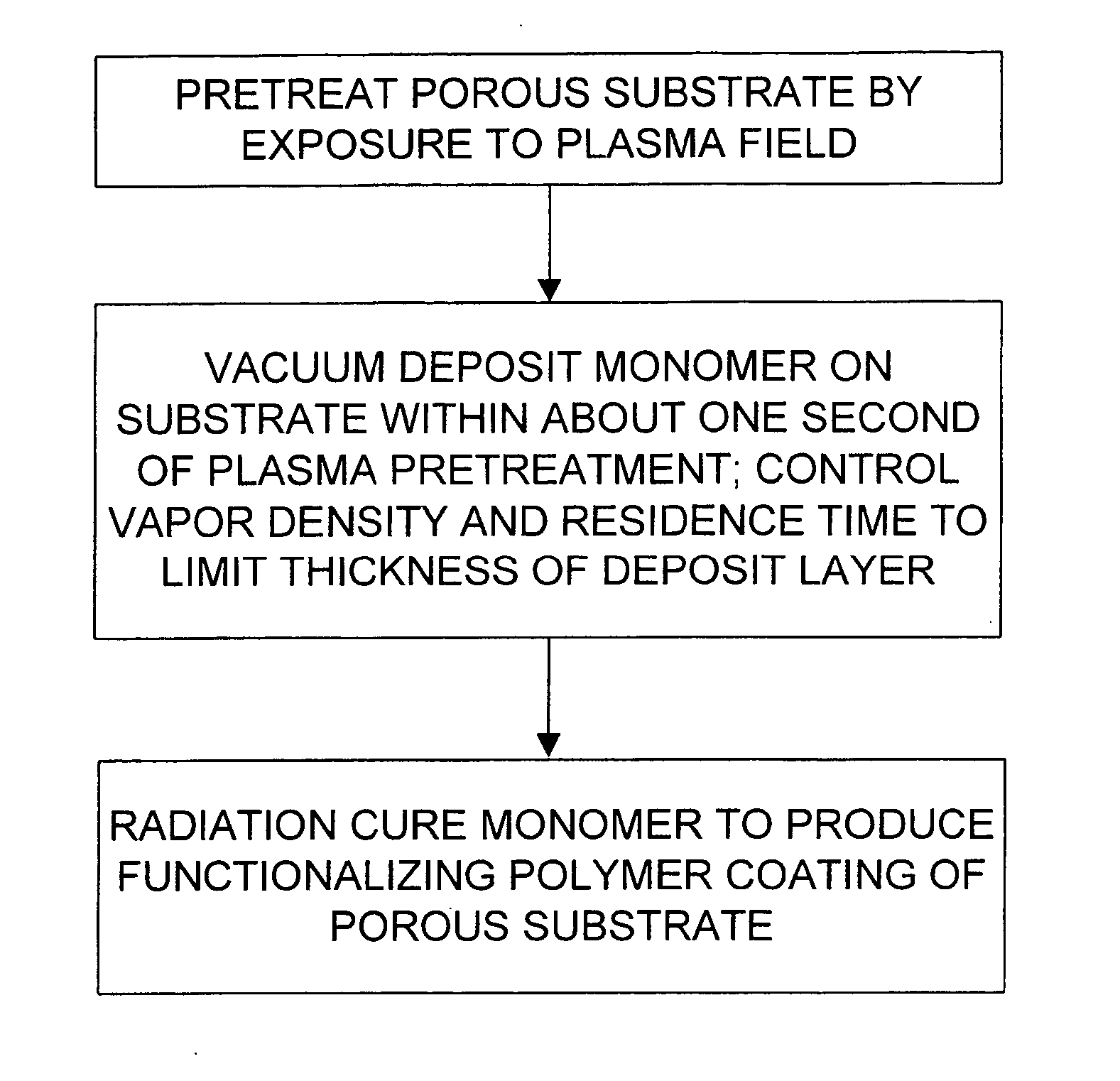
As a result, the porosity of the substrate is essentially unaffected while the fibers and the final product acquire the desired functionality.
For example, while it has been known to deposit metal layers directly on fabrics in order to add reflectivity, the resulting coated products have exhibited low durability and poor resistance to abrasion (i.e., the metal particles do not form an even layer over the microscopically rough fiber surfaces and metal flakes tend to separate from the fabric).

Method used

the structure of the environmentally friendly knitted fabric provided by the present invention; figure 2 Flow chart of the yarn wrapping machine for environmentally friendly knitted fabrics and storage devices; image 3 Is the parameter map of the yarn covering machine
View more

Image

Smart Image Click on the blue labels to locate them in the text.
Viewing Examples
Smart Image
  • Functionalization of porous materials by vacuum deposition of polymers
  • Functionalization of porous materials by vacuum deposition of polymers
  • Functionalization of porous materials by vacuum deposition of polymers

Examples

Experimental program
Comparison scheme
Effect test

example 1

Hydrophobic / Oleophobic Coating

[0040] A melt-blown polypropylene nonwoven fabric was functionalized with a hydrophobic / oleophobic fluorinated acrylate polymer coating to create a repellent surface. The monomer was flash evaporated at about 100 Millitorr. The fabric was pretreated in a plasma field and within one second it was exposed to the monomer vapor for condensation while traveling at a speed of about 50 meters / minute. The condensed monomer layer was cured in-line by electron beam radiation within 100 milliseconds. A polymer coating thickness of about 0.1 μm resulted from the run, which was found to provide adequate repellency for water and oil with a surface energy of about 27 dyne / cm. The functionalized fabric repelled both water-based and oil-based fluids while substantially retaining the original permeability of the fabric. The coated materials showed high performance as electrostatic charged filter media. The same coating process with the same fluoro-acrylate monomer was r...

example 2

Hydrophilic Coating

[0041] A melt-blown polypropylene nonwoven fabric was coated with a hydrophilic acrylate polymer film functionalized with hydroxyl, carboxyl, sulfonic, amino, amido and ether groups (in separate tests) to create a water absorbent surface. The monomer was flash evaporated at about 10 Millitorr. The fabric was pretreated in a plasma field and within one second it was exposed to the monomer vapor for condensation while traveling at a speed of about 30 meters / minute. The condensed monomer layer was cured in-line by electron beam radiation within 150 milliseconds. A polymer coating thickness of about 0.1 μm resulted from the run, which was found to provide adequate wettability in all cases by water with a surface energy of about 70-72 dyne / cm. The functionalized fabrics absorbed water while substantially retaining the original permeability of the fabrics. The coated materials showed high performance as water absorbent media. The same coating process with the same hydr...

example 3

Hydrophobic / Oleopbobic Colored Coating

[0042] The same experiment as in Example 1 was repeated with 3-5% organic dyes (e.g., disperse red) mixed in the fluorinated acrylate monomer. The coated substrates showed the same levels of water and oil repellency, measured at about 6 and 5 on the Dupont® Teflon® Repellency Test, respectively, with the color added to the coating. The intensity of the color can be controlled by monitoring either the amount of organic dye or the thickness of the coating.

the structure of the environmentally friendly knitted fabric provided by the present invention; figure 2 Flow chart of the yarn wrapping machine for environmentally friendly knitted fabrics and storage devices; image 3 Is the parameter map of the yarn covering machine
Login to View More

PUM

PropertyMeasurementUnit
sizeaaaaaaaaaa
surface energyaaaaaaaaaa
coating thicknessaaaaaaaaaa
Login to View More

Abstract

A porous substrate is pretreated in a plasma field and a functionalizing monomer is immediately flash-evaporated, deposited and cured over the porous substrate in a vacuum vapor-deposition chamber. By judiciously controlling the process so that the resulting polymer coating adheres to the surface of individual fibers in ultra-thin layers (approximately 0.02-3.0 μm) that do not extend across the pores in the material, the porosity of the porous substrate is essentially unaffected while the fibers and the final product acquire the desired functionality. The resulting polymer layer is also used to improve the adherence and durability of metallic and ceramic coatings.

Description

RELATED APPLICATION [0001] This application is a divisional application of U.S. Ser. No. 10 / 830,608, filed Apr. 23, 2004, which is based on U.S. Provisional Application Ser. No. 60 / 465,719, filed Apr. 25, 2003; this application is also a continuation-in-part application of copending U.S. Ser. No. 10 / 465,399, filed Jun. 19, 2003, which is based on U.S. Provisional No. 60 / 391,864, filed Jun. 26, 2002.BACKGROUND OF THE INVENTION [0002] 1. Field of the Invention [0003] This invention is related in general to the functionalization of the surface of materials for the purpose of improving their properties for particular applications. In particular, it pertains to a combined plasma-treatment / vapor-deposition process for functionalizing paper, membranes, and other woven and non-woven porous materials. [0004] 2. Description of the Related Art [0005] The term “functionalization” and related terminology are used in the art and herein to refer to the process of treating a material to alter its s...

Claims

the structure of the environmentally friendly knitted fabric provided by the present invention; figure 2 Flow chart of the yarn wrapping machine for environmentally friendly knitted fabrics and storage devices; image 3 Is the parameter map of the yarn covering machine
Login to View More

Application Information

Patent Timeline
no application Login to View More
Patent Type & AuthorityApplications(United States)
IPC IPC(8): B32B3/26B32B3/06B01D39/16B01D39/20B01D67/00B01D71/02B05D3/14B05D7/24C23C8/02C23C8/20C23C8/80C23C28/00C23C30/00D04H1/42D06M10/02D06M10/08D06M14/18
CPCB01D39/1623B01D2325/38B01D39/2017B01D39/2065B01D67/0072B01D67/0088B01D67/009B01D71/02B01D71/022B01D2239/0241B01D2239/0414B01D2239/0421B01D2239/0428B01D2239/045B01D2239/0457B01D2239/0478B01D2239/0492B01D2239/065B01D2239/10B01D2239/1291B05D1/60B05D3/142B05D3/144C23C8/02C23C8/20C23C8/80C23C28/00C23C30/00D04H1/42D06M10/025D06M10/08D06M14/18B01D2325/04B01D2325/26B01D2325/30B01D2325/36B01D39/18Y10T428/249987Y10T428/24999Y10T428/249953Y10T428/249956
InventorMIKHAEL, MICHAEL G.YIALIZIS, ANGELO
OwnerSIGMA LAB OF ARIZONA LLC