Superconducting gamma and fast-neutron spectrometers with high energy resolution

a gamma and neutron spectrometer technology, applied in the field of superconducting gamma and neutron spectroscopy, can solve the problems of inefficient charge transfer from the absorber to the sensor, low detection efficiency, and insufficient efficiency and count rate, so as to achieve high energy resolution, reduce thermal fluctuations, and high detection efficiency

Inactive Publication Date: 2007-04-05
LAWRENCE LIVERMORE NAT SECURITY LLC
View PDF8 Cites 4 Cited by
  • Summary
  • Abstract
  • Description
  • Claims
  • Application Information

AI Technical Summary

Benefits of technology

[0011] Superconducting Gamma-ray and fast-neutron spectrometers with very high energy resolution operated at very low temperatures are provided. The sensor consists of a bulk absorber and a superconducting thermometer, weakly coupled to a cold reservoir. It determines the energy of the incident particle from the rise in temperature upon absorption. A superconducting film operated at the transition between its superconducting and its normal state, also known as a transition-edge sensor (TES) is used as the thermometer. Sensor operation at temperatures around 0.1 K reduces thermal fluctuations and thus enables very high energy resolution. Depending on the choice of absorber material, the spectrometer can be configured either as a Gamma-spectrometer or as a fast-neutron spectrometer. For Gamma-spectrometry, the absorber consists of a superconducting material such as tin, and for fast-neutron spectroscopy, an insulating absorber crystal with high (n,alpha) absorption cross section such as 6LiF or 10B is used. In addition to offering very high energy resolution, calorimetric fast-neutron spectrometers are compact, provide easy discrimination against Gamma and neutron scattering events, and have a simple response function.

Problems solved by technology

Neutron-spectroscopy is currently not as common as Gamma-spectroscopy, primarily because high-resolution neutron spectrometers are either very large and have low detection efficiency (e.g., time-of-ffight spectrometers), or have complicated response functions (e.g., 3He-based systems).
These technologies have so far not met the requirements for high energy resolution, efficiency and count rate required for sensitive nuclear analysis.
For detector designs based on tunnel junctions the charge transport from the absorber to the sensor was to inefficient, and for semiconductor thermistor technologies either energy resolution or efficiency or maximum count rates are too low.

Method used

the structure of the environmentally friendly knitted fabric provided by the present invention; figure 2 Flow chart of the yarn wrapping machine for environmentally friendly knitted fabrics and storage devices; image 3 Is the parameter map of the yarn covering machine
View more

Image

Smart Image Click on the blue labels to locate them in the text.
Viewing Examples
Smart Image
  • Superconducting gamma and fast-neutron spectrometers with high energy resolution
  • Superconducting gamma and fast-neutron spectrometers with high energy resolution
  • Superconducting gamma and fast-neutron spectrometers with high energy resolution

Examples

Experimental program
Comparison scheme
Effect test

Embodiment Construction

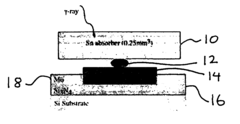
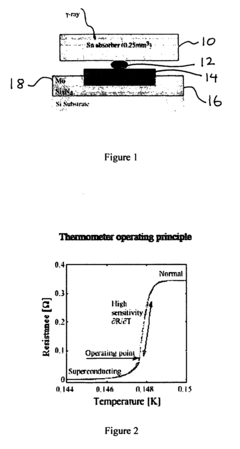
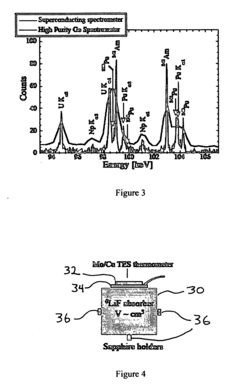
[0020] The present invention enables cryogenic Gamma and neutron spectrometers based on superconducting transition edge sensors (TESs) coupled to bulk absorbers. Referring to FIG. 1, an embodiment of the gamma detector design consists of 0.25-mm-thick tin foil absorber 10 attached with glue 12 to a Mo / Cu multilayer TES 14 on a thin silicon nitride (SiN) membrane 16. In the particular embodiment shown, the TES is contacted electrically with molybdenum leads 18. FIG. 2 shows the thermometer temperature operating point. The TES is operated at the temperature of the superconducting transition where its resistance changes rapidly with temperature, thereby providing high sensitivity for measuring temperature variations. Gamma-ray absorption increases the temperature of the tin foil in proportion to the gamma-ray energy, and this increase is measured as a change in resistance of the superconducting Mo / Cu TES, before both absorber and TES cool back down to the base temperature through the w...

the structure of the environmentally friendly knitted fabric provided by the present invention; figure 2 Flow chart of the yarn wrapping machine for environmentally friendly knitted fabrics and storage devices; image 3 Is the parameter map of the yarn covering machine
Login to View More

PUM

No PUM Login to View More

Abstract

Superconducting Gamma-ray and fast-neutron spectrometers with very high energy resolution operated at very low temperatures are provided. The sensor consists of a bulk absorber and a superconducting thermometer weakly coupled to a cold reservoir, and determines the energy of the incident particle from the rise in temperature upon absorption. A superconducting film operated at the transition between its superconducting and its normal state is used as the thermometer, and sensor operation at reservoir temperatures around 0.1 K reduces thermal fluctuations and thus enables very high energy resolution. Depending on the choice of absorber material, the spectrometer can be configured either as a Gamma-spectrometer or as a fast-neutron spectrometer.

Description

[0001] The United States Government has rights in this invention pursuant to Contract No. W-7405-ENG-48 between the United States Department of Energy and the University of California for the operation of Lawrence Livermore National Laboratory.BACKGROUND OF THE INVENTION [0002] 1. Field of the Invention [0003] The present invention relates techniques for assaying nuclear materials, and more specifically, it relates to Gamma- and neutron-spectroscopy. [0004] 2. Description of Related Art [0005] Gamma- and neutron-spectroscopy are powerful techniques widely used to determine the composition of nuclear materials non-destructively. Gamma-spectroscopy relates the measured intensity of characteristic gamma-rays from radioactive decay to the concentration and the ratio of gamma-emitting isotopes in the sample. The precision of isotope ratio measurements typically increases when based on intense gamma-lines with similar energies, because variations in detection efficiency and matrix effects...

Claims

the structure of the environmentally friendly knitted fabric provided by the present invention; figure 2 Flow chart of the yarn wrapping machine for environmentally friendly knitted fabrics and storage devices; image 3 Is the parameter map of the yarn covering machine
Login to View More

Application Information

Patent Timeline
no application Login to View More
Patent Type & AuthorityApplications(United States)
IPC IPC(8): G01T1/16H01L27/18G01T3/00H10N69/00
CPCG01T1/1606G01T1/366G01T3/04
InventorFRIEDRICH, STEPHANNIEDERMAYR, THOMASLABOV, SIMON
OwnerLAWRENCE LIVERMORE NAT SECURITY LLC