
Electrically Controllable Color Conversion Cell
a color conversion cell and electric control technology, applied in the field of diodes light sources, can solve the problems of difficult to perform the simple task of dimming a light source without changing its color, and the relative intensities of giving a desired color will change, so as to increase the intensity of source light incident, the effect of improving the efficiency of color conversion
- Summary
- Abstract
- Description
- Claims
- Application Information
AI Technical Summary
Benefits of technology
Problems solved by technology
Method used
Image

Examples
Embodiment Construction
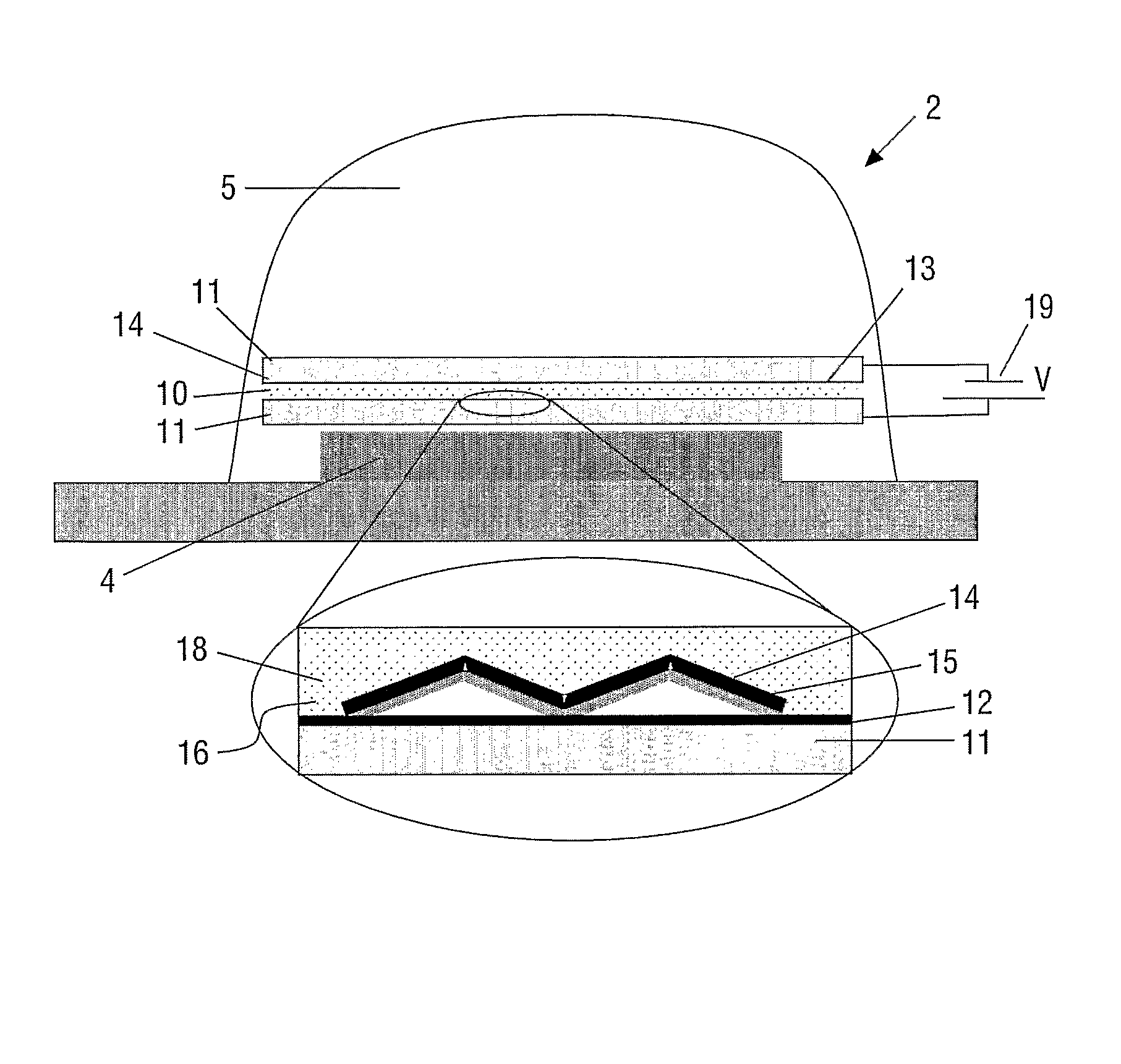
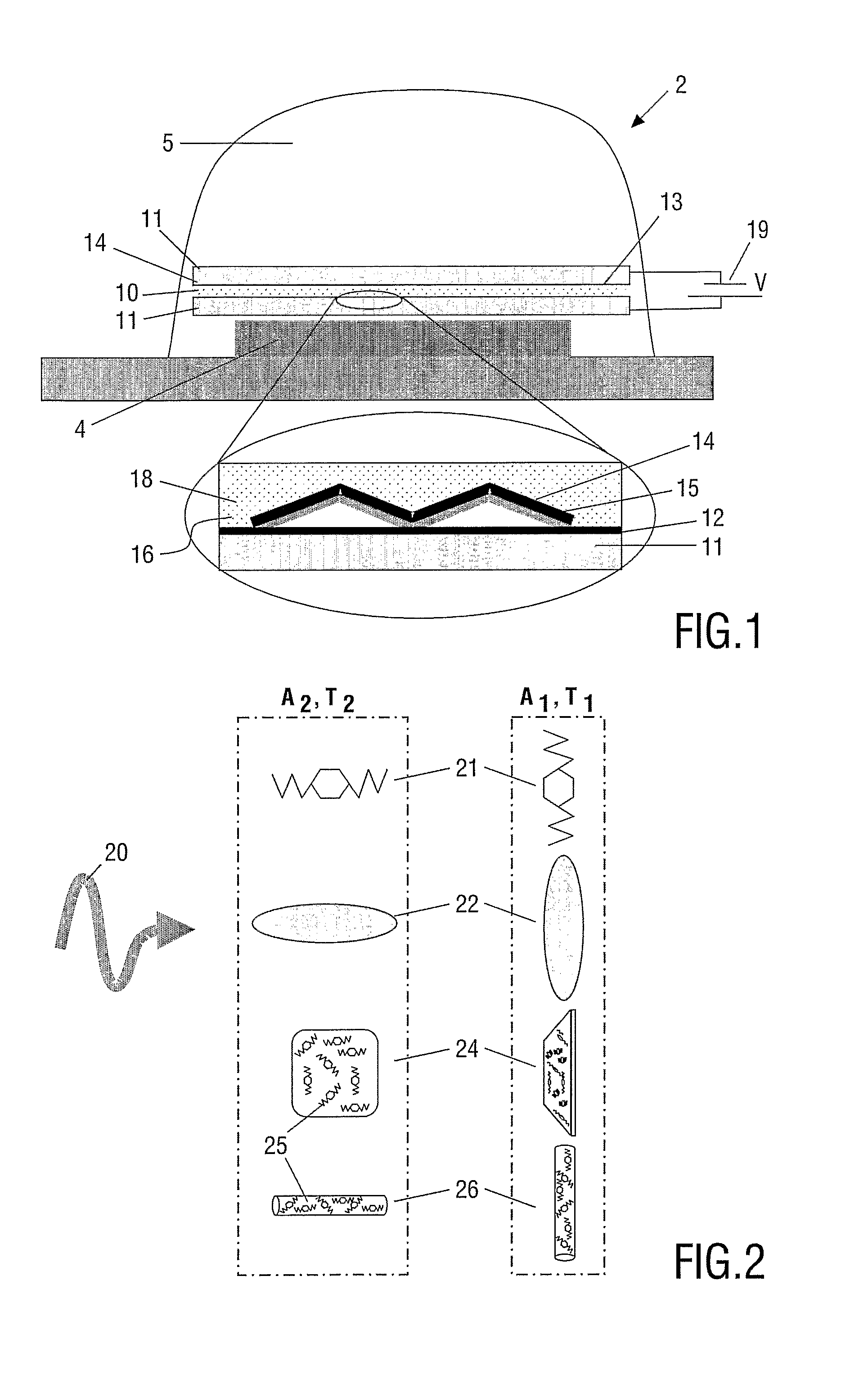
[0060] The following description proposes several light emitting devices for performing electrically controllable color conversion based on adjustable absorption and reemission by a color converting substance, typically a fluorescent dye. FIG. 1 illustrates a typical layout of such light emitting device. The designs presented in the present description primarily serves to illustrate the working principle of the invention and its embodiments, and secondly to present ways for carrying out the invention. These designs are not intended to restrict the scope of the invention in any way.
[0061] In FIG. 1, a light emitting device 2 comprises an LED light source 4 and a color conversion cell 10, all encapsulated in a lens 5. The cell 10 has transparent glass walls 11 with transparent electrodes 12 and 13 and a reflector 15 at the wall nearest the LED. The cell contains a color converting substance 18 mixed in a liquid matrix 16. The orientation of either the constituents of the matrix 16, t...
PUM
| Property | Measurement | Unit |
|---|---|---|
| thickness | aaaaa | aaaaa |
| diameter | aaaaa | aaaaa |
| thickness | aaaaa | aaaaa |
Abstract
Description
Claims
Application Information
 Login to View More