Semiconductor memory
- Summary
- Abstract
- Description
- Claims
- Application Information
AI Technical Summary
Problems solved by technology
Method used
Image



Examples
first example
(1) First Example
[0085]A. Structure
[0086]FIG. 3 shows a main section of the NAND type flash memory.
[0087]j (j is any number not less than 2) blocks BK1, BK2, . . . , BKj are arranged in the second direction in the memory cell array 1. The blocks BK1, BK2, . . . , BKj have a plurality of NAND cell units which are arranged in the first direction, respectively.
[0088]The row decoder (word line driver) 2 selects selected one word line in selected one block BKi (i is one of 1 to j) at the time of reading / writing.
[0089]A data latch circuit 4 has a function for temporarily latching data at the time of reading / writing. The data latch circuit 4 is arranged on both endmost portions of the memory cell array area 1 in the second direction. This layout is effective for an ABL (all bit line) sense principle.
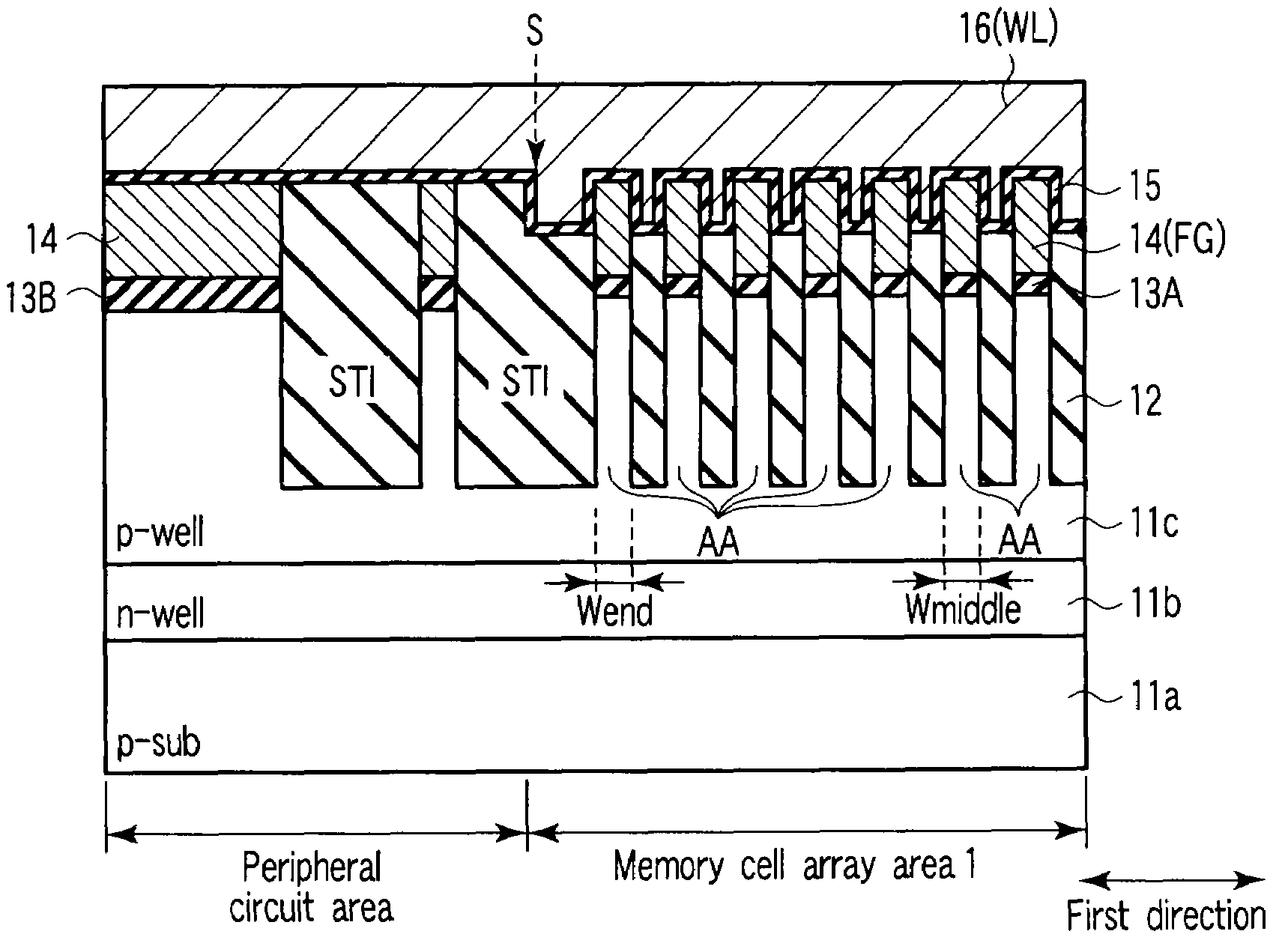
[0090]FIG. 4 is a plan view showing the memory cell array area. FIG. 5 is a cross-sectional view taken along line V-V of FIG. 4, and FIG. 6 is a cross-sectional view taken along line VI-VI of F...
second example
(2) Second Example
[0141]In contrast to the first example, a second example relates to the closed-loop structured active area where at least the first active area from the endmost portion in the first direction is arranged in the peripheral circuit area.
[0142]A. Structure
[0143]FIG. 24 is a plan view showing the memory cell array area. FIG. 25 is a cross-sectional view taken along line XXV-XXV of FIG. 24, and FIG. 26 is a cross-sectional view taken along line XXVI-XXVI of FIG. 24.
[0144]The double well region, which includes the n-type well region (n-well) 11b and the p-type well region (p-well) 11c, is formed in the p-type semiconductor substrate (p-sub) 11a.
[0145]In the memory cell array area 1, the active areas AA and the element isolation areas (areas other than the active areas AA) are arranged alternately in the first direction so as to form the periodical structure. The n-th (n is odd number) active area AA from the endmost portion in the first direction and the (n+1)-th active...
modification example
4. MODIFICATION EXAMPLE
[0200]Some modification examples of the present invention will be described.
[0201]The position of the step of the element isolation insulating film can be set between the (m−1)-th active area from the endmost portion in the first direction and the m-th active area in the second example. However, m is any number not less than 2.
[0202]For example as shown in FIGS. 44 and 45, the step may be set between the first active area AA from the endmost portion in the first direction and the second active area AA in the closed-loop structured active areas AA constituting the periodical structure.
[0203]FIGS. 44 and 45 correspond to FIGS. 40 and 43 in the above manufacturing method.
[0204]In this case, as is clear from FIG. 45, an opposed area between the conductive layer 14 and the control gate electrode 16 (WL) is small on the first active area AA from the endmost portion in the first direction. As a result, the capacitance of the capacitor (corresponding to C2 in FIG. 41)...
PUM
 Login to View More
 Abstract
Description
Claims
Application Information
 Login to View More