Wind turbine with mixers and ejectors

a wind turbine and mixer technology, applied in the direction of machines/engines, stators, liquid fuel engines, etc., can solve the problems of significant bird strikes and kills, poor performance at low wind speed, irritating pulsating noise, etc., and achieve the effect of increasing the productivity of wind farms

US20090317231A1Inactive Publication Date: 2009-12-24FLODESIGN WIND TURBINE
59 Cites 16 Cited by

Patent Information

Authority / Receiving Office
US · United States
Patent Type
Applications(United States)
Current Assignee / Owner
Publication Date
2009-12-24
Estimated Expiration
Not applicable · inactive patent

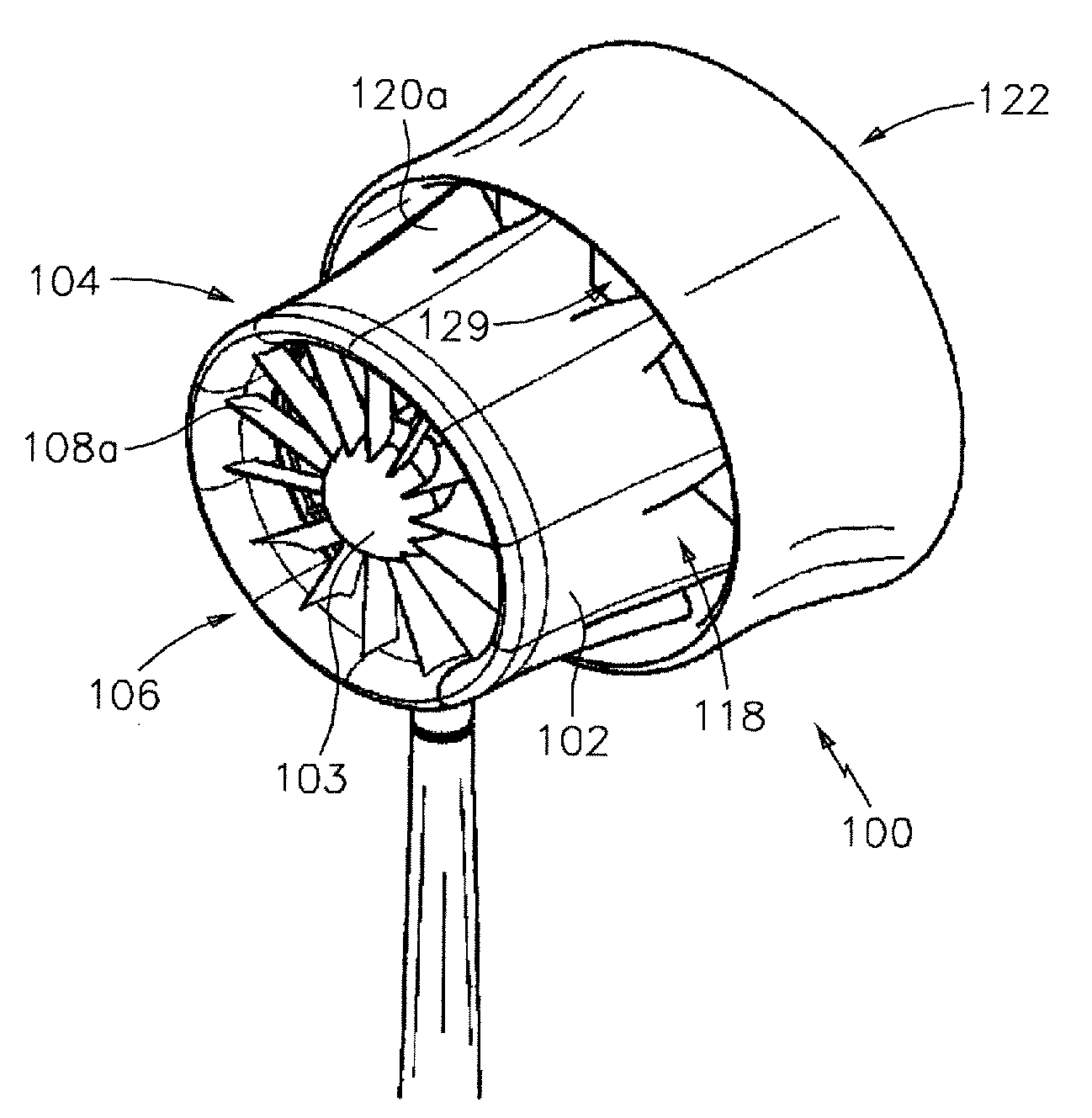
Smart Images

  • Figure 1
    Figure 1
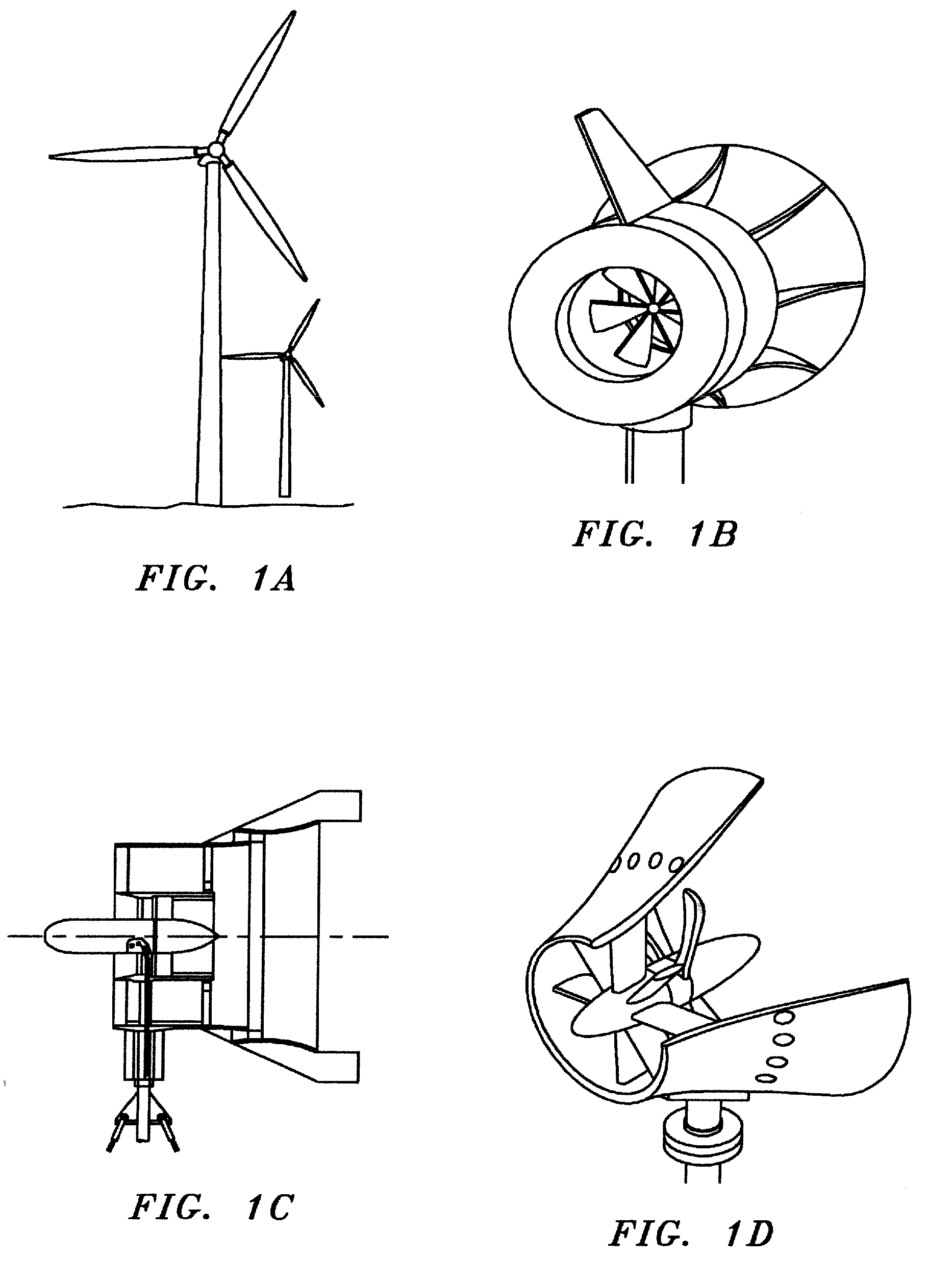
  • Figure 2
    Figure 2
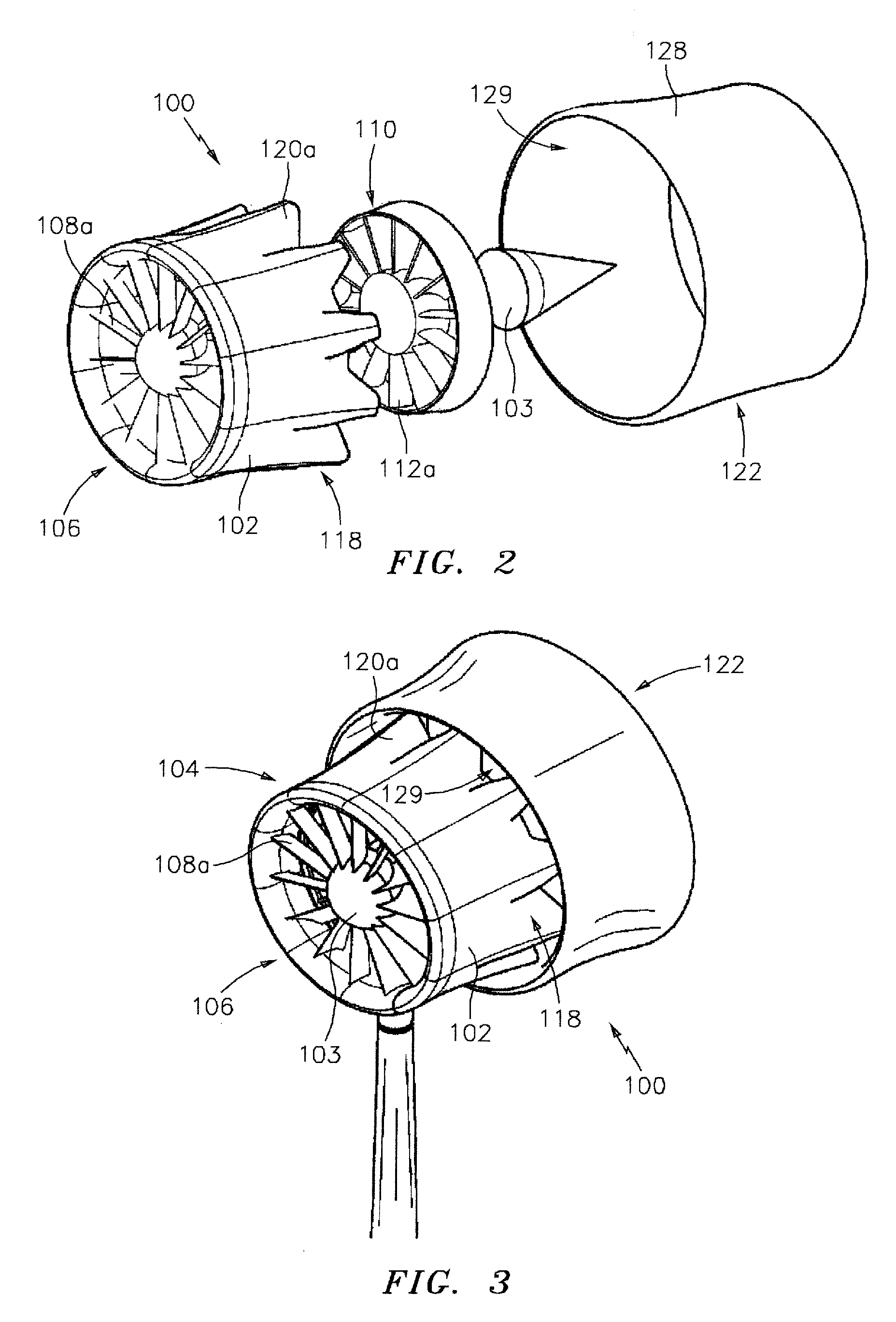
  • Figure 3
    Figure 3
Patent Text Reader

Abstract

A Mixer / Ejector Wind Turbine (“MEWT”) system is disclosed which routinely exceeds the efficiencies of prior wind turbines. Unique ejector concepts are used to fluid-dynamically improve many operational characteristics of conventional wind turbines for potential power generation improvements of 50% and above. Applicants' preferred MEWT embodiment comprises: an aerodynamically contoured turbine shroud with an inlet; a ring of stator vanes; a ring of rotating blades (i.e., an impeller) in line with the stator vanes; and a mixer / ejector pump to increase the flow volume through the turbine while rapidly mixing the low energy turbine exit flow with high energy bypass wind flow. The MEWT can produce three or more time the power of its un-shrouded counterparts for the same frontal area, and can increase the productivity of wind farms by a factor of two or more. The same MEWT is safer and quieter providing improved wind turbine options for populated areas.
Need to check novelty before this filing date? Find Prior Art

Description

RELATED APPLICATION

[0001] This application is a continuation of U.S. patent application Ser. No. 12 / 054,050, filed Mar. 24, 2008. That application claims priority from Applicants' U.S. Provisional Patent Application Ser. No. 60 / 919,588, filed Mar. 23, 2007 (hereinafter “Applicants' Provisional Application”). Applicants hereby incorporate the disclosure of both applications by reference in their entirety.FIELD OF INVENTION

[0002] The present invention deals generally with axial flow turbines, such as axial flow wind turbines.BACKGROUND OF INVENTION

[0003] Improvements in the technology of electrical power generation by wind turbines are being sought throughout the world as part of the effort to reduce dependency on fossil fuels. The European Union has just announced a major sustainable energy project that includes significant use of wind power and is requesting the US to join this effort.

[0004] To fully achieve the ultimate potential of such systems, several problems / limitations need to be...

Examples

Embodiment Construction

[0067]In a one-dimensional actuator disc model, the turbine or propeller's effect is taken as a discontinuous extraction or addition of power. FIG. 27 provides the geometry and nomenclature for the more general ducted case. The unducted case is recovered when the duct size and the attendant force Fs are allowed to shrink to zero. Using a control volume analysis that includes the turbine / propeller blade as a discontinuity as well as the inflows and outflows at upstream and downstream infinity, the conservation of mass, momentum and energy for a low speed and / or incompressible fluid leads to the equations for power and thrust as:

PowerP=14ρAp(Vo2-Va2)(Vo+Va)Equation(1)ThrustT=2P / (Vo+Va)Equation(2)

[0068]The equations are first presented in dimensional form and later non-dimensionalized per their application. As seen, there are four variables, power P, thrust T, free stream velocity, Va and the downstream core velocity, Vo. For wind / water turbines, only forward velocity Va is known thus ...