Method and apparatus for the treatment of focal dystonia

a dystonia and focal technology, applied in the field of neurologic movement disorders, can solve the problems of significant impact on quality of life, experienced a return of phonatory spasms, and both procedures were eventually abandoned

a dystonia and focal technology, applied in the field of neurologic movement disorders, can solve the problems of significant impact on quality of life, experienced a return of phonatory spasms, and both procedures were eventually abandoned

US20130261699A1Inactive Publication Date: 2013-10-03MED EL ELEKTROMEDIZINISCHE GERAETE GMBH

Image

Smart Image Click on the blue labels to locate them in the text.
Viewing Examples
Smart Image
  • Method and apparatus for the treatment of focal dystonia
  • Method and apparatus for the treatment of focal dystonia
  • Method and apparatus for the treatment of focal dystonia

Examples

Experimental program
Comparison scheme
Effect test

Embodiment Construction

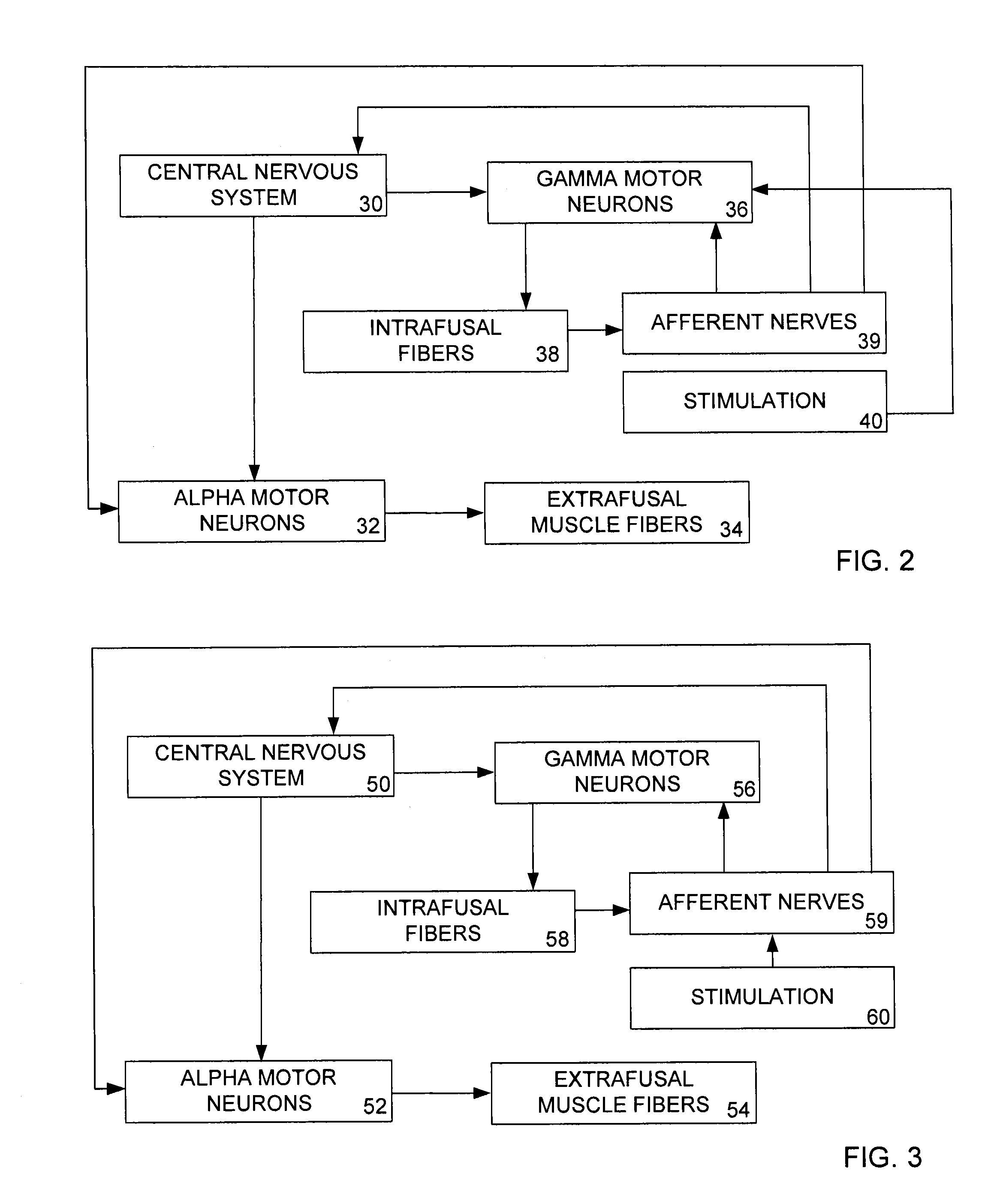
[0014]As discussed above, the general belief is that symptoms of focal dystonia result from abnormal motor signals to motor neurons which control the muscles. Abnormal motor neural activity causes muscles to spasm, resulting in the symptoms of focal dystonia. Within this paradigm it is assumed that BTX is effective because it interferes with the motor nerves innervating the muscle into which it has been injected, and thus interferes with the muscle's ability to spasm. The central nervous system continues to send abnormal motor signals to motor neurons, but they are unable to cause muscle contractions as forcefully.

[0015]The inventor has realized that contrary to conventional thinking, focal dystonias are more likely caused by abnormal afferent nerve signals and not abnormal motor nerve signals.

[0016]Efferent nerves, also known as motor neurons, carry nerve impulses from the central nervous system to effectors such as muscles. They are involved in muscular control. Afferent neurons, ...

the structure of the environmentally friendly knitted fabric provided by the present invention; figure 2 Flow chart of the yarn wrapping machine for environmentally friendly knitted fabrics and storage devices; image 3 Is the parameter map of the yarn covering machine
Login to View More

PUM

No PUM Login to View More

Abstract

A method and apparatus for using low levels of electrical stimulation to treat focal dystonia by stimulating the afferent nervous system and / or altering the function of the gamma motor neurons innervating muscles which experience symptomatic spasms.

Description

CROSS-REFERENCE TO RELATED APPLICATIONS[0001]This application claims the benefit of U.S. Provisional Patent Application No. 61 / 617,537, entitled “METHOD AND APPARATUS FOR THE TREATMENT OF SPASMODIC DYSPHONIA” filed on Mar. 29, 2012, which is hereby incorporated by reference in its entirety for all purposes.BACKGROUND OF THE INVENTION[0002]Focal dystonias are neurological movement disorders characterized by involuntary muscle contractions causing spasms, twisting, repetitive movements, or abnormal postures. Focal dystonias include cervical dystonia, blepharospasm, focal hand dystonia, and spasmodic dysphonia. These disorders can significantly impact quality of life.[0003]Treatment of dystonia has focused on inhibiting the action of alpha motor neurons which cause the muscles to contract in spasm. For example, historically treatment of spasmodic dysphonia has been aimed at paralyzing or weakening one of the vocal folds in order to decrease its ability spasm and interrupt phonation. De...

Claims

the structure of the environmentally friendly knitted fabric provided by the present invention; figure 2 Flow chart of the yarn wrapping machine for environmentally friendly knitted fabrics and storage devices; image 3 Is the parameter map of the yarn covering machine
Login to View More

Application Information

Patent Timeline
03 Oct 2013
Publication
US20130261699A1
IPC
A61N1/36
CPC
A61N1/36057; A61N1/36164; A61N1/3601; A61N1/36003; A61N1/36067; A61N1/36171; A61N1/36175
Inventors
PITMAN, MICHAEL J.