Unlock instant, AI-driven research and patent intelligence for your innovation.

Writing, Braille and Drawings Board for Blind or Visually Impaired Persons

a writing board and braille technology, applied in the field of educational applications, can solve the problems of confusion, inability to check if what has been written is correct, and complex writing system, and achieve the effect of simple, convenient and efficient drawing

Inactive Publication Date: 2014-09-25
KAPARAZOOM S L U
View PDF41 Cites 27 Cited by
  • Summary
  • Abstract
  • Description
  • Claims
  • Application Information

AI Technical Summary

Benefits of technology

The present invention is a new board that allows people with blindness or visual impairment to write and draw. The board has a grid of holes and relief elements placed on it using a matrix. The blind person can read the writing or draw using their fingertip. The board can also be provided with different colors and surface finishes to make it easier for people with mild visual impairments or without visual impairments to use it.

Problems solved by technology

These are extremely complex writing systems, many mistakes being made by having to write in reverse, and not being able to check if what has been written is correct until the paper is turned over.
In the case of errors being made, the current method of correction consists of flattening the punched area, this method thereby creating confusion when reading, as, on occasion, it is unclear whether this is a marked or unmarked point.
It is difficult to remove the correct part using this procedure, as it is easy to lose track of the position when the panel is turned over.
Using these devices makes this a slow and complicated procedure.
Handling spheres that have a diameter of less than 3.5 mm is extremely complicated.
These patents improve the classic writing system, although it is not possible to verify what has been written until the stencil has been lifted.

Method used

the structure of the environmentally friendly knitted fabric provided by the present invention; figure 2 Flow chart of the yarn wrapping machine for environmentally friendly knitted fabrics and storage devices; image 3 Is the parameter map of the yarn covering machine
View more

Image

Smart Image Click on the blue labels to locate them in the text.
Viewing Examples
Smart Image
  • Writing, Braille and Drawings Board for Blind or Visually Impaired Persons
  • Writing, Braille and Drawings Board for Blind or Visually Impaired Persons
  • Writing, Braille and Drawings Board for Blind or Visually Impaired Persons

Examples

Experimental program
Comparison scheme
Effect test

Embodiment Construction

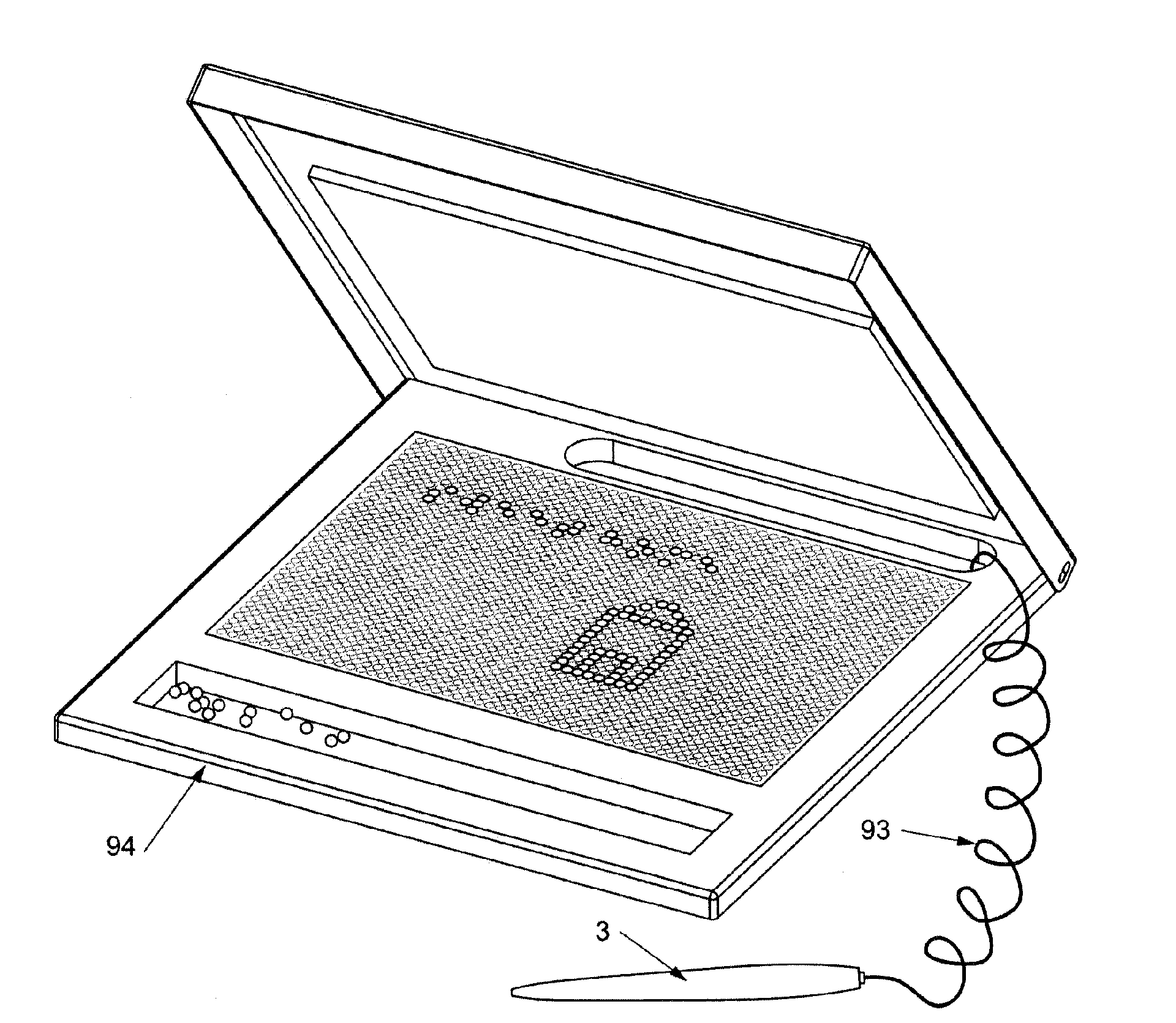
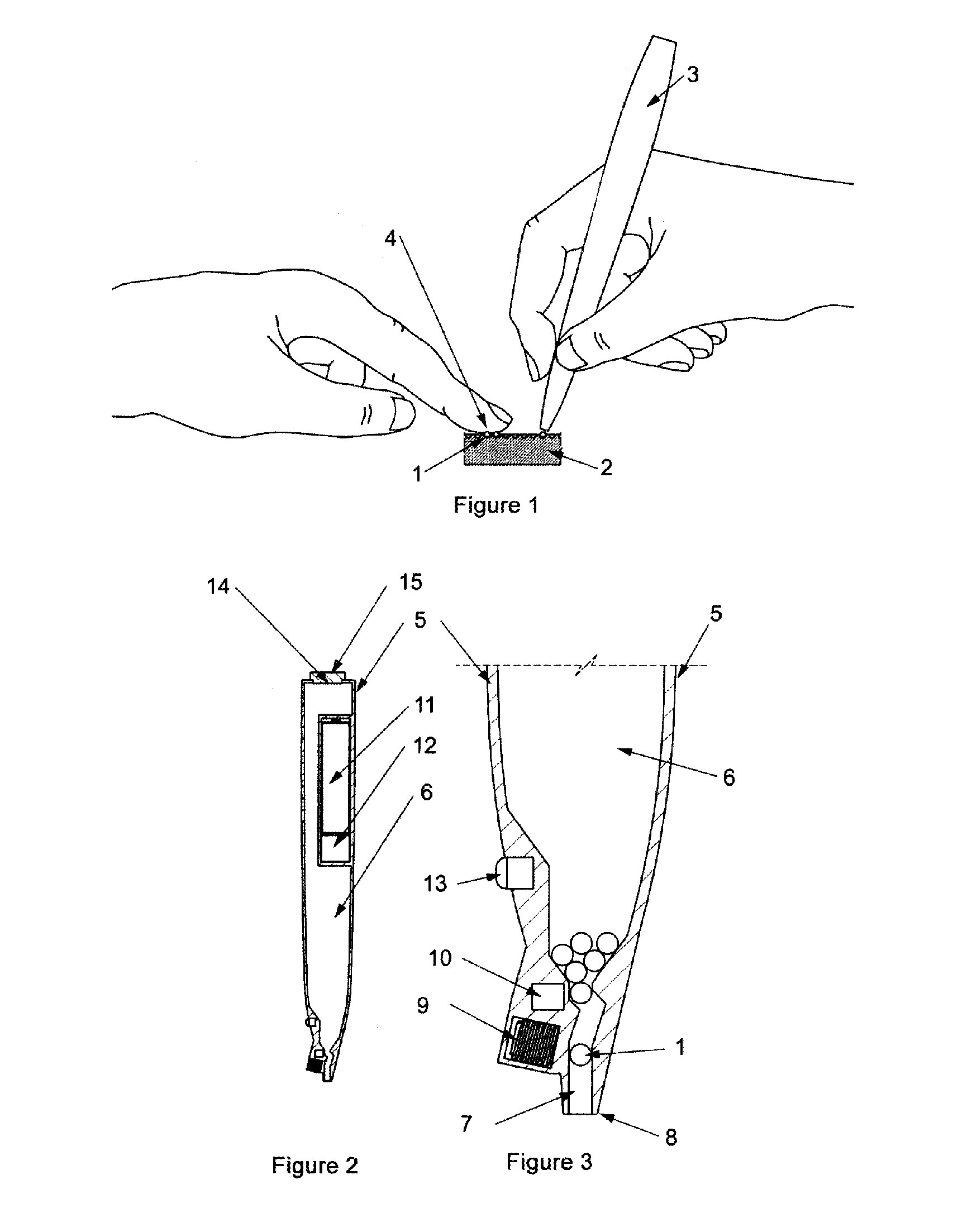
[0018]The present invention proposes a new board which makes it possible for persons with blindness or visual impairment to write and draw. Writing and drawing on this board is performed by using a grid (3) to place relief elements (1) on a panel (2) which has a matrix of holes. The blind person can read the writing or draw using their fingertip (4).

[0019]The new board for the blind or visually impaired provides a quick and practical method, proposing solutions to different problems related to drawing and writing for blind persons.

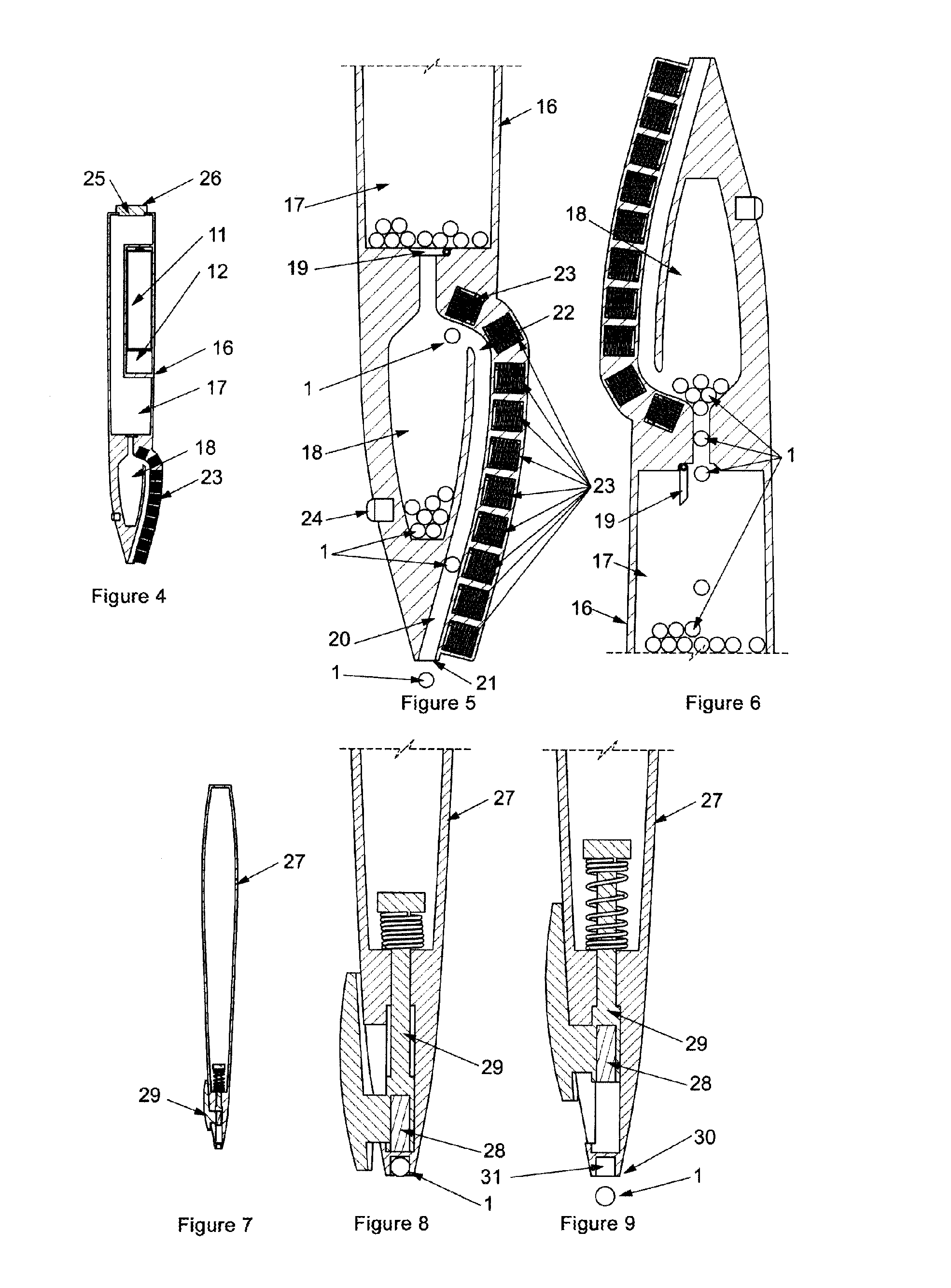
[0020]The difficulty in handling small relief elements is solved by using one or more grids in order to pick up the relief elements and put them down them individually. This grid makes it possible to store one or more relief elements and place them in the matrix of holes on the panel by conventional means such as magnets, electromagnets, electric motors, mechanical elements, adjustments using pressure, air vacuum, capillarity, tensioners, bearings, gears, ...

the structure of the environmentally friendly knitted fabric provided by the present invention; figure 2 Flow chart of the yarn wrapping machine for environmentally friendly knitted fabrics and storage devices; image 3 Is the parameter map of the yarn covering machine
Login to View More

PUM

No PUM Login to View More

Abstract

The invention relates to a board for blind persons, which makes it easier to write, draw and learn shapes through positive relief elements that can be reused. When writing or drawing, it is possible to check what has been done and to correct errors detected with the fingertip (4). Said board has a grid (3) for picking up, putting down and storing small-size relief elements (1). Said relief elements are placed on a panel (2) with a matrix of holes, forming letters and drawings. There is a means for making copies of what was written or drawn. Drawing tools or stencils that can be attached with pins to the matrix of the panel are provided. Once the activity is finished, there is a means of collecting the relief elements and storing same in the container in the panel or the grid.

Description

FIELD OF THE ART[0001]The present invention is comprised included within the sector dedicated to educational applications and, in particular, devices intended to improve the quality of life for persons with blindness or visual impairment.BACKGROUND OF THE INVENTION[0002]Since the braille alphabet was created in the mid-nineteenth century, there have been different systems for the blind or visually impaired to be able to write in Braille, as well as draw.[0003]There are traditional writing devices consisting of etching dots on a sheet of paper on a semi-rigid surface using a stencil. Writing using these systems has to be done in reverse. Once written and the paper is turned over, the braille can be read correctly. These are extremely complex writing systems, many mistakes being made by having to write in reverse, and not being able to check if what has been written is correct until the paper is turned over. In the case of errors being made, the current method of correction consists o...

Claims

the structure of the environmentally friendly knitted fabric provided by the present invention; figure 2 Flow chart of the yarn wrapping machine for environmentally friendly knitted fabrics and storage devices; image 3 Is the parameter map of the yarn covering machine
Login to View More

Application Information

Patent Timeline
no application Login to View More
IPC IPC(8): G09B21/02
CPCG09B21/02
Inventor VILLAR CLOQUELL, JAVIER
Owner KAPARAZOOM S L U