

Multi-Domain Source Routed Forwarding Based on Collaborating Network Controllers
a network controller and multi-domain technology, applied in the field of telecom networks, can solve the problems of inability to achieve source routed forwarding in multi-domain networks, inconvenient multi-domain network routing, and inefficient traditional source routed forwarding techniques
- Summary
- Abstract
- Description
- Claims
- Application Information
AI Technical Summary
Benefits of technology
Problems solved by technology
Method used
Image

Examples
Embodiment Construction
[0020]The making and using of embodiments of this disclosure are discussed in detail below. It should be appreciated, however, that the concepts disclosed herein can be embodied in a wide variety of specific contexts, and that the specific embodiments discussed herein are merely illustrative and do not serve to limit the scope of the claims. Further, it should be understood that various changes, substitutions and alterations can be made herein without departing from the spirit and scope of this disclosure as defined by the appended claims.
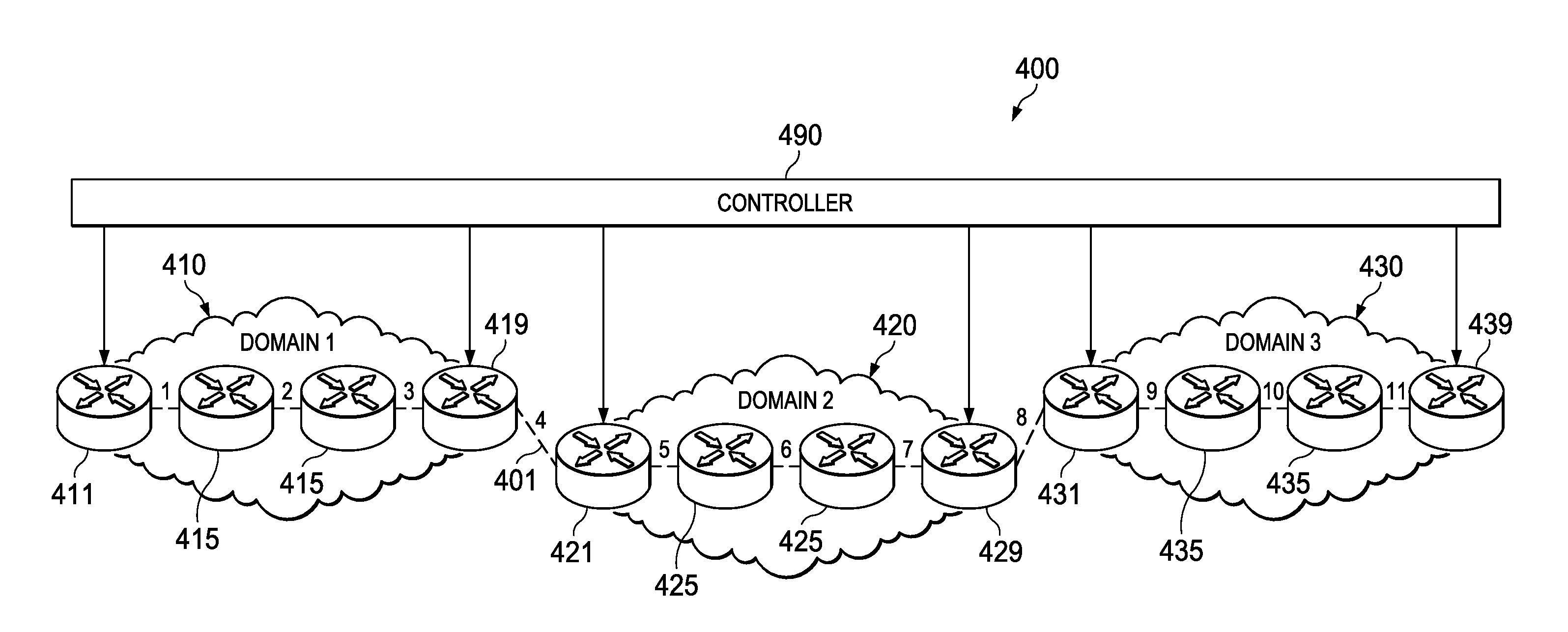
[0021]Aspects of this disclosure achieve efficient / scalable source routed forwarding in multi-domain networks by using path identifiers in place of intra-domain hop lists in packet headers at the source node. The path identifiers (e.g., label, address, etc.) are then swapped with the intra-domain hop lists once the packets reach ingress edge nodes of corresponding domains to allow the packets to be forwarded over the corresponding intra-domain path...
PUM
 Login to View More
 Abstract
Description
Claims
Application Information
 Login to View More