
Deposition print head
a printing head and print head technology, applied in the direction of coil arrangement, induction heating, induction heating apparatus, etc., can solve the problems of degeneration of material, delay in operation of the printing head, and fouling of the deposition printer comprising the deposition print head, so as to adapt to different filament materials, the effect of adaptability
- Summary
- Abstract
- Description
- Claims
- Application Information
AI Technical Summary
Benefits of technology
Problems solved by technology
Method used
Image

Examples
Embodiment Construction
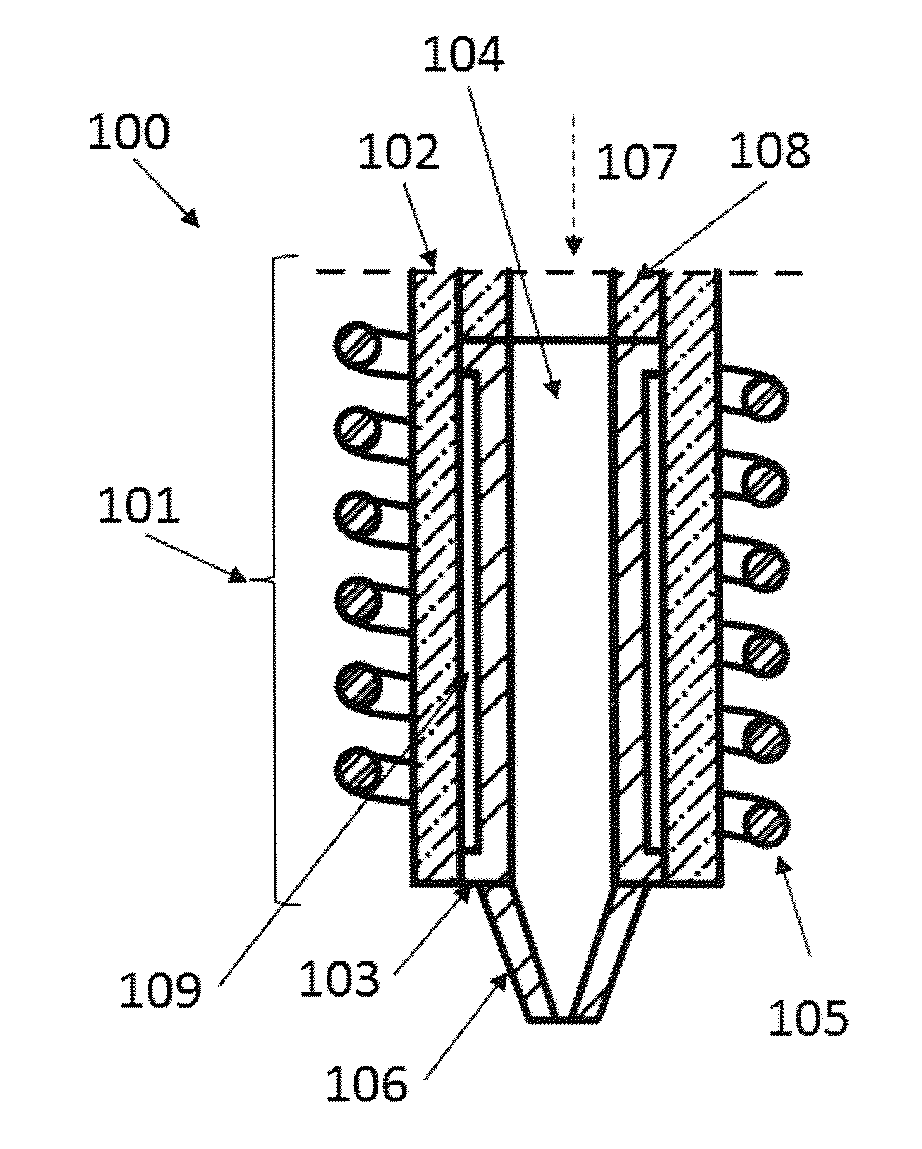
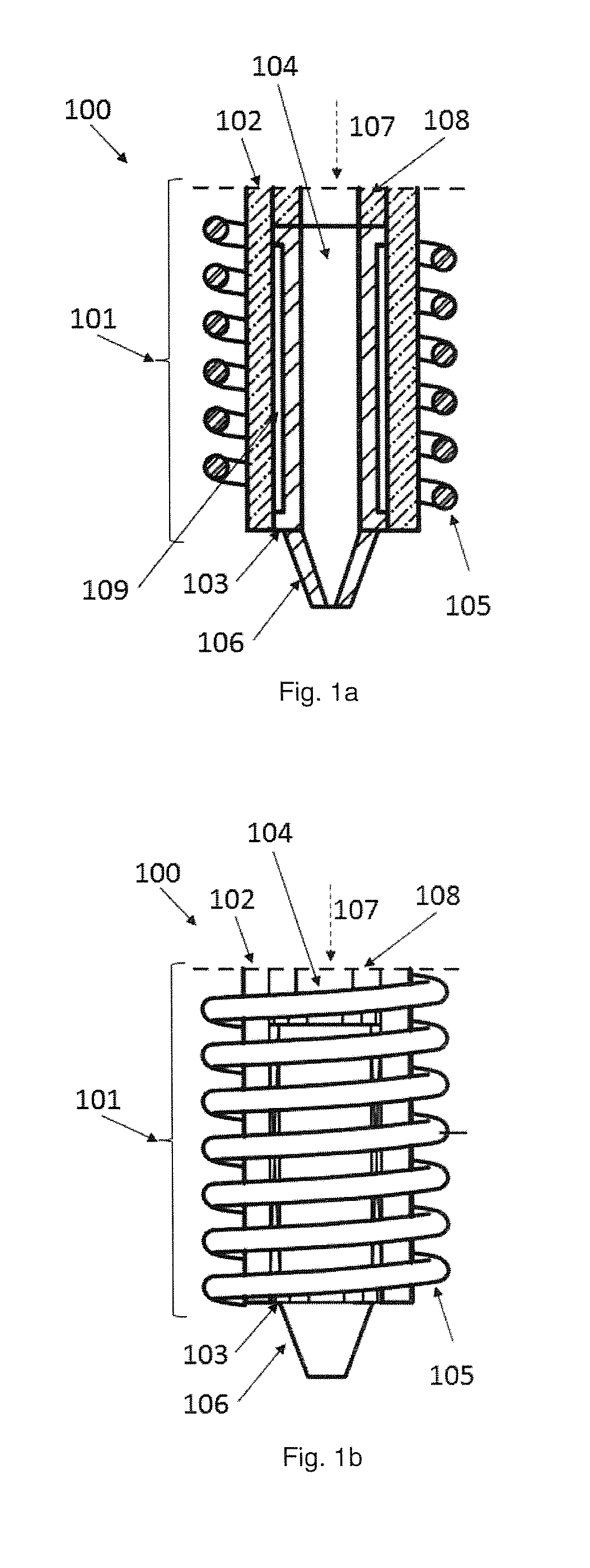
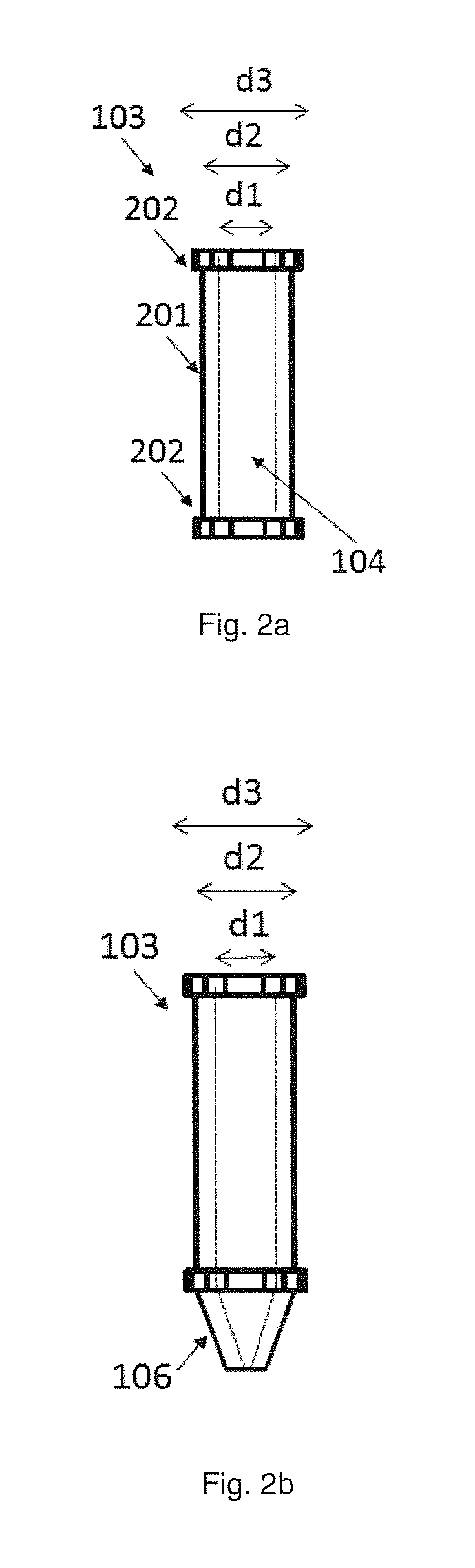
[0053]FIG. 1a shows a cross section of a deposition print head 100 having a sleeve 102, a susceptive element 103, an exciter 105 and a nozzle 106. The susceptive element 103 is arranged inside the sleeve 102. The susceptive element 103 has a tubular shape leaving a channel 104 for allowing feed through of thermoplastic filament. The exciter 105 is arranged around the susceptive element 103. The nozzle 106 can preferably be attached to the susceptive element 103, but can also be attached to the sleeve 102. The exciter 105 is connectable to an energy source such as an electric power supply, and when supplied it generates a field compatible with the susceptive element 103.
[0054]The exciter 105 can be an induction coil combined with a ferromagnetic tubular element as susceptive element 103. Ferromagnetic materials for the susceptive element 103 include iron, iron alloys. Also materials with low conductivity can be used such as steel, carbon, tin, tungsten, which cause heating up by mean...
PUM
| Property | Measurement | Unit |
|---|---|---|
| Temperature | aaaaa | aaaaa |
| Power | aaaaa | aaaaa |
| Magnetic field | aaaaa | aaaaa |
Abstract
Description
Claims
Application Information
 Login to View More