
On-Demand Manufacturing of Laser-Finished Apparel
a technology of apparel and laser finishing, applied in the field of apparel manufacturing, can solve the problems of high processing cost, resource intensive, faded or distressed jeans through normal washing and wear, etc., and achieve the effect of reducing finishing cost, reducing carrying cost, and increasing productivity
- Summary
- Abstract
- Description
- Claims
- Application Information
AI Technical Summary
Benefits of technology
Problems solved by technology
Method used
Image

Examples
Embodiment Construction
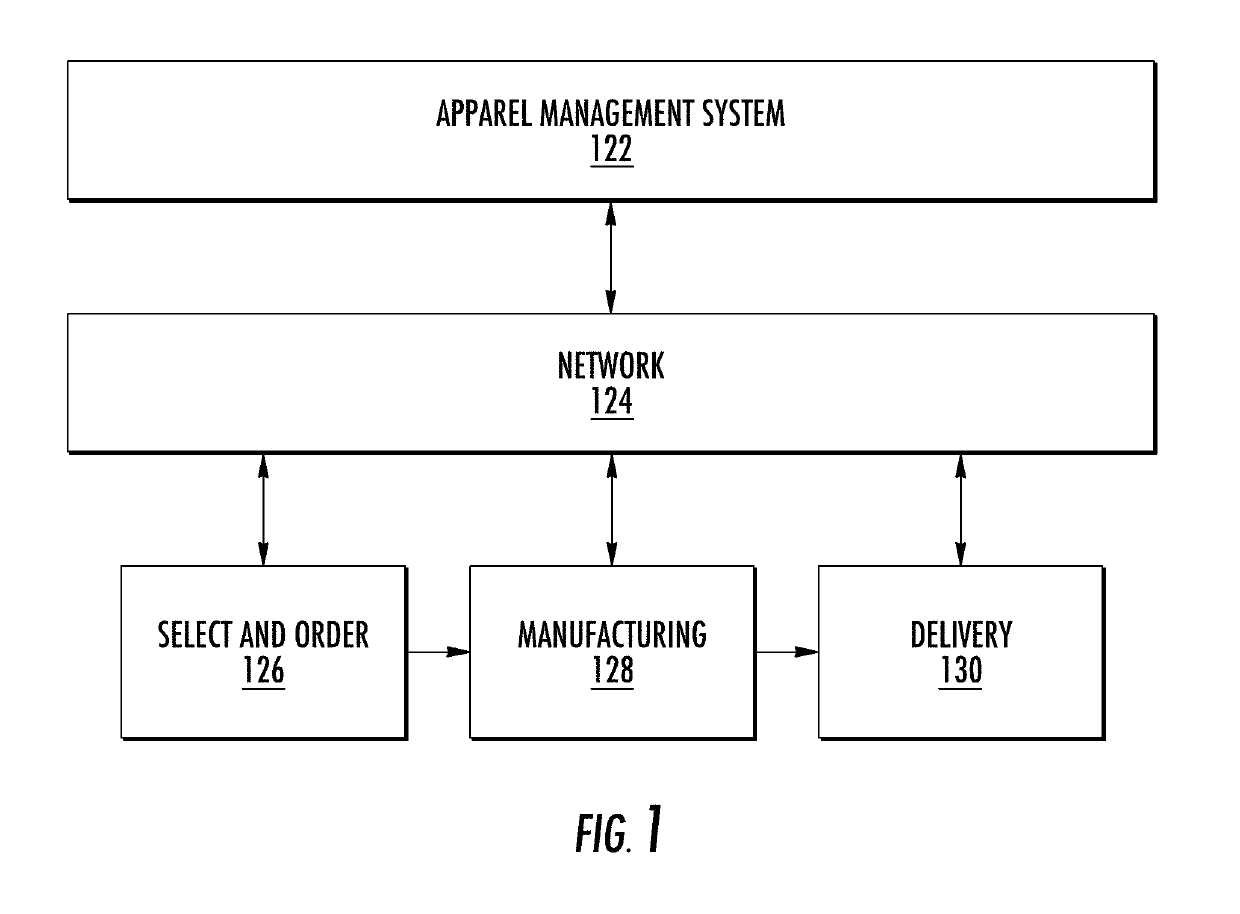
[0042]FIG. 1 shows a system for on-demand manufacturing of laser-finished apparel. There is an apparel management system 122, which controls operation of the system. The apparel management system is connected by a network 124 to components of the system, including select and order 126, manufacturing 128, and delivery 130 components. The network can be a computer network, such as the Internet.
[0043]Using the select and order component, a customer selects a garment to order. The selection process can include customizing and selecting a fit, style, and size of one or more garments. As an example, the customer can order a garment via a Web site managed by the apparel management system. After the customer completes the order, the order is sent via the network (e.g., Internet) to the apparel management system.
[0044]The apparel management system sends the order to the manufacturing component, where the order is made. Manufacturing can include cutting the fabric material, assembling or sewi...
PUM
| Property | Measurement | Unit |
|---|---|---|
| frequency | aaaaa | aaaaa |
| frequency | aaaaa | aaaaa |
| sizes | aaaaa | aaaaa |
Abstract
Description
Claims
Application Information
 Login to View More