
Method and plant for separation of wax and fibers from plants
a technology of plant wax and processing plant, which is applied in the direction of fatty substance production, fatty oil/fat production, grain treatment, etc., can solve the problems of relatively inefficient separation of wax, low availability of commercially available plant waxes, and large amount of de-waxing agents, etc., to achieve the effect of simple production and low cost of large volumes of wax
- Summary
- Abstract
- Description
- Claims
- Application Information
AI Technical Summary
Benefits of technology
Problems solved by technology
Method used
Image

Examples
Embodiment Construction
Definitions
[0039]“Straw” means the remains of a agricultural plant, e.g. a cereal, after the seed head has been removed, i.e. the leaves and the stem / stover (nodes and internodes). Straw may also mean the whole of a high energy grass, such as for example elephant grass.
[0040]“Feedstock” means the plant material applied to mechanical treatment.
[0041]“Straw fibers” and “mill generated fiber” mean the fraction of mechanically treated feedstock enriched in fibers and low in wax content.
[0042]“Mill generated fines” means the fraction of mechanically treated feedstock enriched in wax content and low in fibers content.
[0043]“Straw fines” means the fiber fraction of mill-generated fines.
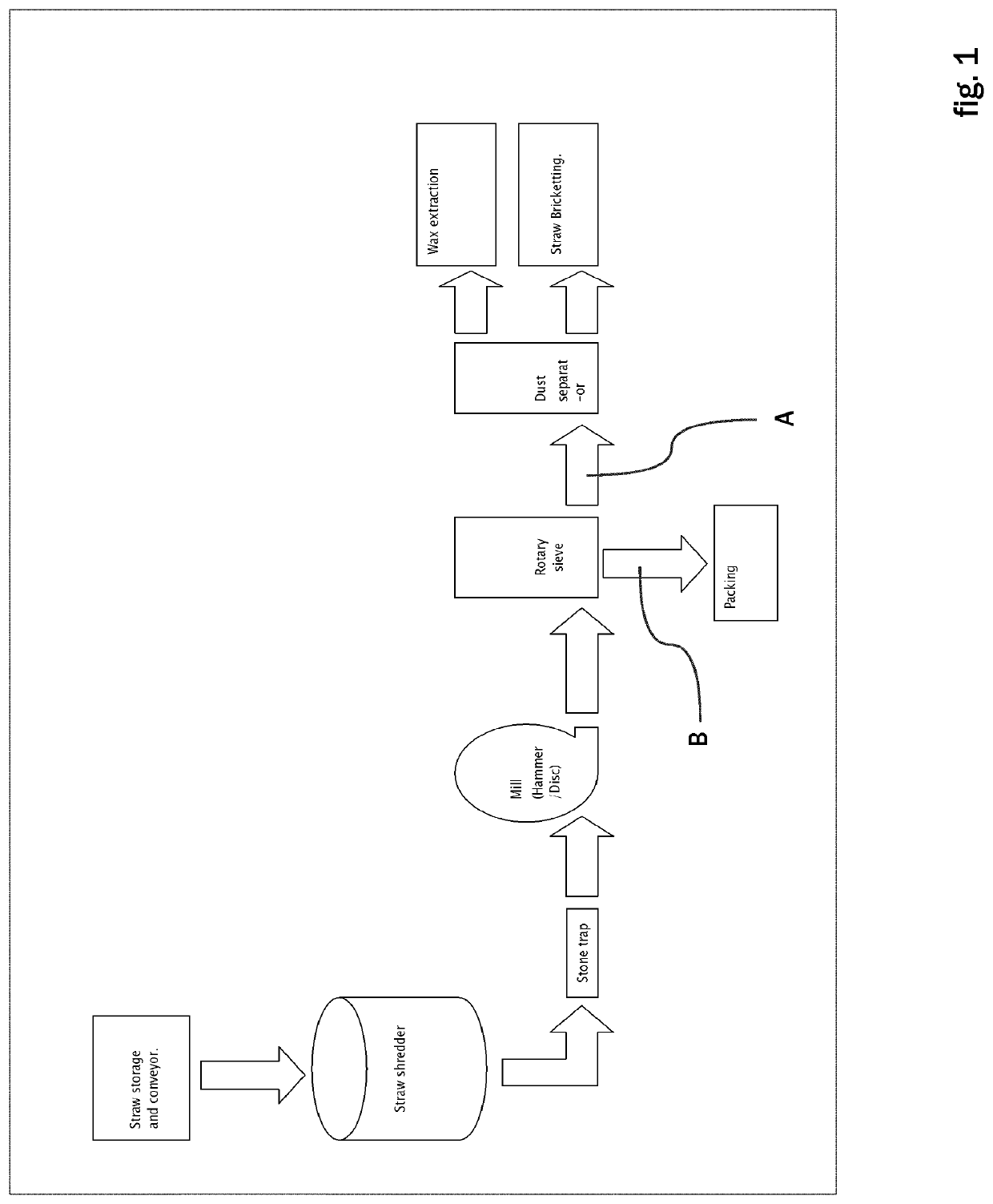
[0044]As mentioned above, wax is a surface component on leaves and the stem of most plants. The present invention may be applied to most kinds of plant feedstock comprising wax. In the following, however, a preferred embodiment of a processing plant and method is disclosed being adapted especially for the pu...
PUM
| Property | Measurement | Unit |
|---|---|---|
| length | aaaaa | aaaaa |
| length | aaaaa | aaaaa |
| degree of separation | aaaaa | aaaaa |
Abstract
Description
Claims
Application Information
 Login to View More