Unlock instant, AI-driven research and patent intelligence for your innovation.

Device, system and method to provide line level tagging of data at a processor cache

a technology of caches and devices, applied in the field of memory systems, can solve the problems of system performance negatively affecting system performance, device access times increasing dramatically, and processors often having to remain idle for substantial amounts of tim

Pending Publication Date: 2022-03-24
INTEL CORP
View PDF0 Cites 5 Cited by
  • Summary
  • Abstract
  • Description
  • Claims
  • Application Information

AI Technical Summary

Benefits of technology

The patent text discusses techniques for improving the performance of computer systems by tagging data in memory. The invention provides methods for tagging data at different levels of granularity, such as lines of a cache memory or memory device. By using tags to identify specific types of data, the invention enables faster processing and better performance. The technical effects of the invention include faster memory access times, reduced latency, and improved performance of computer systems.

Problems solved by technology

What this means is that processors often have to remain idle for substantial amounts of time while waiting for the memory to respond to a memory request.
As a result, system performance can be negatively impacted.
However, as one moves down the down the memory hierarchy from caches to long term storage, device access times increase dramatically.
But in most systems, such memory is present in only limited amounts or the program demands more memory than is available.

Method used

the structure of the environmentally friendly knitted fabric provided by the present invention; figure 2 Flow chart of the yarn wrapping machine for environmentally friendly knitted fabrics and storage devices; image 3 Is the parameter map of the yarn covering machine
View more

Image

Smart Image Click on the blue labels to locate them in the text.
Viewing Examples
Smart Image
  • Device, system and method to provide line level tagging of data at a processor cache
  • Device, system and method to provide line level tagging of data at a processor cache
  • Device, system and method to provide line level tagging of data at a processor cache

Examples

Experimental program
Comparison scheme
Effect test

Embodiment Construction

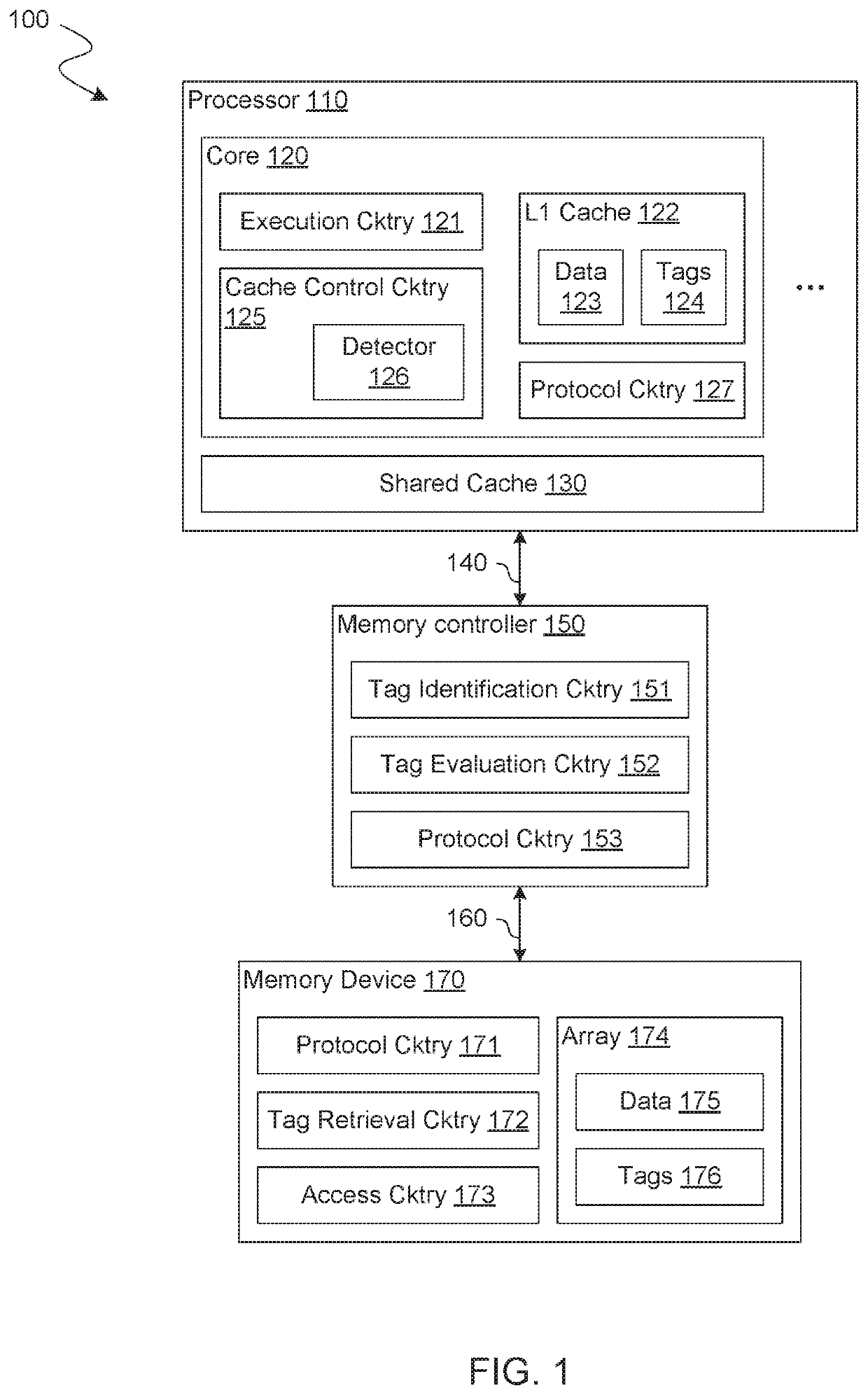
[0019]Embodiments discussed herein variously provide techniques and mechanisms for tagging data at different respective levels of granularity, where one such level is for lines of a cache memory of a processor, and a different such level is for lines of a memory device which is coupled to said processor.

[0020]As used herein in the context of tagging data (also referred to in the art as “memory tagging”), “tag” refers to metadata, the value of which identifies a particular class of information to which a corresponding one or more chunks of data belong. Unless otherwise indicated, “tag” refers herein to a metadata value which identifies one and only one corresponding class of information, where (for example) “tag information” could include one or more such tags.

[0021]The term “chunk” refers herein to a discrete quantity of data (e.g., wherein a line of a cache memory or other memory comprises multiple chunks) the entirety of which is able to be classified or otherwise described, by ty...

the structure of the environmentally friendly knitted fabric provided by the present invention; figure 2 Flow chart of the yarn wrapping machine for environmentally friendly knitted fabrics and storage devices; image 3 Is the parameter map of the yarn covering machine
Login to View More

PUM

No PUM Login to View More

Abstract

Techniques and mechanisms for identifying tag information that describes data to be cached at a processor. In an embodiment, a memory controller services a memory access request from the processor, wherein the memory controller reads multiple chunks of data from a memory device, and determines first tag information which corresponds to the multiple chunks. One or more of the multiple chunks are sent to the processor in a response to the request. Based on the first tag information, the memory controller detects for a match—if any—between at least two tags. Where such a match is detected, the memory controller further indicates to the processor that second tag information corresponds to the one or more chunks. In another embodiment, the first tag information is more granular than the second tag information.

Description

BACKGROUND1. Technical Field[0001]This disclosure generally relates to memory systems and more particularly, but not exclusively, to the tagging of data at a cache of a processor.2. Background Art[0002]Since the beginning of computing, processors have been faster than memories. Even though memory technology has evolved and improved over time, so has processor technology. What this means is that processors often have to remain idle for substantial amounts of time while waiting for the memory to respond to a memory request. As a result, system performance can be negatively impacted.[0003]Computer systems have evolved to include memory hierarchies comprising various types of long term storage, main memory, and caches. However, as one moves down the down the memory hierarchy from caches to long term storage, device access times increase dramatically. An ideal solution is to have enough cache memory or fast main memory available to service the currently executing program. But in most sys...

Claims

the structure of the environmentally friendly knitted fabric provided by the present invention; figure 2 Flow chart of the yarn wrapping machine for environmentally friendly knitted fabrics and storage devices; image 3 Is the parameter map of the yarn covering machine
Login to View More

Application Information

Patent Timeline
no application Login to View More
Patent Type & Authority Applications(United States)
IPC IPC(8): G06F12/0895
CPCG06F12/0895G06F2212/1021G06F12/0811G06F12/0886
Inventor SHANBHOGUE, VEDVYASCHHABRA, SIDDHARTHA
Owner INTEL CORP