
Electrically conductive thermoplastic elastomer composite
a thermoplastic elastomer and composite technology, applied in the direction of non-metal conductors, cellulosic plastic layered products, conductors, etc., can solve the problems of increasing the volume fraction, and increasing the cost of production, so as to improve the electrical conductivity of the elastomer, the elastomer composite of the invention is low, and the electrical conductivity is good
- Summary
- Abstract
- Description
- Claims
- Application Information
AI Technical Summary
Benefits of technology
Problems solved by technology
Method used
Image

Examples
example 1
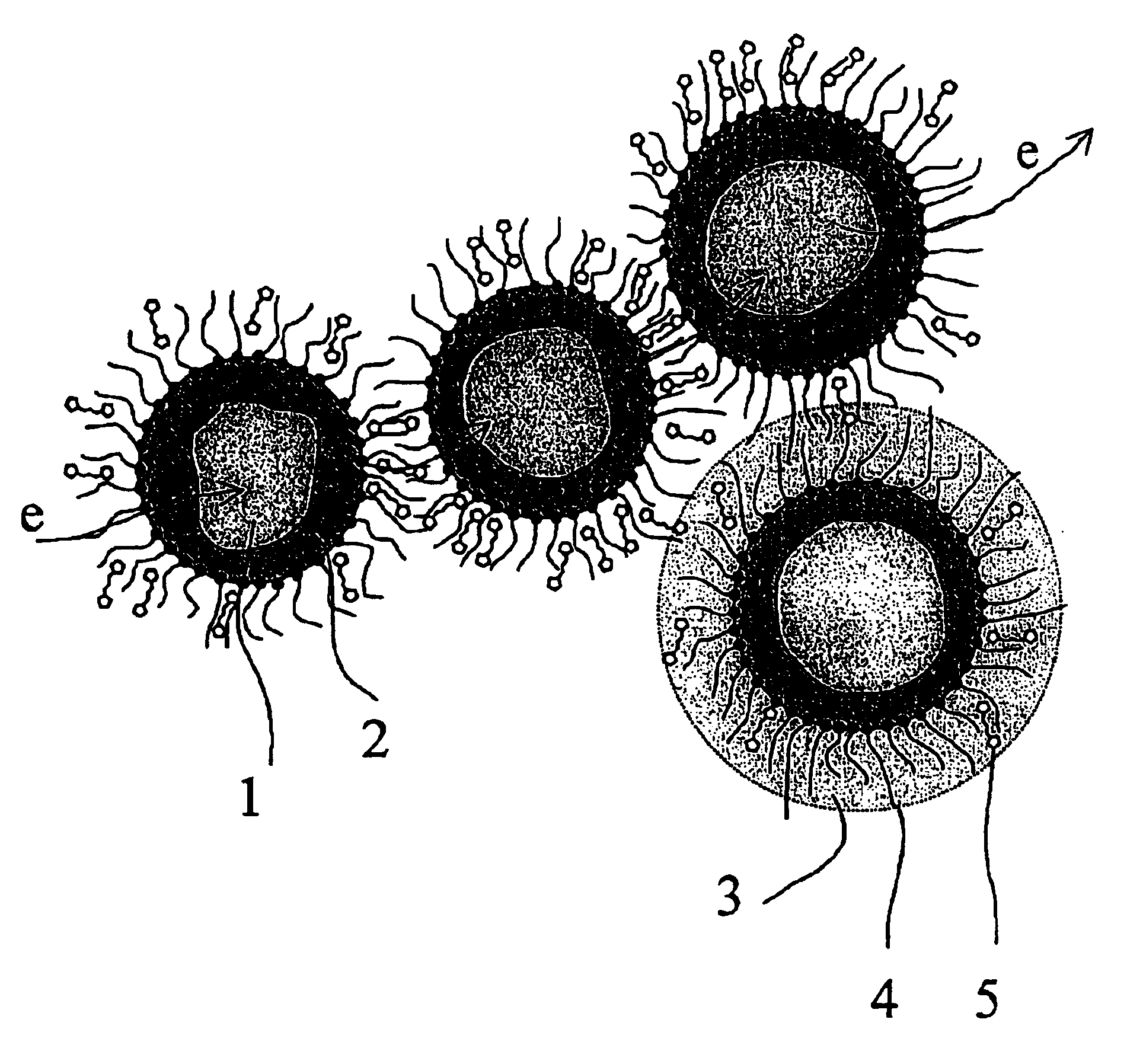
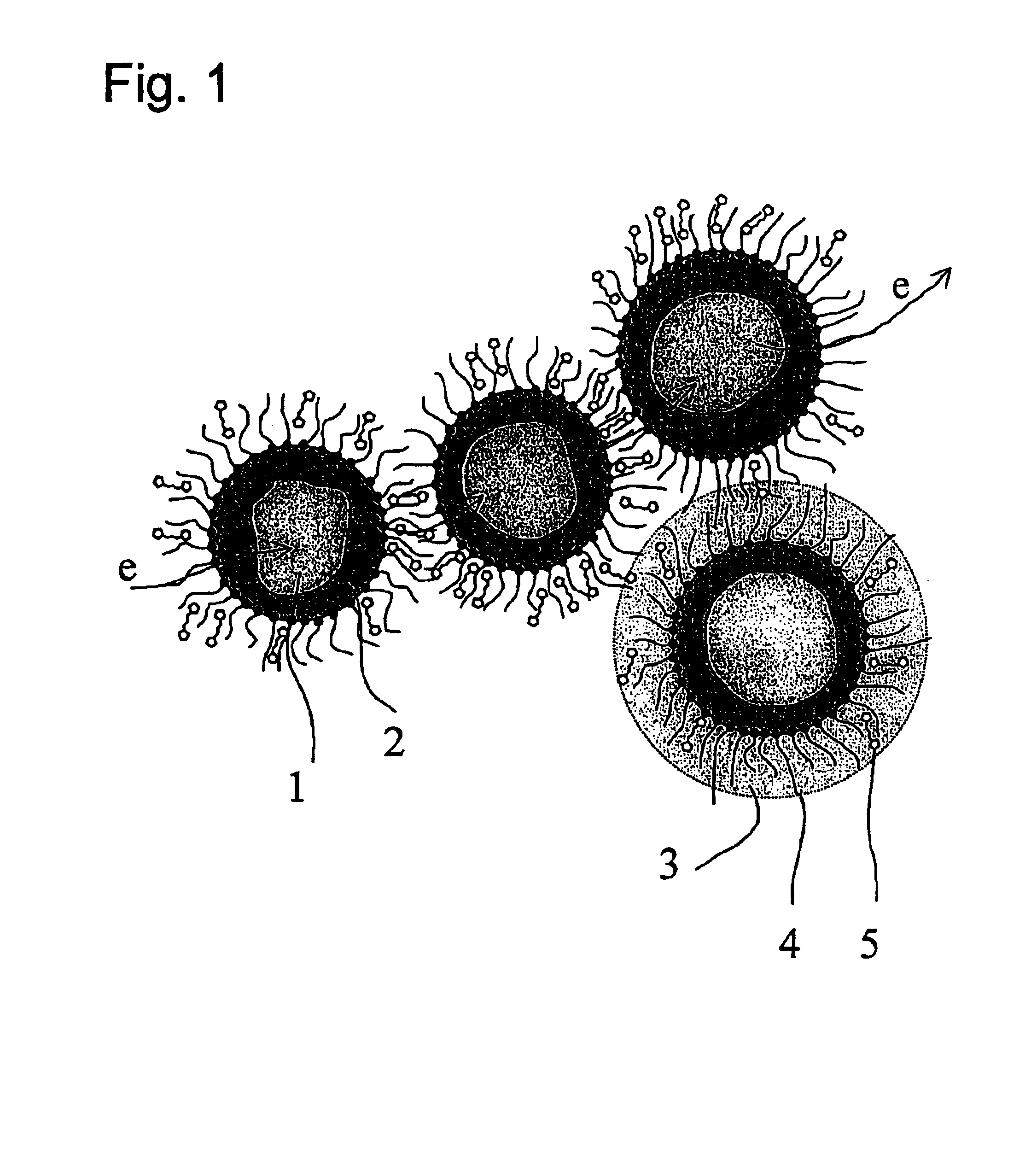
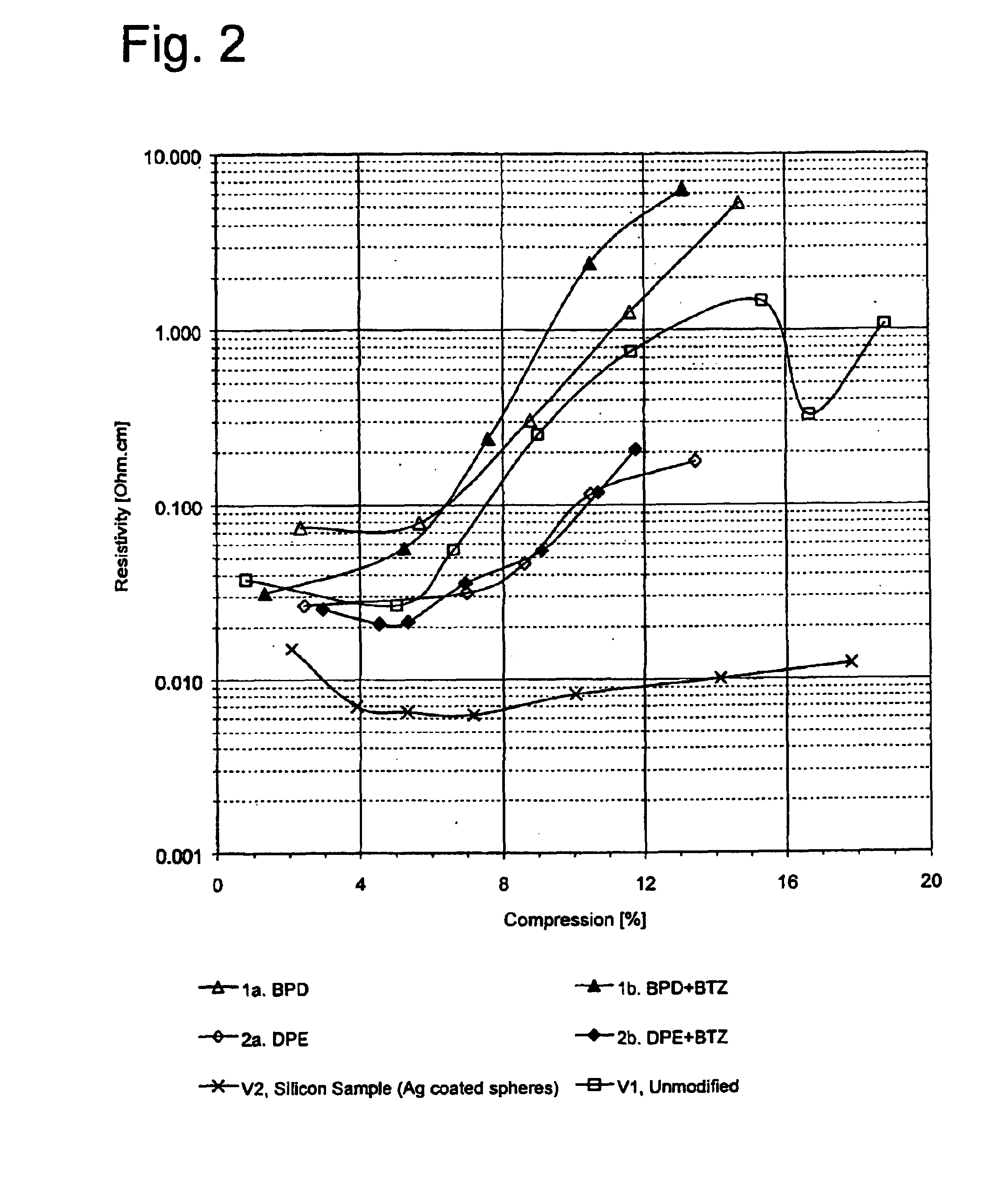
The direct coating of molecular wires was studied by self-assembly on the surface of filler particles. As the molecular wire, the effect of BPD and DPE (Sagara et al, Langmuir 6, 254-262) on the resistivity values of the elastomer test specimens was tested. Electrically conductive elastomers of the invention were prepared, and the resistivity values of the test specimens made from them were measured. The effect of BTZ was also studied, since BTZ is known to be strongly adsorbed onto silver surfaces (S. Kapoor, Langmuir 14 (1998) 1021-1025, N. Shibata & S. Suzuki, J. Pat. 3158230, 1991).
Coating Filler Particles
Different compound combinations were diluted in 250 ml organic solvent in accordance with Table 1. The solution was added to 60 grams of silver-coated fibreglass particles. The slurry obtained was mixed for at least 1 hour at room temperature, and the slurry was then filtered in a Buchner funnel. The particles were rinsed three times carefully with a solvent, and then the parti...
example 2
In example 2, the effect of octadecylmercaptan ODM and different aromatic compounds on the resistivity values of prepared elastomer test specimens was studied. The fibrous filler particles were coated as in Example 1. The elastomer was prepared and the resistivity of the elastomer composite measured as in Example 1. The compounds used and their amounts are given in Table II.
TABLE IICompounds andSolvent (adsorptionSpecimenamounts thereof / 250phase / washingNo.ml solvent and 60 g fillerphase)3a1 g ODMToluene / toluene3b1 g ODM + 0.24 g QT)1toluene / acetone4a1 g ODMchloroform / chloroform4b1 g ODM + 0.5 g BTZchloroform / chloroform4c1 g ODM + 0.24 g QT)2chloroform / chloroform4d1 g ODM + 0.24 g DPHTchloroform / chloroform 5a)o1 g ODM + 0.24 g DPHTchloroform / chloroform)1QT was not completely dissolved, )2the solution had to be filtered, )osilver-coated spheres
Results
FIG. 3 shows the resistivities of the elastomer composites according to Example 2. The resistivities of elastomer composites filled wi...
example 3
Example 3 deals with the effect of octadecylmercaptan ODM, dodecylmercaptan DDM and 1,6-diphenyl-1,3,5-hexatriene DPHT on the resistivity of elastomers. In these tests, coated spheres (50 percent by volume of the entire elastomer composite) are used instead of silver-coated fibres, and as solvent toluene, which has a better working safety than chloroform. Table III shows the compounds used. The filler particles were coated as in Examples 1 and 2, but the amount of substance was halved relative to the amount of filler. The elastomer was prepared and the resistivity of the elastomer composite was measured in the same way as in Examples 1 and 2.
TABLE IIICompounds andSpecimenthe amounts thereof / No.125 ml solvent and 60 g fillersolvent6a0.5 g ODMtoluene6b0.5 g ODM + 0.12 g DPHTtoluene7a0.5 g DDMtoluene7b0.5 g DDM + 0.12 g DPHTtoluene
Results
FIG. 4 shows the resistivity values of the different elastomer composites as a function of compression. Specimen 5a (Table II) gives a significantly l...
PUM
| Property | Measurement | Unit |
|---|---|---|
| temperature | aaaaa | aaaaa |
| electrically conductive | aaaaa | aaaaa |
| electrically | aaaaa | aaaaa |
Abstract
Description
Claims
Application Information
 Login to View More