
Time division multiple access over broadband modulation method and apparatus
a technology of time division and multiple access, applied in the field of information delivery and distribution, can solve the problems of signal loss and line noise, inconvenient use of existing network equipment, and insufficient broadband content technology to meet the demand, and achieve the effect of accurately resolving burst communications
- Summary
- Abstract
- Description
- Claims
- Application Information
AI Technical Summary
Benefits of technology
Problems solved by technology
Method used
Image

Examples
Embodiment Construction
[0033]Preferred embodiments of the present invention and their advantages may be understood by referring to FIGS. 1-10, wherein like reference numerals refer to like elements, and are described in the context of an information distribution system employing a hybrid fiber coax network. Nevertheless, the inventive concept can be adapted to an optical fiber network, coax cable network, or a wireless network, or any combination thereof.
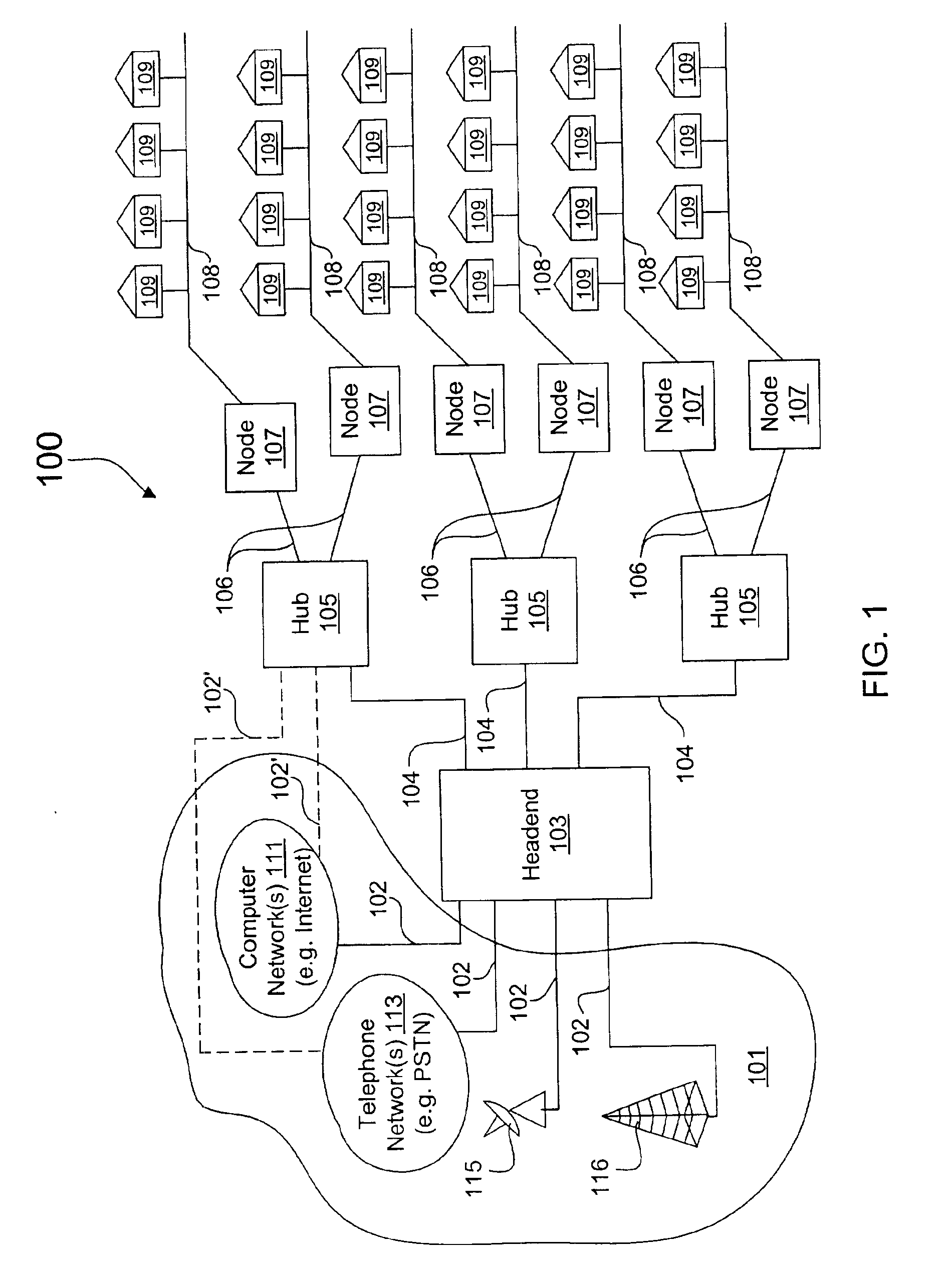
[0034]FIG. 1 is a block diagram of an exemplary communication system 100 with exemplary network architecture. One or more sources 101 are coupled via appropriate communication links 102 to deliver source information to a headend 103, which distributes the source information to one or more distribution hubs 105 via respective communication links 104. Each distribution hub 105 further distributes source information to one or more nodes 107 via communication links 106, where each node 107 in turn distributes the source information to one or more subscriber l...
PUM
 Login to View More
 Abstract
Description
Claims
Application Information
 Login to View More