Unlock instant, AI-driven research and patent intelligence for your innovation.

Dynamic management of computer workloads through service level optimization

Inactive Publication Date: 2007-06-05
HEWLETT PACKARD DEV CO LP
View PDF4 Cites 68 Cited by
  • Summary
  • Abstract
  • Description
  • Claims
  • Application Information

AI Technical Summary

Benefits of technology

[0012]It is a technical advantage of the invention that entitlements are no longer a fixed configuration. As the application's needs change, the computer will automatically adjust entitlements based on what the user desired through the stated goals. This makes it into a dynamic system.
[0013]It is another technical advantage of the invention that an administrator no longer has to estimate the initial entitlements as the invention will determine the correct resource allocation to achieve the stated goal, and the system will converge on a certain entitlement value that achieves the stated performance goal.
[0014]It is a further technical advantage of the invention that priorities can be assigned to the different goals. Consequently, different goals can be met based on system resources, e.g., with a high amount of resources, all goals can be met, however, with a lesser amount of resources the higher priority goal will be met before the lower priority goals.
[0015]It is a still further technical advantage of the invention that changes to the system can be made as soon as the WLM detects performance changes, and action by the system administrator is not required.
[0016]The foregoing has outlined rather broadly the features and technical advantages of the present invention in order that the

Problems solved by technology

Computer systems inherently have limited resources, particularly CPU resources.
These limited resources must be allocated among the different applications operating within the system.
For example, one application may be mostly idle, but occasionally has a large amount of work to do.
Under the static mechanism with fixed entitlements, this application would be allocated a smaller fraction of the CPU resources, as a larger fraction can not be justified because of the large amount of idle time.
Consequently, when the large amount of work is received, then the application's performance will suffer because of its low entitlement.
Therefore, the transactions will take longer to process.
Another example is where a transaction requires large amounts of resources for extended periods of time, but also has periods of idle time.
Consequently, when this application is idle, other applications' performances will suffer, as this application is assigned a large amount of resources that are not being used, and thus are not available for other applications.
Therefore, the other transactions will take longer to process.
Thus, this mechanism cannot handle changes in the requirements of the different applications.
Another problem is the partitioning the resources by the administrator.
This is problematic because the resources and applications are operating at a lower level than what a person typically views.

Method used

the structure of the environmentally friendly knitted fabric provided by the present invention; figure 2 Flow chart of the yarn wrapping machine for environmentally friendly knitted fabrics and storage devices; image 3 Is the parameter map of the yarn covering machine
View more

Image

Smart Image Click on the blue labels to locate them in the text.
Viewing Examples
Smart Image
  • Dynamic management of computer workloads through service level optimization
  • Dynamic management of computer workloads through service level optimization
  • Dynamic management of computer workloads through service level optimization

Examples

Experimental program
Comparison scheme
Effect test

Embodiment Construction

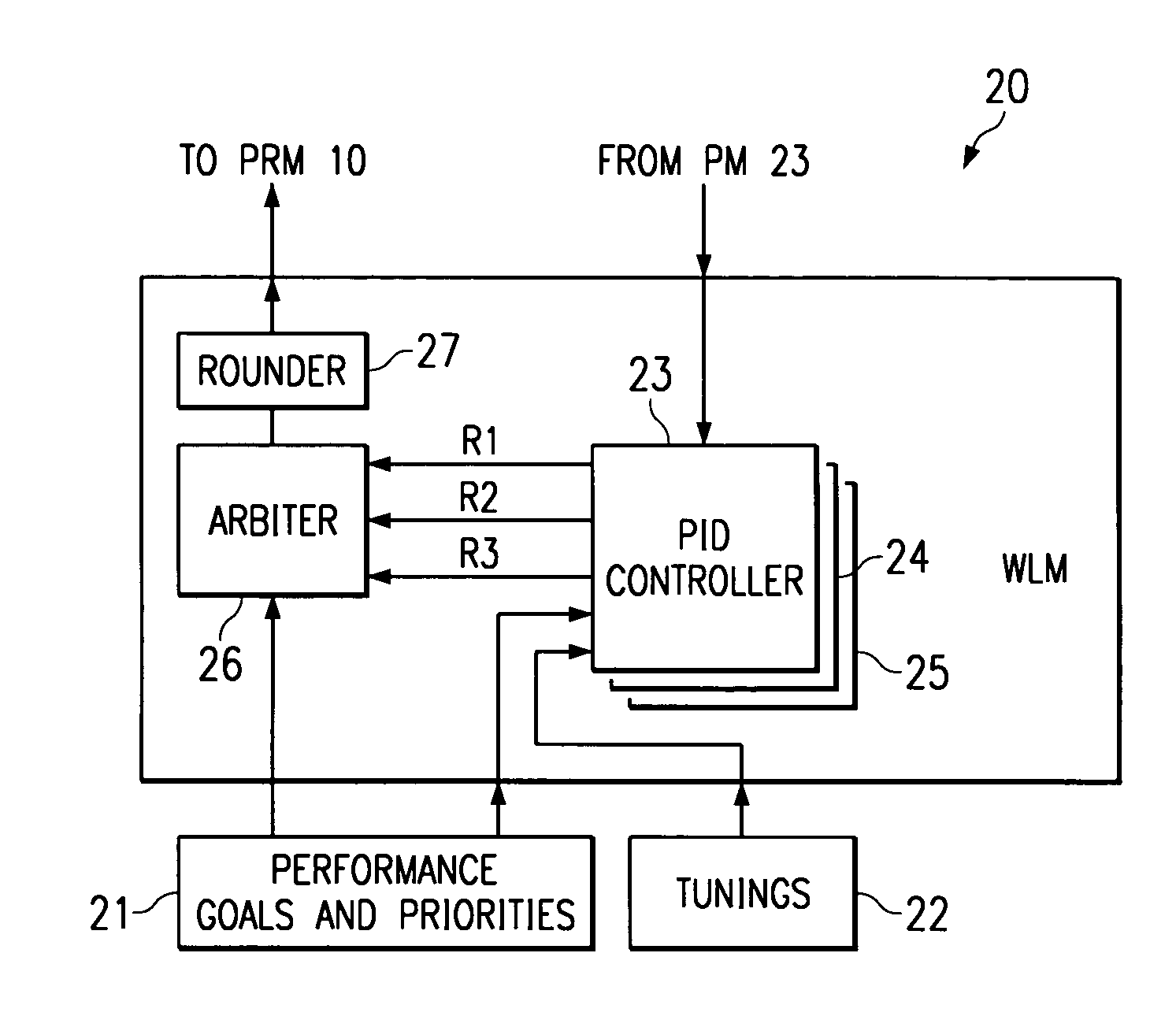
[0031]FIG. 2 depicts the various components of the inventive system, which includes performance goals 21. Goals 21 comprise a configuration file, which is defined by a user or system administrator, that describes the users preferences with regards to what characteristic(s) of the application is of interest and is being measured, what is the desired level of performance of the application in terms of the characteristic, and what is the priority of achieving this goal. A user can also specify time periods for a particular goal to be in effect. For example, a first application may be a first database and the user will specify in the configuration file that the characteristic is for a particular type of transaction to be completed within two seconds, and have a high priority. The application may also have a second goal for the same characteristic, e.g. the same type of transactions are to be completed within one half of a second, and have a low priority. A second application may be a se...

the structure of the environmentally friendly knitted fabric provided by the present invention; figure 2 Flow chart of the yarn wrapping machine for environmentally friendly knitted fabrics and storage devices; image 3 Is the parameter map of the yarn covering machine
Login to View More

PUM

No PUM Login to View More

Abstract

The inventive work load manager (WLM) dynamically responds to changes in workload characteristics. The WLM bases response on performance goals set by the administrator, and manipulates the resources to achieve these goals. The WLM receives performance information from performance monitors. The WLM examines the information from the performance monitors and compares the information with the goals using a Proportional Integral and Derivative controller. Based on the comparison, the WLM may increase, decrease, or leave unchanged, the resources devoted to an application. If the performance of an application is performance is lagging, e.g., if transactions are taking longer than the goal, then the WLM increases the entitlement. If an application is over-achieving, then the WLM will decrease its entitlement and allocate it to another application. The WLM uses an arbiter which allocates the resources between the different applications, based on the priorities of the applications. Consequently, the WLM creates a feedback loop between application performance and CPU entitlements.

Description

TECHNICAL FIELD[0001]This application relates in general to computer systems, and in specific to dynamic allocation of computer resources among applications.BACKGROUND[0002]Computer systems inherently have limited resources, particularly CPU resources. These limited resources must be allocated among the different applications operating within the system. A prior allocation mechanism for allocating system resources to applications is a system known as Process Resource Manager (PRM) 10 as shown in FIG. 1A. It is used to partition the CPU resource 11 and various other resources among the different applications 12, 13, 14. The PRM partitions the resources into fractions of the whole, which are expressed as percentages in PRM configuration, as shown in FIG. 1B. The fractions or pieces are then assigned to groups of processes, which comprise applications. Each application would then receive some portion of the available resources, particularly the CPU.[0003]The PRM is a static mechanism, ...

Claims

the structure of the environmentally friendly knitted fabric provided by the present invention; figure 2 Flow chart of the yarn wrapping machine for environmentally friendly knitted fabrics and storage devices; image 3 Is the parameter map of the yarn covering machine
Login to View More

Application Information

Patent Timeline
no application Login to View More
IPC IPC(8): G06F9/46G06F9/50
CPCG06F9/5061
Inventor MCCARTHY, CLIFFORD A.DAOUD, RAJA
Owner HEWLETT PACKARD DEV CO LP