AI technical title is built by PatSnap AI team. It summarizes the technical point description of the patent document.
a surface treatment agent and metal technology, applied in the field of metal surface treatment agents, can solve the problems of low adhesiveness to resins, peeling of oxide films, and inability to prevent copper oxidation upon heating, and achieve the effects of improving heat resistance, adhesiveness to resins, and solder wettability
Active Publication Date: 2008-07-01
JX NIPPON MINING & METALS CORP
View PDF31 Cites 21 Cited by
Summary
Abstract
Description
Claims
Application Information
AI Technical Summary
This helps you quickly interpret patents by identifying the three key elements:
Problems solved by technology
Method used
Benefits of technology
Benefits of technology
[0016]An object of the present invention is to provide a surface-treating agent which further improves heat resistance, adhesiveness to a resin, and solder wettability.
[0017]As a result of diligent research, the inventors perfected the present invention upon finding that surface treatment by a specific tetrazole derivative is more effective.
Problems solved by technology
Although the compounds have excellent moisture resistance and effectively prevent copper discoloration during storage of treated products, they are susceptible to heat, which is problematic in that copper is oxidized by heating and this results in the oxide film peeling.
However, this surface-treating agent, though avoiding the peeling of the oxidized film, does not prevent copper oxidation upon heating.
However, these involve thick films of several tenths of microns to several microns, which have therefore low adhesiveness to resins.
Method used
the structure of the environmentally friendly knitted fabric provided by the present invention; figure 2 Flow chart of the yarn wrapping machine for environmentally friendly knitted fabrics and storage devices; image 3 Is the parameter map of the yarn covering machine
View more
Image
Smart Image Click on the blue labels to locate them in the text.
Viewing Examples
Smart Image
Click on the blue label to locate the original text in one second.
Reading with bidirectional positioning of images and text.
Smart Image
Examples
Experimental program
Comparison scheme
Effect test
examples
[0039]The present invention will be explained more in detail below through Examples.
[0040]A rolled copper raw foil, measuring 100 mm×100 mm and having a thickness of 70 μm, was surface-treated by immersion in an aqueous solution of the surface-treating agent given in the tables below; thereafter, specimens prepared by cutting the foil into an appropriate size were tested as follows.
[0041]For the solder wettability test, printed wiring boards after surface treatment of dipping in a surface-treating agent solution were checked.
[0042]The results of the surface treatment were evaluated based on the following criteria:
[0043]Appearance:
[0044]∘ exhibited no defective appearance, such as treatment unevenness or the like; x exhibited defective appearance.
[0045]Moisture Resistance:
[0046]Specimens were left to stand for 96 hours under an environment at 40° C. and 90% humidity, after which the presence or absence of discoloration on the copper foil surface was checked visually. ∘ showed no disc...
the structure of the environmentally friendly knitted fabric provided by the present invention; figure 2 Flow chart of the yarn wrapping machine for environmentally friendly knitted fabrics and storage devices; image 3 Is the parameter map of the yarn covering machine
Login to View More
PUM
Property
Measurement
Unit
concentration
aaaaa
aaaaa
concentration
aaaaa
aaaaa
carbon number
aaaaa
aaaaa
Login to View More
Abstract
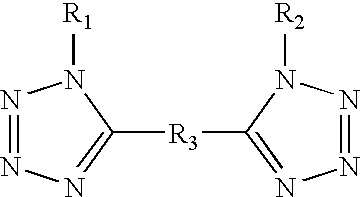
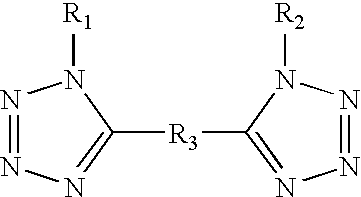
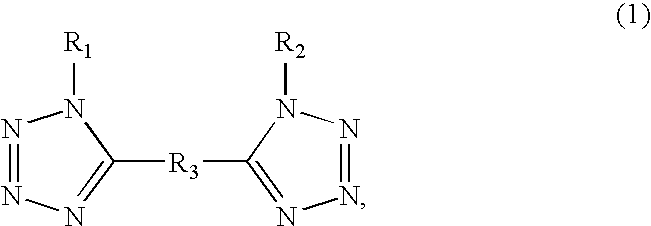
The present invention provides a surface-treating agent which improves heat resistance, adhesiveness to resin and solder wettability. The surface-treating agent for metal contains a tetrazole derivative represented by the following formula and / or a salt thereof,wherein R1 and R2 each independently represent a hydrogen atom, a halogen atom, or an alkyl group or an aryl group, etc., which each have a carbon number of not more than 10, and a group having a halogen atom, a hydroxyl group, a carboxyl group, an amino group or a mercapto group added thereto, or represent an amino group, a mercapto group, a hydroxyl group or a carboxyl group; and R3 represents a bond or an alkylene group, etc., which each have a carbon number of not more than 10, and a group having a halogen atom, a hydroxyl group, a carboxyl group, an amino group, a mercapto group, an azo group (—N═N—), a sulfide group (—S—), or a disulfide group (—S—S—) added thereto, or represents an azo group, a sulfide group, or disulfide group, and may contain a metal or metal compound.
Description
TECHNICAL FIELD[0001]The present invention relates to a surface-treating agent for metal.BACKGROUND ART[0002]Triazoles and derivatives thereof are well-known agents to prevent discoloration of copper and copper alloys. Such compounds, arranged for use in electronic materials, include an acidic solution to prevent copper discoloration proposed by the present applicants, which contains 5-methyl-1H-benzotriazole, 5,6-dimethyl-1H-benzotriazole, or 2-mercaptopyrimidine (Patent Document 1 (Japanese Patent Publication No. H04-160173)). Although the compounds have excellent moisture resistance and effectively prevent copper discoloration during storage of treated products, they are susceptible to heat, which is problematic in that copper is oxidized by heating and this results in the oxide film peeling. The present applicants solved this problem in the application of Patent Document 2 (Japanese Patent No. 3373356), which is a solution to prevent copper discoloration obtained by adding a met...
Claims
the structure of the environmentally friendly knitted fabric provided by the present invention; figure 2 Flow chart of the yarn wrapping machine for environmentally friendly knitted fabrics and storage devices; image 3 Is the parameter map of the yarn covering machine
Login to View More
Application Information
Patent Timeline
Application Date:The date an application was filed.
Publication Date:The date a patent or application was officially published.
First Publication Date:The earliest publication date of a patent with the same application number.
Issue Date:Publication date of the patent grant document.
PCT Entry Date:The Entry date of PCT National Phase.
Estimated Expiry Date:The statutory expiry date of a patent right according to the Patent Law, and it is the longest term of protection that the patent right can achieve without the termination of the patent right due to other reasons(Term extension factor has been taken into account ).
Invalid Date:Actual expiry date is based on effective date or publication date of legal transaction data of invalid patent.



 Login to View More