

Sequence number schemes for acceptance/rejection of duplicated packets in a packet-based data network
a packet-based data network and sequence number technology, applied in the field of sequence number schemes for the acceptance/rejection of duplicated packets in the packet-based data network, can solve problems such as one or more packets to be los
- Summary
- Abstract
- Description
- Claims
- Application Information
AI Technical Summary
Benefits of technology
Problems solved by technology
Method used
Image

Examples
case b
[0037] Processing with Lost Packet
[0038]The example for Case B is based on the same assumptions as for Case A, except that, for some reason, the next expected packet (i.e., the packet transmitted over the faster path having sequence number 9) is lost during transmission from the source node to the destination node.
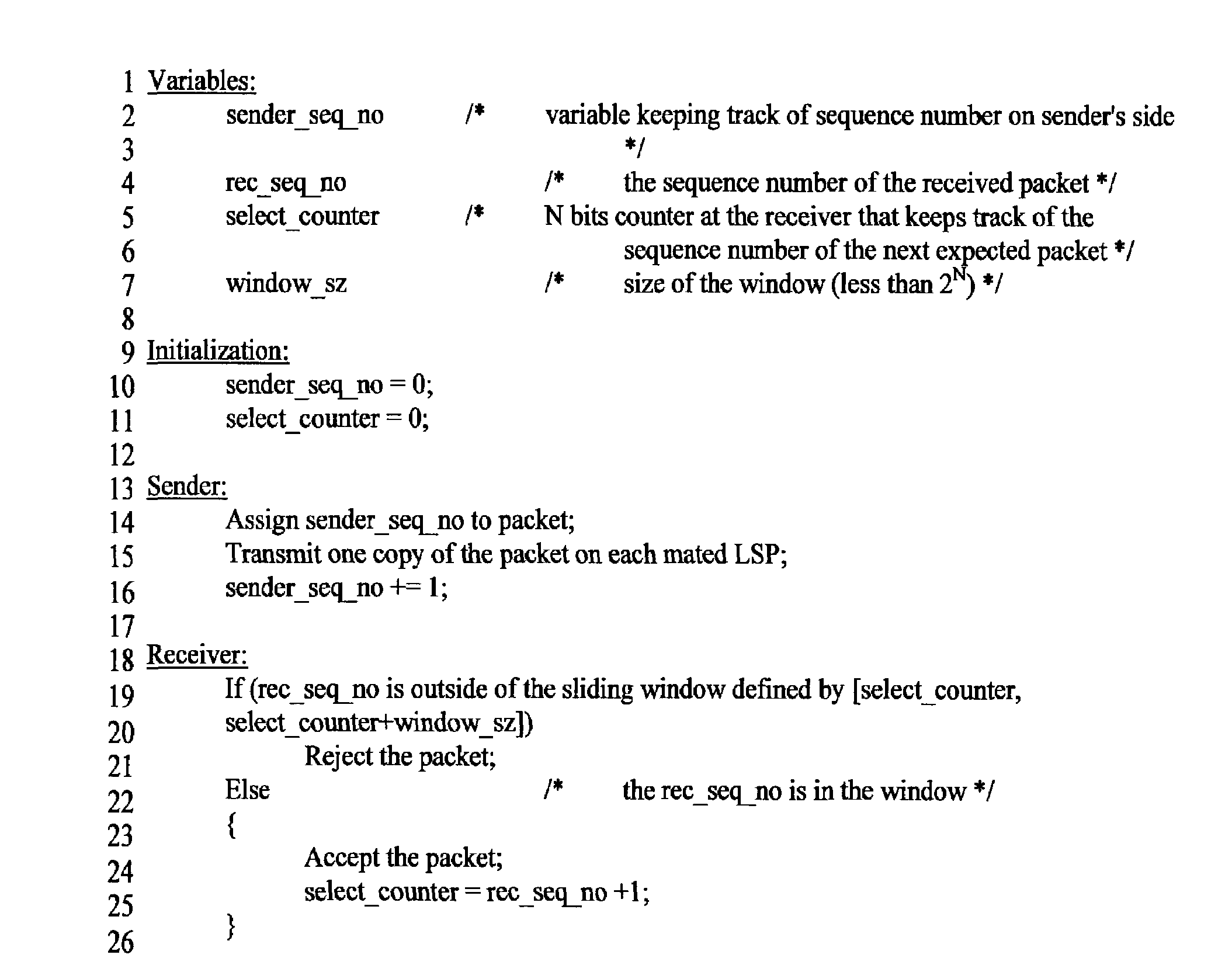
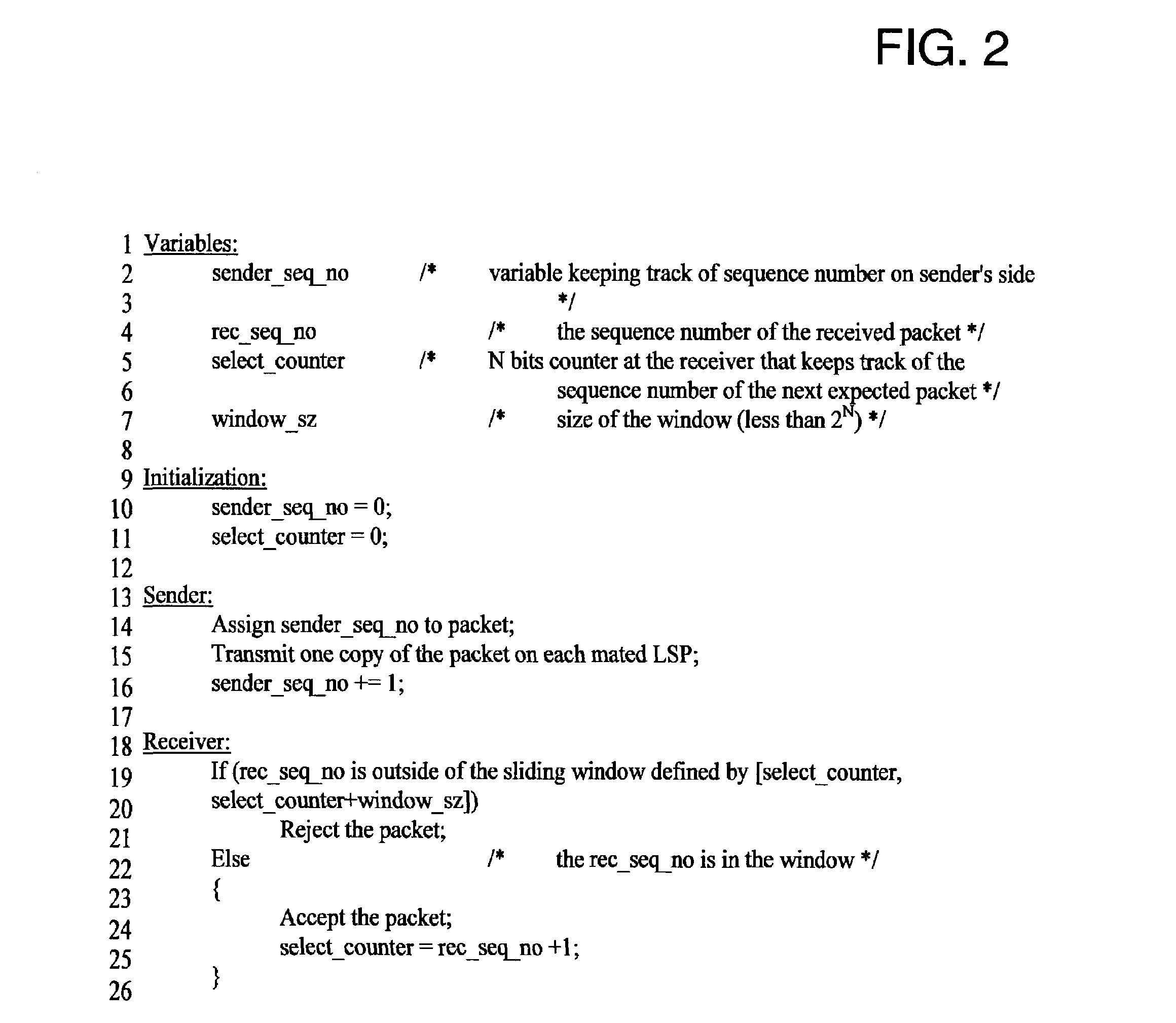
[0039]In that case, if the next packet is received via the faster path, then rec_seq_no=10, and Lines 19-20 will determine that rec_seq_no is inside the current sliding window of (9 to 19). As such, Line 24 will accept the packet, and Line 25 will set select_counter to 11 for the next received packet. Note that the option exists to implement a destination node with the ability to buffer one or more packets. In this case, data corresponding to the lost packet can be recovered from the corresponding duplicate packet if and when it eventually arrives at the destination node via the slower path.
[0040]If, instead, the next packet is received via the slower path, then rec_seq_no...
case c
[0042] Nominal Wrap-Around Processing
[0043]As an example of Case C, assume that the sequence number of the next expected packet (select_counter) is 31, which means that the current sliding window extends from 31 (i.e., select_counter) back to 0 and then to 9 (i.e., select_counter+window_sz taking into account sequence-number roll-over). Under nominal operating conditions (i.e., no lost packets), the next packet received via the faster path will have a sequence number of rec_seq_no=31, while the next packet received via the slower path will have a sequence number of rec_seq_no=25.
[0044]If the next packet is received via the faster path, then rec_seq_no=31, and Lines 19-20 of FIG. 2 will determine that rec_seq_no is inside the current sliding window of (31 to 9). As such, Line 24 will accept the packet, and Line 25 will set select_counter to 0 for the next received packet, taking into account the roll-over of the sequence number.
[0045]If, instead, the next packet is received via the s...
case d
[0047] Wrap-Around Processing with Lost Packet
[0048]The example for Case D is based on the same assumptions as for Case C, except that, for some reason, the next expected packet is lost during transmission from the source node to the destination node.
[0049]In that case, if the next packet is received via the faster path, then rec_seq_no=0, and Lines 19-20 will determine that rec_seq_no is inside the current sliding window of (31 to 9). As such, Line 24 will accept the packet, and Line 25 will set select_counter to 1 for the next received packet.
[0050]If, instead, the next packet is received via the slower path, then rec_seq_no=26, and Lines 19-20 will determine that rec_seq_no is outside the current sliding window of (31 to 9), causing Line 21 to reject the packet. (Note that the other copies of both the lost packet and the rejected packet would nominally have been received and accepted by the destination node 6 packets earlier.)
[0051]In either case, the received packet is handled a...
PUM
 Login to View More
 Abstract
Description
Claims
Application Information
 Login to View More