

Minimizing power consumption in a wireless system for a sensor networks using time slots for nodes
a wireless system and sensor network technology, applied in the field of sensor networks, can solve problems such as energy consumption, packets to be corrupted by another packet, and protocol design constraints, and achieve the effect of reducing the number of collisions
Inactive Publication Date: 2010-06-15
RGT UNIV OF CALIFORNIA
View PDF10 Cites 36 Cited by
- Summary
- Abstract
- Description
- Claims
- Application Information
AI Technical Summary
Benefits of technology
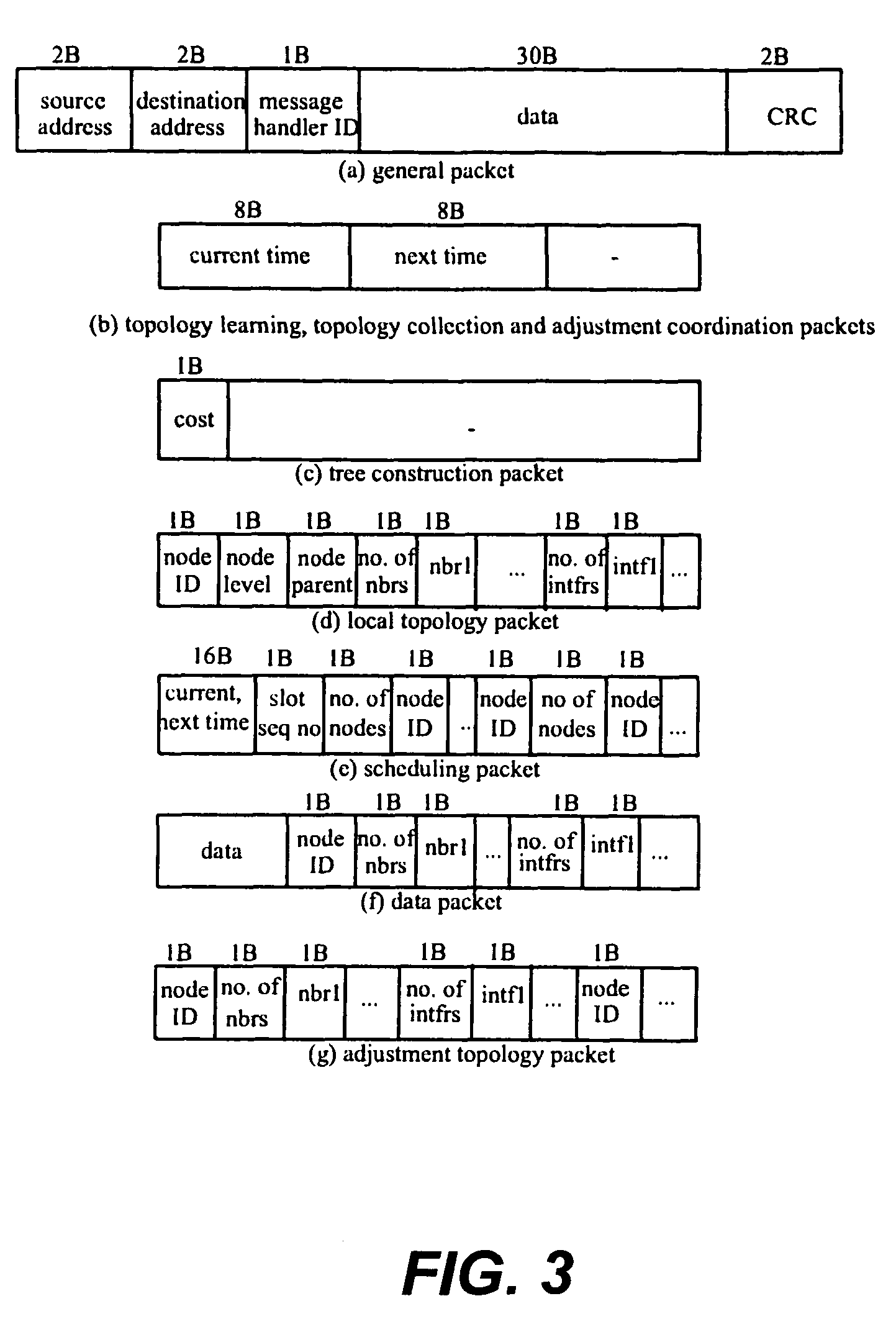
[0017]In this phase, a random access scheme has to be used since no node has any topology information. The random access scheme and its parameters should be chosen so that the nodes learn about all of their neighbors and interferers with high probability so that scheduling phase can be successful. The nodes listen to the radio for a random amount of time before transmitting and then transmit if the channel is idle. We have added a random delay before carrier sensing in order to further reduce the number of collisions.
Problems solved by technology
However, if the network is not functional due to node failures, the AP will interpret this as having no fire.
The energy limitation of the sensor nodes due to their small size and long lifetime requirements imposes constraints on the protocol design.
The primary source of energy consumption is the radio.
Collision causes a packet to be corrupted by another packet.
Since this packet is discarded, the energy consumption per successful transmission will increase.
Method used
the structure of the environmentally friendly knitted fabric provided by the present invention; figure 2 Flow chart of the yarn wrapping machine for environmentally friendly knitted fabrics and storage devices; image 3 Is the parameter map of the yarn covering machine
View moreImage
Smart Image Click on the blue labels to locate them in the text.
Smart ImageViewing Examples

Examples
Experimental program
Comparison scheme
Effect test
case 1
[0115] The tree graph G=(V,E) is linear, that is each node uεV has at most one child. The interference graph C=(V, I) is such that I=Ø.
case 2
[0116] The tree graph G=(V,E) is general. The interference graph C=(V, I) satisfies the ancestor property, that is, there do not exist u, v, b such that (u, v)εI and |d(u, b)−d(v, b)|>1. This represents the case where shortest path routing is used with the cost of each path being equal to the number of nodes on that path and only nodes that can hear each other can interfere, which is the assumption of previously proposed TDMA scheduling algorithms.
case 3
[0117] The tree graph G=(V,E) is general and the interference graph C=(V, I) is such that the maximum difference between the levels of two interfering nodes is K.
the structure of the environmentally friendly knitted fabric provided by the present invention; figure 2 Flow chart of the yarn wrapping machine for environmentally friendly knitted fabrics and storage devices; image 3 Is the parameter map of the yarn covering machine
Login to View More PUM
 Login to View More
 Abstract
A power efficient system architecture that exploits the characteristics of sensor networks in order to decrease the power consumption in the network. The primary characteristic of sensor networks is that the destination of all the data packets in the network is a central data collector and this central data collector, which is usually denoted as access point (AP), has unlimited transmission power and energy whereas the sensor nodes have limited battery energy and transmission power. The system uses the AP to directly synchronize and explicitly schedule the nodes' transmissions over Time Division Multiple Access (TDMA) time slots.
Description
CROSS REFERENCE TO RELATED APPLICATIONS[0001]This application claims priority under 35 USC §119(e) from Provisional patent application Ser. No.: 60 / 528,145, filed Dec. 8, 2003, which is incorporated by reference herein for all purposes.[0002]Attached hereto and incorporated by reference for all purposes are thesis of Sinem Coleri titled “PEDAMACS: Power Efficient and Delay Aware Medium Access Protocol for Sensor Networks, ” Graduate Division of the University of California, Berkeley, Fall 2002 (Dec. 20, 2002); Coleri and Varaiya “Power Efficient System for Sensor Networks”, Proceedings of the Eighth IEEE International Symposium on Computers and Communication 2003; Coleri Ergen and Varaiya “PEDAMACS: Power Efficient and Delay Aware Medium Access Protocol for Sensor Networks,” (unpublished); Coleri Ergen and Varaiya “Scheduling Algorithm with Delay Guarantee for Sensor Networks,” (unpublished).BACKGROUND OF THE INVENTION[0003]This invention relates generally to sensor networks such as...
Claims
the structure of the environmentally friendly knitted fabric provided by the present invention; figure 2 Flow chart of the yarn wrapping machine for environmentally friendly knitted fabrics and storage devices; image 3 Is the parameter map of the yarn covering machine
Login to View More Application Information
Patent Timeline
 Login to View More
 Patent Type & AuthorityPatents(United States)
IPC IPC(8): H04B7/212G08B29/00H04L12/28H04W52/02H04W84/18
CPCH04W40/22H04W72/1268H04W74/0808H04W84/22Y02B60/50H04W52/0219H04W52/0238H04W52/0245H04W52/0254H04W52/0216Y02D30/70
InventorVARAIYA, PRAVINCOLERI ERGEN, SINEM
OwnerRGT UNIV OF CALIFORNIA