Unlock instant, AI-driven research and patent intelligence for your innovation.

Enterprise-level transaction analysis and reporting

a transaction analysis and enterprise-level technology, applied in the field of business intelligence, can solve the problems of inability to define additional dimension hierarchies for non-technical end users, high upfront time, and inability to achieve substantial upfront time, and achieve the effect of high-performance query processing

Inactive Publication Date: 2012-07-24
CERTENT
View PDF14 Cites 5 Cited by
  • Summary
  • Abstract
  • Description
  • Claims
  • Application Information

AI Technical Summary

Problems solved by technology

Traditionally, the BI projects would be information technology (IT)-intensive, and requires substantial upfront time for setting up metadata (data about the numeric values) and continues to require IT involvement in making adjustments to the structure / layout of the data warehouse.
It is not usually possible for a non-technical end user to define additional dimension hierarchies nor is it normal for the OLAP server to update itself with new dimensions when and if the underlying transactions indicates that new data attributes are available and that can be used as dimensions.
A major disadvantage of the constraints imposed using the approach taken by OLAP servers is that, generally, OLAP cubes are defined using only “first class” dimensions such as time, accounts, product, region.
While a user can create a report based on these dimensions, a user cannot create an aggregate based on some other attribute of the data.

Method used

the structure of the environmentally friendly knitted fabric provided by the present invention; figure 2 Flow chart of the yarn wrapping machine for environmentally friendly knitted fabrics and storage devices; image 3 Is the parameter map of the yarn covering machine
View more

Image

Smart Image Click on the blue labels to locate them in the text.
Viewing Examples
Smart Image
  • Enterprise-level transaction analysis and reporting
  • Enterprise-level transaction analysis and reporting
  • Enterprise-level transaction analysis and reporting

Examples

Experimental program
Comparison scheme
Effect test

example # 1

Example #1

Query Processing and Balance Creation

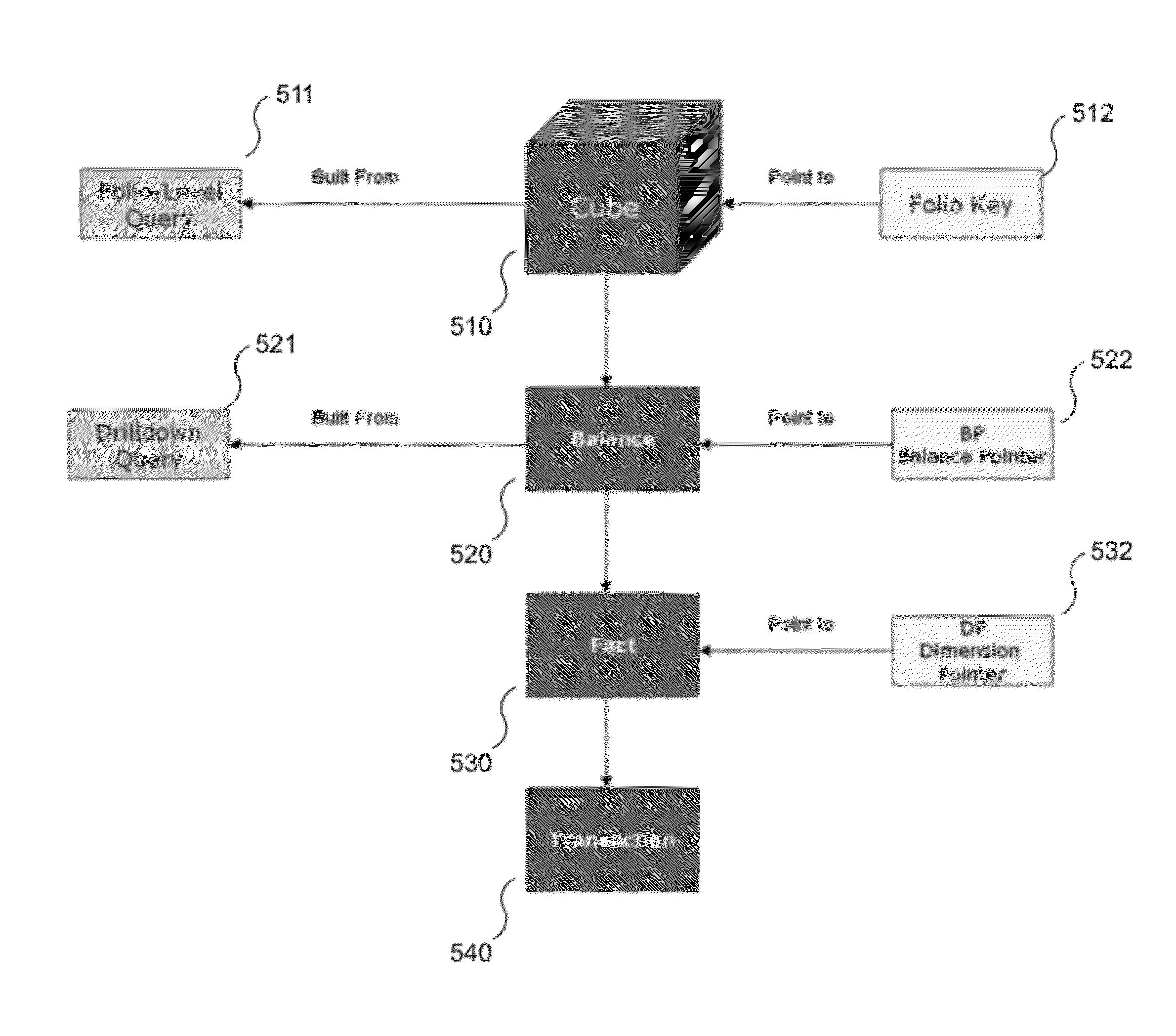
[0127]The following illustrates an example of how an enterprise-level analysis and reporting system processes one request and creates the balances according to one embodiment of the present invention.

[0128]The current example assumes the following DPs are currently defined in the system:

[0129]

DPEntityLocDepartmentProductManagerAccount11DenMktWidget1100110021Den200410031DenWidget1410041Widget16500

[0130]A key table may be created as follows:

[0131]

Key TypeKey CodeDP ArrayEntity1{1, 2, 3, 4}LocDen{1, 2, 3}DepartmentMkt{1}ProductWidget1{1, 3, 4}Manager100{1}Manager200{2}Account1100{1}Account4100{2, 3}Account6500{4}

[0132]If the system received a query for [Entity-1], [Loc.Den], [Account.4100], [Actual, USD, Jan. 1, 2003-Jan. 31, 2003), the following process may be executed to create the balances:[0133](1) The system resolves the DPs that are shared by the keys in the query[0134][Entity.1]→{1,2,3,4}[0135][Loc.Den]→{1,2,3}[0136][Account.4100]→{...

example # 2

Example #2

Data Loading

[0142]The following illustrates an example of how an enterprise-level analysis and reporting system loads data into a transaction manager according to one embodiment of the present invention.

[0143]According to the present example, the customer has the following three customer key segments:

[0144]

Key Segment NameKey Segment IdKey Value IdsCompany11, 2Sales Person21, 2, 3, 4, 5, 6Product Id31, 2, 3, 4, 5, 6, 7, 8, 9, 10

[0145]According to the present example, the customer has the following values for the system key segments:

[0146]

Key Segment NameKey codeKey value IdsScenarioScenario11Scenario22Balance TypeCredit1Debit2Posting statusPosted1Currency CodeUSD1Canadian Dollar2Euro3Originating CurrencyUSD1Canadian Dollar2Euro3Adjustment statusNone1Month end adjustment2Year end adjustment3

[0147]According to the present example, the Id numbers in the above tables represent the internal identification for the actual key segment names and key codes. The transaction manager m...

example # 3

Example #3

Query Processing

[0161]The following illustrates an example of how an enterprise-level analysis and reporting system processes a query according to one embodiment of the present invention and based on the data loaded in Example #2 above.

Query 1: Total Sold by Sales Persons 1,2,3 in 2003 in USD

Customer Key of query=sales persons 1,2,3

Date range—Fiscal year 103, Fiscal period 1 . . . 12 (as this includes the complete year)

Amount currency=USD

DPs that satisfy customer key={1,2,3,4}

Amount attribute that satisfy USD={1,3,5}

Total amount for DPs {1,2,3,4}, Amount attribute={1,3, 5}

And fiscal year 103, fiscal period 1=100+200+360+1800=2460.

Result=2460.

Creating balance records for query 1.

Balance Key=Sales Persons 1,2,3

DPList={1,2,3,4}

Timebucket=yearly

Balance[ ]=the following table

[0162]

AmountBPattribute IdAmountFiscal YearFiscal periodCalendar Id1130010311125401031113360103111460010311151800103111630001031117150010311

This looks just like the fact table, but imagine that the same set...

the structure of the environmentally friendly knitted fabric provided by the present invention; figure 2 Flow chart of the yarn wrapping machine for environmentally friendly knitted fabrics and storage devices; image 3 Is the parameter map of the yarn covering machine
Login to View More

PUM

No PUM Login to View More

Abstract

Systems and methods for a multi-level advanced caching engine that is designed for processing a high-volume of transaction data and ensuring high performance query processing is provided. A folio is interactively updated on-demand for an organizational hierarchy with aggregated information from pre-summarized balances. Responsive to user-generated folio-level queries which depend upon balance values not currently stored within the financial transaction system, multiple instances of balances are dynamically created and populated with new balance values based on the user-generated folio-level query. Responsive to new transaction data, clean balance values are maintained within the dependent balances by regenerating the associated balance values. Responsive to a user-generated folio-level query, an instance of a cube is dynamically created and populated having dimensions defined by parameters of the user-generated folio-level query and which aggregates the balance values of the balances into appropriate slices of the cube.

Description

CROSS-REFERENCE TO RELATED APPLICATIONS[0001]This application claims the benefit of priority of U.S. Provisional Application No. 60 / 785,250, filed on Mar. 22, 2006, which is hereby incorporated by reference in its entirety for all purposes.[0002]This application is related to U.S. patent application Ser. No. 11 / 163,965, now, U.S. Pat. No. 7,415,482, which is hereby incorporated by reference in its entirety for all purposes.COPYRIGHT NOTICE[0003]Contained herein is material that is subject to copyright protection. The copyright owner has no objection to the facsimile reproduction of the patent disclosure by any person as it appears in the Patent and Trademark Office patent files or records, but otherwise reserves all rights to the copyright whatsoever. Copyright© 2006-2011, Rivet Software, Inc.BACKGROUND[0004]1. Field[0005]Embodiments of the present invention generally relate to business intelligence (BI) systems and systems and methods for performing enterprise-level analysis and re...

Claims

the structure of the environmentally friendly knitted fabric provided by the present invention; figure 2 Flow chart of the yarn wrapping machine for environmentally friendly knitted fabrics and storage devices; image 3 Is the parameter map of the yarn covering machine
Login to View More

Application Information

Patent Timeline
no application Login to View More
Patent Type & Authority Patents(United States)
IPC IPC(8): G06Q10/00G06F9/44G06F7/00G06F17/00
CPCG06Q10/063G06Q10/10
Inventor ROHAN, MICHAEL L.BLAKE, ROBHUANG, EMILY
Owner CERTENT