
Soft hierarchy-based physical synthesis for large-scale, high-performance circuits
a high-performance circuit and physical synthesis technology, applied in the field of design automation, can solve the problems of little user control, flat synthesis does not allow floor planning, and may not be the best approach for large-scale designs
- Summary
- Abstract
- Description
- Claims
- Application Information
AI Technical Summary
Benefits of technology
Problems solved by technology
Method used
Image

Examples
Embodiment Construction
[0014]In one embodiment, the present invention is a method and apparatus for soft hierarchy-based physical synthesis for large-scale, high-performance circuits. Embodiments of the invention perform physical synthesis by combining a substantially flat approach with soft boundaries. In particular, optimization and placement are conducted on a flat netlist. However, placement is constrained by soft boundaries that are created based on logic modules within the design. Within the context of the present invention, a “soft” boundary refers to a boundary across which gates may be moved, if necessary. For example, during timing analysis, optimization transforms may move gates from within the boundary to outside the boundary.
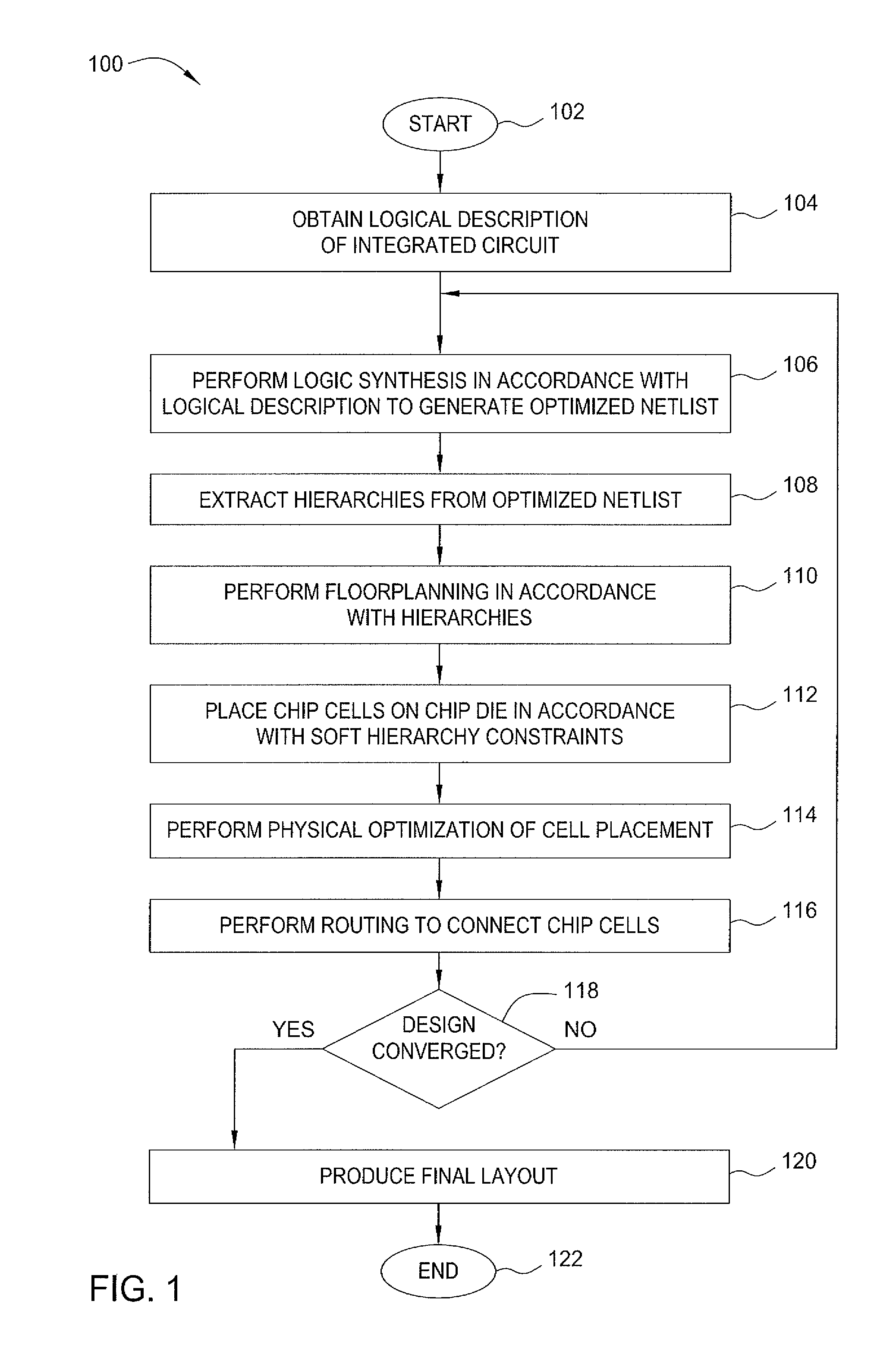
[0015]FIG. 1 is a flow diagram illustrating one embodiment of a method 100 for performing physical synthesis of an integrated circuit, according to the present invention. The method 100 may be implemented, for example, to synthesize a large-scale, high-performance circuit...
PUM
 Login to View More
 Abstract
Description
Claims
Application Information
 Login to View More