
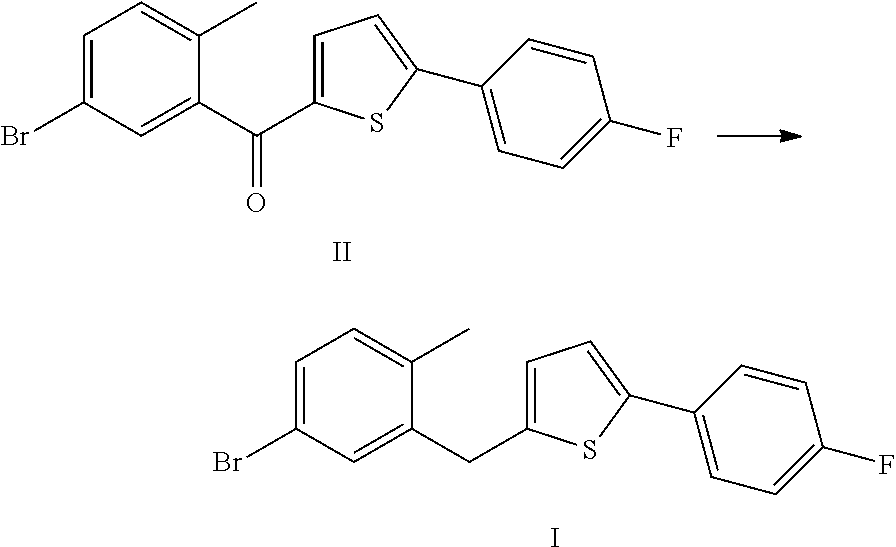
Method for preparing canagliflozin intermediate 2-(2-methyl-5-bromobenzyl)-5-(4-fluorophenyl)thiophene
a technology of canagliflozin and intermediates, applied in the field of synthesizing pharmaceutical intermediates, can solve the problems of high cost of silica reagents, high power consumption, complex post-treatment, etc., and achieves the effects of reducing production cost, saving energy, and improving production efficiency
- Summary
- Abstract
- Description
- Claims
- Application Information
AI Technical Summary
Benefits of technology
Problems solved by technology
Method used
Image

Examples
example 1
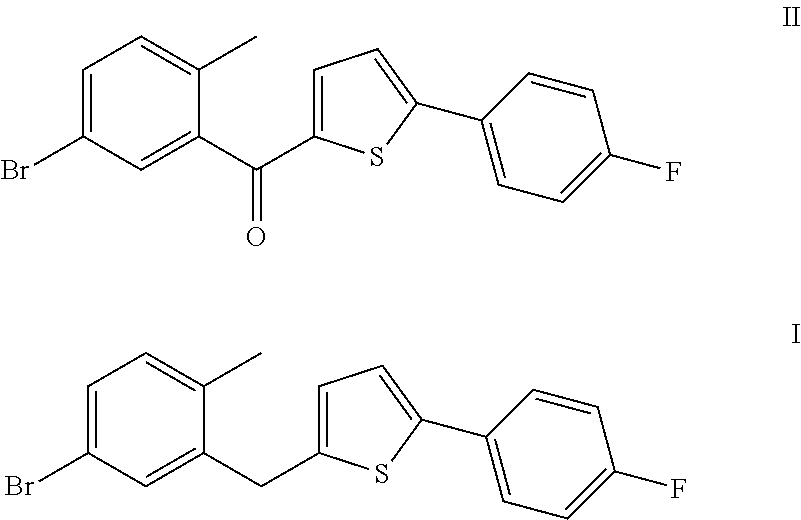
[0016]10 g (5-bromo-2-methylphenyl)[5-(p-fluorophenyl)thiophene-2-yl]methanone was weighed and dissolved in 100 ml tetrahydrofuran, and 4 ml of 1 M borane-tetrahydrofuran complex was added. The system was heated to 50 to 55° C. and reacted for 12 hours. After the complete reaction of raw materials, 20 ml water was added. The mixture was extracted with 50 ml dichlomomethane, and then the extract was concentrated to give 9.5 g of 2-(2-methyl-5-bromobenzyl)-5-(4-fluorophenyl)thiophene, with a purity of 99.0% and in a yield of 97.7%.
[0017]1HNMR (DMSO-d6) δ 2.25 (3H, s), 4.15 (2H, s, Ph-CH2-thiophene), 6.85 (1H, d, J=3.5 Hz, thiophene), 7.17 (1H, d, J=8.0 Hz), 7.21 (2H, quasi-t), 7.31 (1H, d, J=3.5 Hz, thiophene), 7.36 (1H, dd, J=8.0, 1.9 Hz), 7.44 (1H, d, J=1.9 Hz), 7.60 (2H, m).
[0018]Anal. Calcd. for C18H14BrFS: C, 59.84; H, 3.91; Br, 22.12; F, 5.26; S, 8.87. Found: C, 59.89; H, 3.86; Br, 21.93; F, 5.17; S, 8.85.
example 2
[0019]10 g (5-bromo-2-methylphenyl)[5-(p-fluorophenyl)thiophene-2-yl]methanone was weighed and dissolved in 100 ml tetrahydrofuran, 1.5 g sodium borohydride and 7.1 g anhydrous aluminium chloride were added. The system was heated to 50 to 55° C. and reacted for 12 hours. After the complete reaction of raw materials, 20 ml water was added. The mixture was extracted with 100 ml ethyl acetate, and then the extract was concentrated to give 9.4 g of 2-(2-methyl-5-bromobenzyl)-5-(4-fluorophenyl)thiophene, with a purity of 98.5% and in a yield of 96.1%.
example 3
[0020]20 g (5-bromo-2-methylphenyl)[5-(p-fluorophenyl)thiophene-2-yl]methanone was weighed and dissolved in 200 ml tetrahydrofuran, 4.4 g potassium borohydride and 14.2 g anhydrous aluminium chloride were added. The system was heated to 50 to 55° C. and reacted for 12 hours. After the complete reaction of raw materials, 40 ml water was added. The mixture was extracted with 200 ml ethyl acetate, and then the extract was concentrated to give 18.4 g of 2-(2-methyl-5-bromobenzyl)-5-(4-fluorophenyl)thiophene, with a purity of 98.6% and in a yield of 94.2%.
PUM
| Property | Measurement | Unit |
|---|---|---|
| temperature | aaaaa | aaaaa |
| temperature | aaaaa | aaaaa |
| structure | aaaaa | aaaaa |
Abstract
Description
Claims
Application Information
 Login to View More