

Chemical-enzyme method for preparing (S)-2-chlorophenyl glycine methyl ester clopidogrel chiral intermediate
A technology for o-chlorophenylglycine methyl ester and o-chlorophenylglycine, which is applied in the field of chemical-enzymatic methods for preparing a chiral intermediate of clopidogrel-o-chlorophenylglycine methyl ester, and can solve the problem of low optical purity and influence on end products. problems such as the optical purity of clopidogrel, achieving high optical activity, eliminating the recrystallization step, and simplifying the preparation process.
Patent Information
- Authority / Receiving Office
- CN · China
- Patent Type
- Patents(China)
- Current Assignee / Owner
- Publication Date
- 2012-10-10
- Estimated Expiration
- Not applicable · inactive patent
Smart Images
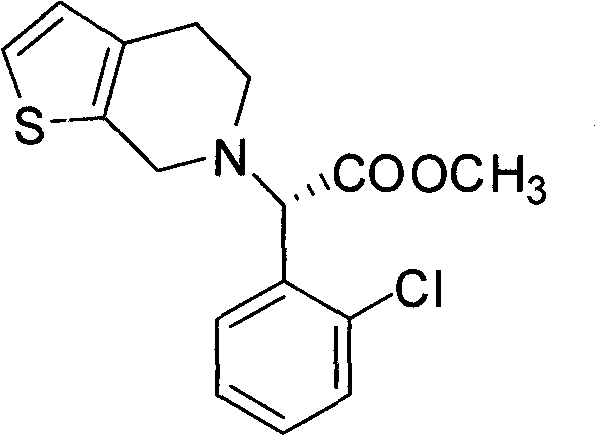
Figure 1 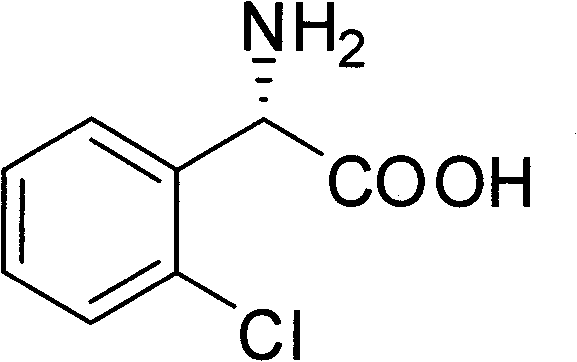
Figure 2 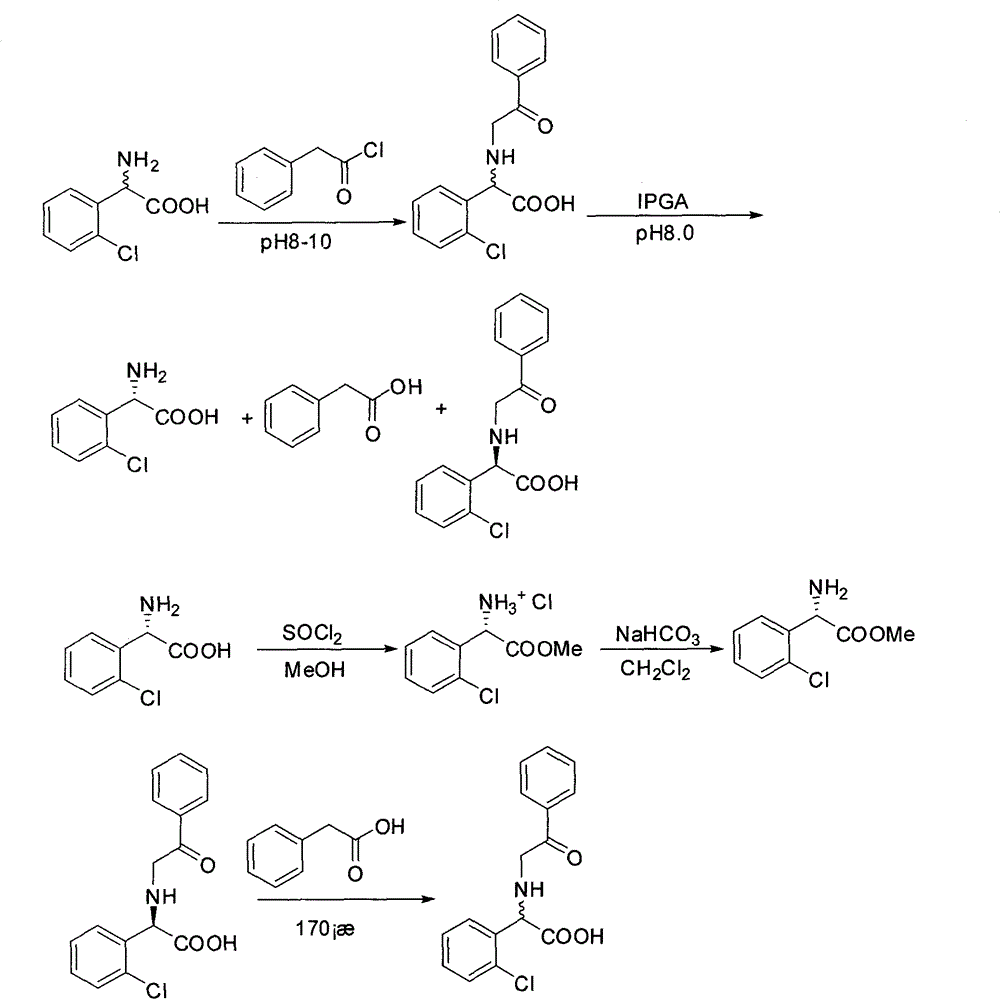
Figure 3
Abstract
Description
technical field
[0001] The invention relates to biocatalytic hydrolysis technology for preparing chiral drug intermediates, in particular to a chemical-enzymatic method for preparing clopidogrel chiral intermediate (S)-o-chlorophenylglycine methyl ester. Background technique
[0002] Clopidogrel (Clopidogrel), the chemical name is (S)-α-(2-chlorophenyl)-4,5,6,7-tetrahydrothieno[3,2-c]pyridine-5(4H)- Methyl acetate ((S)-α-(2-chlorophenyl)-4,5,6,7-tetrohydrothieno[3,2-c]pyridine-5(4H)-acetic acid methylester). Clopidogrel was jointly developed by Japan's Daiichi Pharmaceutical and France's Sanofi, and was launched in the United States in 1998. Clopidogrel has no biological activity in vitro and is converted into active metabolites by hepatic cytochrome P450 enzymes after oral administration. The active metabolite irreversibly binds to the adenosine diphosphate (ADP) receptor on the platelet membrane, inhibiting the ADP-induced activation of the fibrinogen receptor (GP IIb / II...
Examples
Embodiment 1
[0019] Embodiment 1: Preparation of (R, S)-N-phenylacetyl-o-chlorophenylglycine
[0020] Add 74.2g (0.4mol) (R, S)-o-chlorophenylglycine and 48g NaOH (1.2mol) into 700ml water, stir to dissolve. 64ml (0.48mol) of phenylacetyl chloride (or phenylacetic acid, or methyl phenylacetate, or phenylacetyl bromide) was added dropwise under ice-bath conditions. After the dropwise addition was completed, the reaction was carried out overnight at room temperature. Adjust the pH to 1-2 with hydrochloric acid, and precipitate (R, S)-N-phenylacetyl-o-chlorophenylglycine as a solid under stirring. Suction filtration and drying gave 115.6 g of (R, S)-N-phenylacetyl-o-chlorophenylglycine with a yield of 95%.
Embodiment 2
[0021] Example 2: (R, S)-N-phenylacetyl-o-chlorophenylglycine enzyme catalyzed hydrolysis
[0022] Add 91.2g (0.3mol) of (R,S)-N-phenylacetyl-o-chlorophenylglycine to 600ml of water, and adjust the pH to 8.0 with ammonia water. Add 18.3 g of immobilized penicillin acylase, and stir the reaction at 30° C. for 12 h. Remove immobilized penicillin acylase by suction filtration. The filtrate was adjusted to pH 1-2 with concentrated hydrochloric acid, filtered with suction, the solid was washed with hot water, and dried to obtain 44.4 g of (R)-N-phenylacetyl-o-chlorophenylglycine with a yield of 97%. The filtrate was concentrated under reduced pressure at 60°C, and the isoelectric point was adjusted to precipitate a solid. The solid was washed with absolute ethanol and dried to obtain 12.6 g of (S)-o-chlorophenylglycine with a yield of 90% and ee of 100%.
Embodiment 3
[0023] Embodiment 3: Preparation of (S)-o-chlorophenylglycine methyl ester hydrochloride
[0024] Add 18.6g (0.1mol) (S)-o-chlorophenylglycine to 200ml of anhydrous methanol, and add SOCl dropwise in an ice bath (0-5°C) 2 14.5ml. After the dropwise addition was completed, the reaction was carried out at room temperature for 5h. Evaporate to dryness under reduced pressure at 60°C, and dry in vacuo to obtain 23.1 g of (S)-o-chlorophenylglycine methyl ester hydrochloride, with a yield of 98%.