
Bicarbonate hemodialysis agent without acetic acid
A bicarbonate and dialysis agent technology, applied in the field of hemodialysis agents, can solve the problems of expensive glycylglycine and restrict its wide use, achieve the effect of protecting normal cells and residual kidney function, low price, and overcoming adverse effects
- Summary
- Abstract
- Description
- Claims
- Application Information
AI Technical Summary
Problems solved by technology
Method used
Image

Examples
example 1
[0031] 1. Example 1: A component sodium chloride (NaCl) 1610g
[0032] Potassium chloride (KCl) 41.2g
[0033] Calcium chloride (CaCl 2 ·2H 2 O) 97.0g
[0034] Magnesium chloride (MgCl 2 ·6H 2 O) 59.9g
[0035] Glycine hydrochloride (NH 2 CH 2 COOH·HCl) 197.2g
[0036] B component sodium bicarbonate (NaHCO 3 ) 660.1g
[0037] Sodium chloride (NaCl) 304.9g
[0038] According to the above formula, prepare solid preparations of A and B components or add water to dissolve and dilute to 10L to make liquid preparations. Mix A liquid, B liquid and water according to the machine ratio of 1:1.83:34. The final ion concentration (mmol / L) is:
[0039] Na + K + Ca 2+ Mg 2+ Cl - Gly HCO 3 -
[0040] 139.7 1.5 1.8 0.8 112.2 4.8 39.0
example 2
[0041] 2. Example 2: A component sodium chloride (NaCl) 2168.1g
[0042] Potassium chloride (KCl) 78.3g
[0043] Calcium chloride (CaCl 2 ·2H 2 O) 77.2g
[0044] Magnesium chloride (MgCl 2 ·6H 2 O) 24.9g
[0045] Glycine hydrochloride (NH 2 CH 2 COOH·HCl) 97.6g
[0046] B component sodium bicarbonate (NaHCO 3 ) 700g
[0047] Sodium chloride (NaCl) 0
[0048] According to the above formula, prepare solid preparations of A and B components or add water to dissolve and dilute to 10L to make liquid preparations. Mix A liquid, B liquid and water according to the machine ratio of 1:1.26:32.74, and the final ion concentration (mmol / L) is:
[0049] Na + K + Ca 2+ Mg 2+ Cl - Gly HCO 3 -
[0050] 136 3.0 1.5 0.35 115.2 2.5 30.0
example 3
[0051] 3. Example 3: A component sodium chloride (NaCl) 1721.9g
[0052] Potassium chloride (KCl) 41.2g
[0053] Calcium chloride (CaCl 2 ·2H 2 O) 81.2g
[0054] Magnesium chloride (MgCl 2 ·6H 2 O) 37.5g
[0055] Glycine hydrochloride (NH 2 CH 2 COOH·HCl) 123.2g
[0056] B component sodium bicarbonate (NaHCO 3 ) 659g
[0057] Sodium chloride (NaCl) 282g
[0058] According to the above formula, prepare solid preparations of A and B components or add water to dissolve and dilute to 10L to make a liquid preparation. Mix A liquid, B liquid and water according to the machine ratio of 1:1.83:34. The final ion concentration (mmol / L) is:
[0059] Na + K + Ca 2+ Mg 2+ Cl - Gly HCO 3 -
[0060] 143 1.5 1.5 0.5 112.5 3.0 39.0
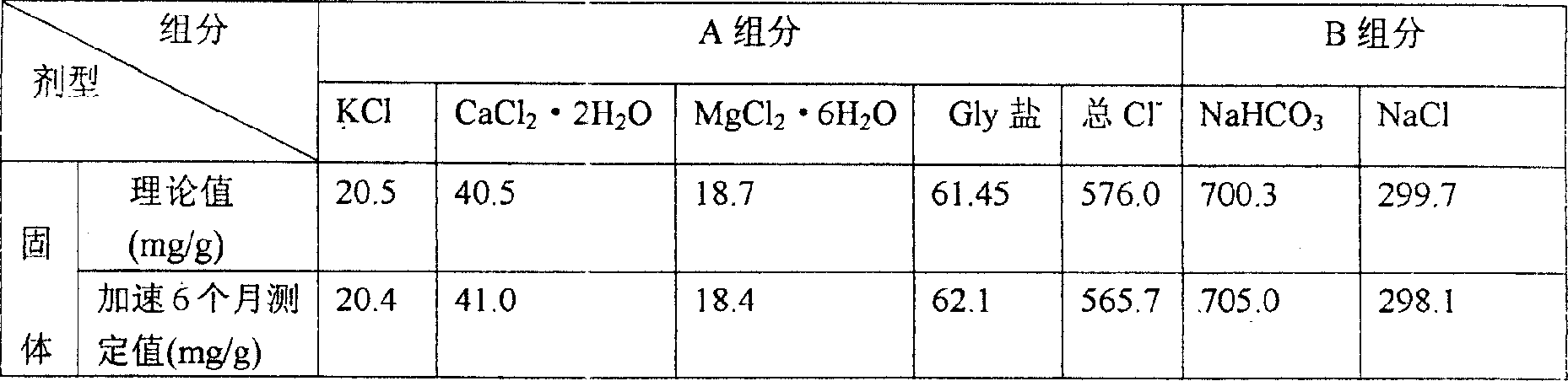
[0061] Take the formulation of Example 3 for stability test (accelerated for 6 months and long-term retention of samples for 12 months), the results are as follows:
[0062] Long-term retention sample 12
[0063] The above results show th...
PUM
 Login to View More
 Abstract
Description
Claims
Application Information
 Login to View More