Multi-ratio automatic transmission with independent rate of engagement and/or disengagement control of friction elements

A technology of transmission device and friction element, applied in the field of multi-speed automatic transmission device, can solve problems such as low efficiency

CN101133266AInactive Publication Date: 2008-02-27DSI HLDG PTY LTD
0 Cites 4 Cited by

Patent Information

Authority / Receiving Office
CN · China
Current Assignee / Owner
Publication Date
2008-02-27
Estimated Expiration
Not applicable · inactive patent

Smart Images

  • Figure 1
    Figure 1
  • Figure 2
    Figure 2
  • Figure 3
    Figure 3
Patent Text Reader

Abstract

A multi-ratio automatic transmission (10) for a vehicle, the transmission (10) having at least one planetary gear set (16, 18), a plurality of friction elements (C1, C2, C3, B1, B2) for coupling components of the planetary gear set (16, 18) between an input and an output of the transmission in different configurations so as to achieve a plurality of drive ratios, and a control system (26) for selectively engaging / disengaging the friction elements (C1, C2, C3, B1, B2) in different combinations to effect selection of the ratios, wherein rate of engagement and / or disengagement of one or more of the friction elements (C1, C2, C3, B1, B2) is controlled independently of the or each of the other friction element(s) (C1, C2, C3, B1, B2).
Need to check novelty before this filing date? Find Prior Art

Description

technical field

[0001] The present invention relates to a transmission, more particularly but not exclusively to a multi-speed automatic transmission for automobiles. Background technique

[0002] Automatic transmissions for automobiles are widely used in modern vehicles and are recognized for their convenience and ease of use. The trend toward such automatic transmissions is to generate more forward ratios for better acceleration and fuel economy. Early automatic transmissions had two forward ratios, with the ratios widely spaced for acceptable top speed capability when the engine coupled to the transmission was forced to rotate at higher speeds in first gear, Acceleration and fuel economy are limited. However, in recent years, automatic transmissions for automobiles have been developed with 3, 4, 5 and 6 forward ratios. With more forward ratios, the ratios are more closely spaced while still achieving good top speed capability, so that the engine can operate in a narrow...

Examples

Embodiment Construction

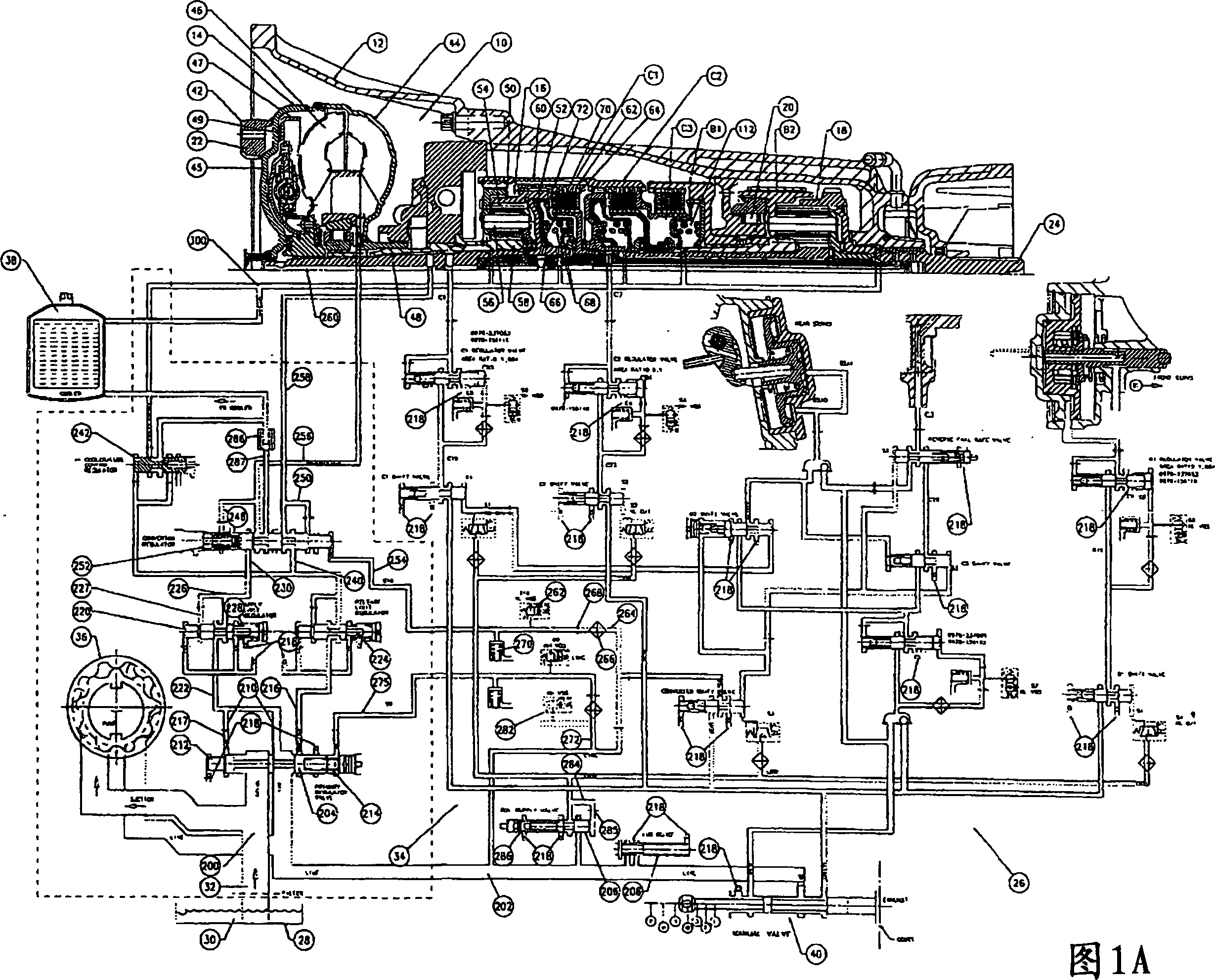
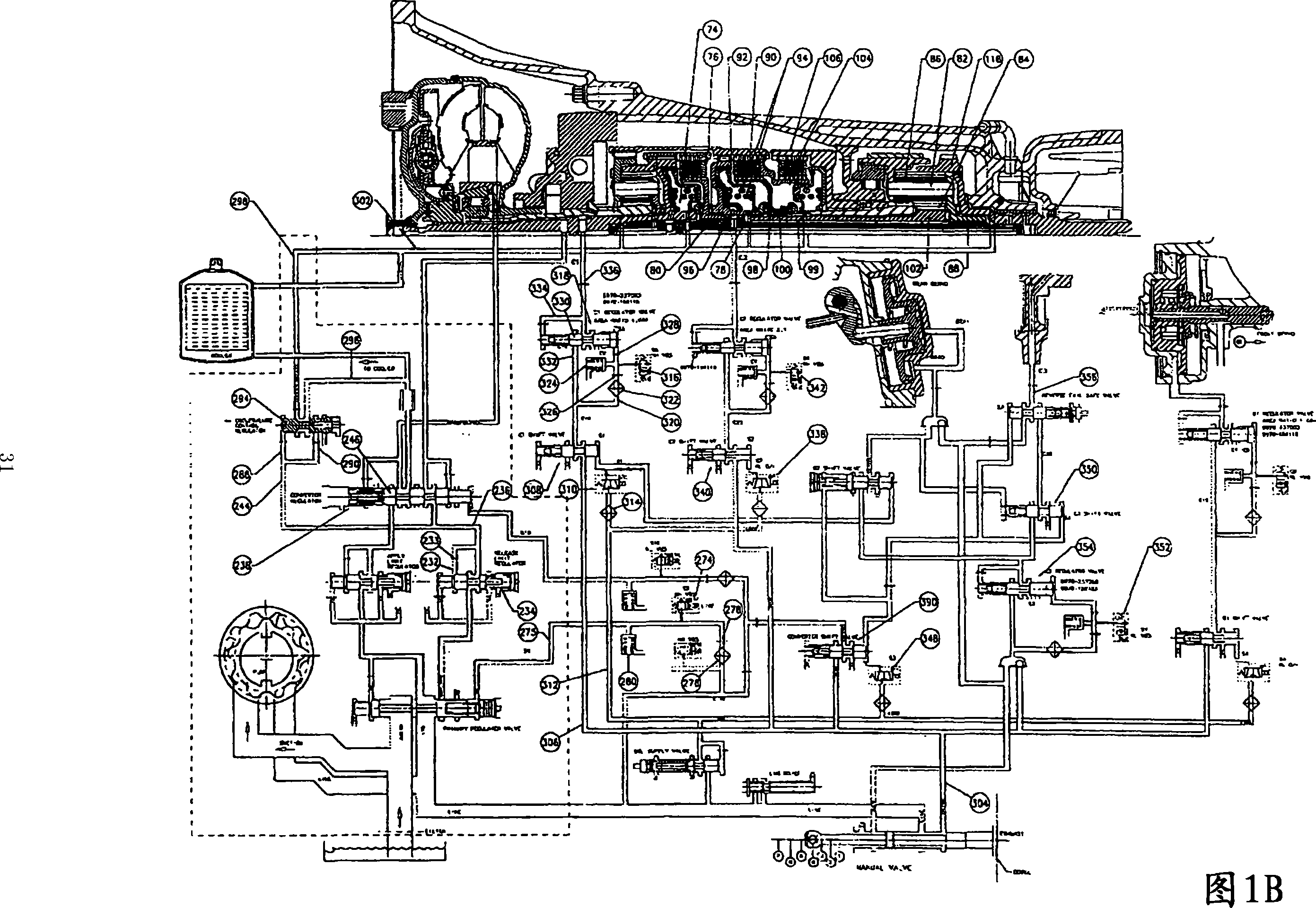
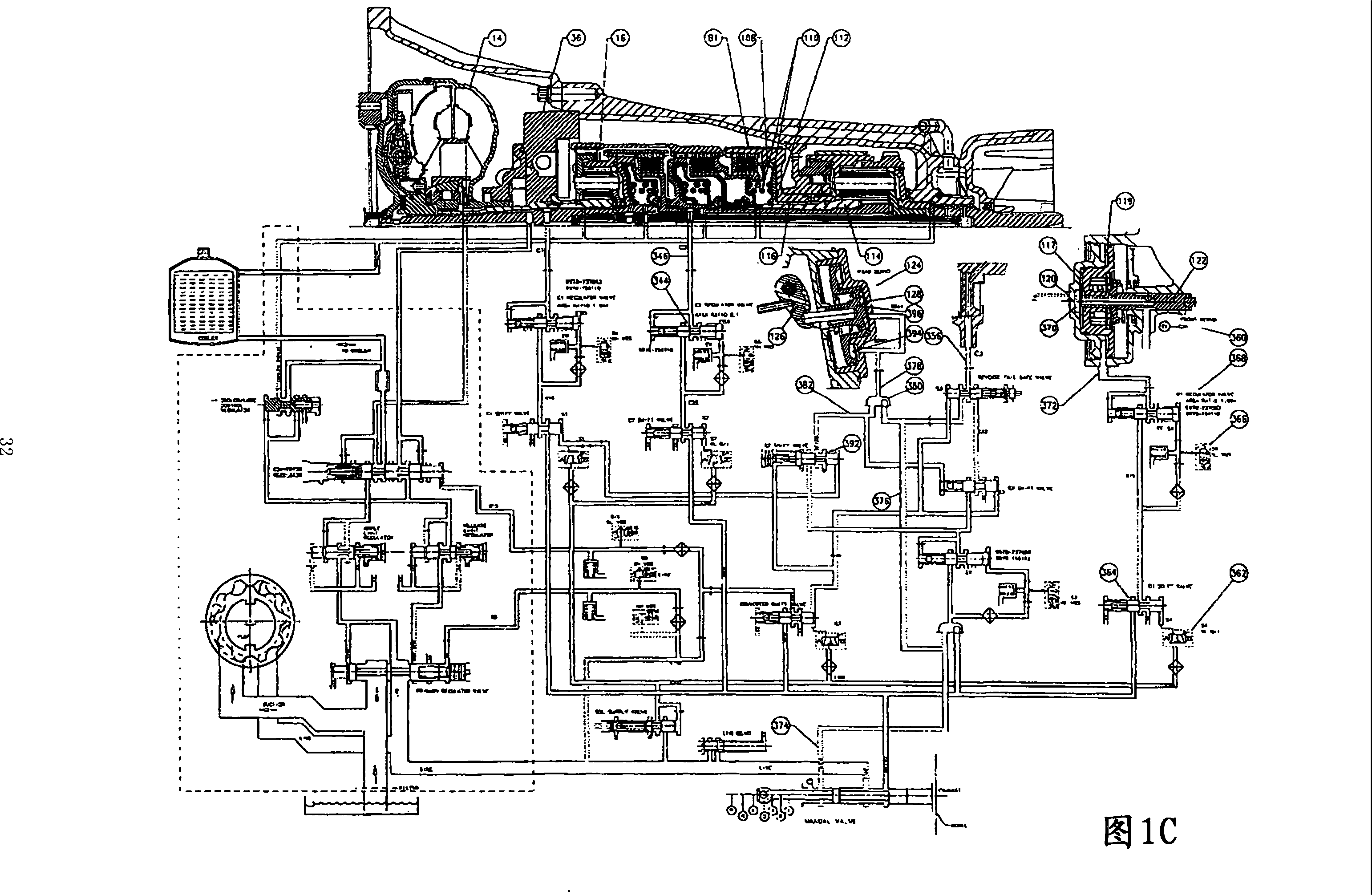
[0048] introduction

[0049] Referring to Figures 1A, 1B, 1C and 2A, an automatic transmission 10, especially for a rear-wheel drive vehicle, has a bell-shaped housing 12 in which a torque converter 14, three friction clutches C1, C2 are housed. and C3 , two braking bands B1 and B2 , a first simple planetary gear set 16 , a second Ravigneux-type planetary gear set 18 and a one-way clutch 20 . Since each of clutches C1 , C2 and C3 and brake bands B1 and B2 are friction elements (ie, used to selectively hold one portion relative to another by friction), transmission 10 has a total of five friction elements. The transmission 10 utilizes these mechanical components to transmit power at different ratios from the input 22 of the transmission 10 to the output 24 of the transmission 10 . The exemplary transmission shown in the drawings provides six forward gear ratios for forward propulsion of the vehicle and a reverse gear ratio and a neutral state for reverse propulsion of the vehi...