Check patentability & draft patents in minutes with Patsnap Eureka AI!

Subpixel registration

A sub-pixel, pixel technology, applied in the field of image registration, which can solve the problems of appearance, blurring of artifacts, high manufacturing cost, etc.

Active Publication Date: 2009-11-04
ADOBE INC
View PDF0 Cites 4 Cited by
  • Summary
  • Abstract
  • Description
  • Claims
  • Application Information

AI Technical Summary

Problems solved by technology

[0004] Although super-resolution images can be obtained by increasing the resolution of camera image sensors, higher resolution sensors also lead to higher manufacturing costs and greater shot noise
Also, increasing sensor chip size to accommodate a larger number of pixels results in increased capacitance, which reduces data transfer rates
Additionally, applying pixel-level registration between images during super-resolution image formation can lead to artifacts such as blurring and double features

Method used

the structure of the environmentally friendly knitted fabric provided by the present invention; figure 2 Flow chart of the yarn wrapping machine for environmentally friendly knitted fabrics and storage devices; image 3 Is the parameter map of the yarn covering machine
View more

Image

Smart Image Click on the blue labels to locate them in the text.
Viewing Examples
Smart Image
  • Subpixel registration
  • Subpixel registration
  • Subpixel registration

Examples

Experimental program
Comparison scheme
Effect test

Embodiment Construction

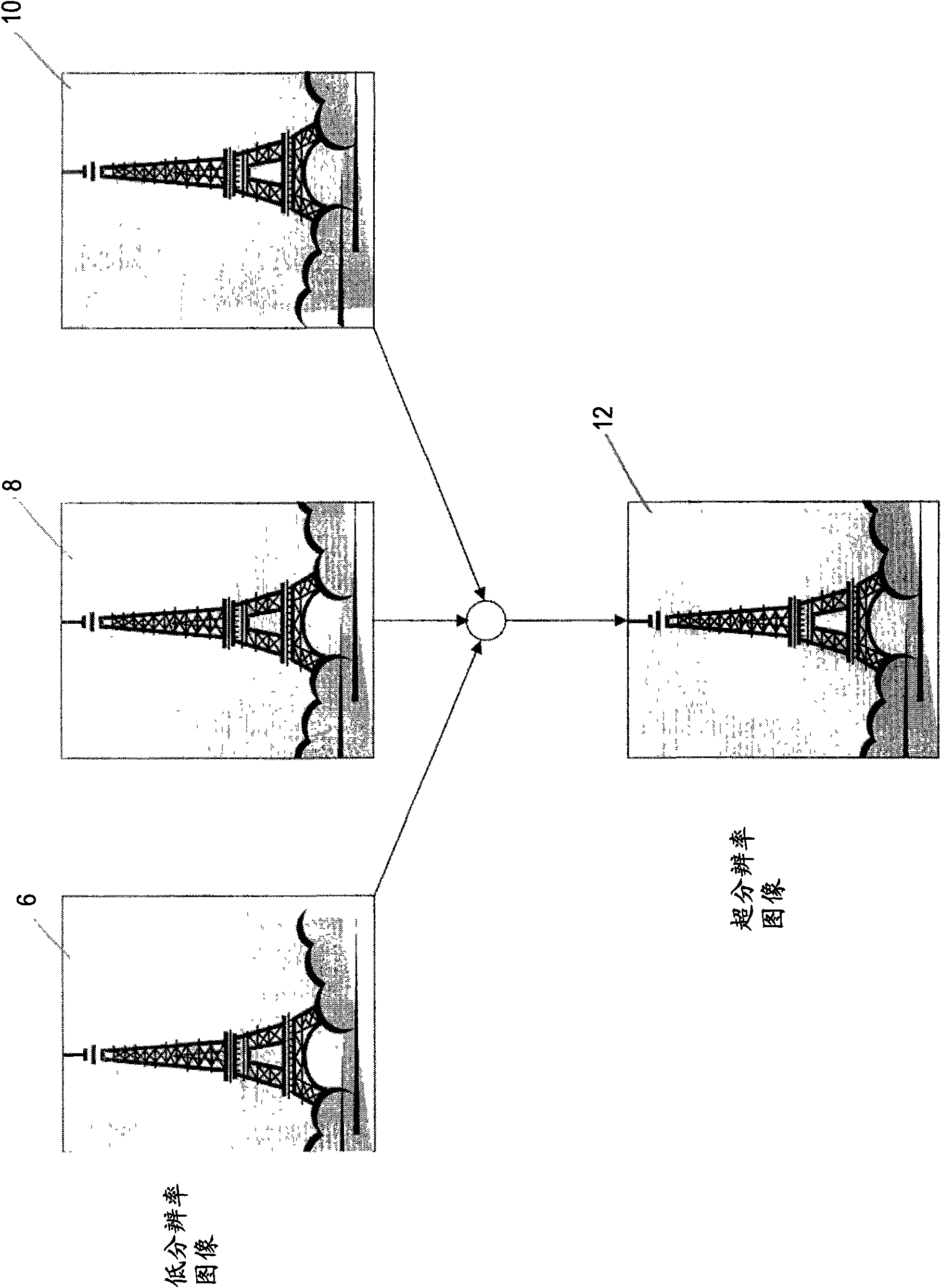
[0026] The term "super-resolution", also known as resolution enhancement, is used to describe the process of obtaining a high-resolution image or series of high-resolution images from a set of lower-resolution images. A variety of techniques exist for obtaining low-resolution images, including, for example, using multiple sensors to image a single scene, using a single sensor that captures multiple low-resolution images of a scene simultaneously, or using a single sensor to image a scene over a period of time .

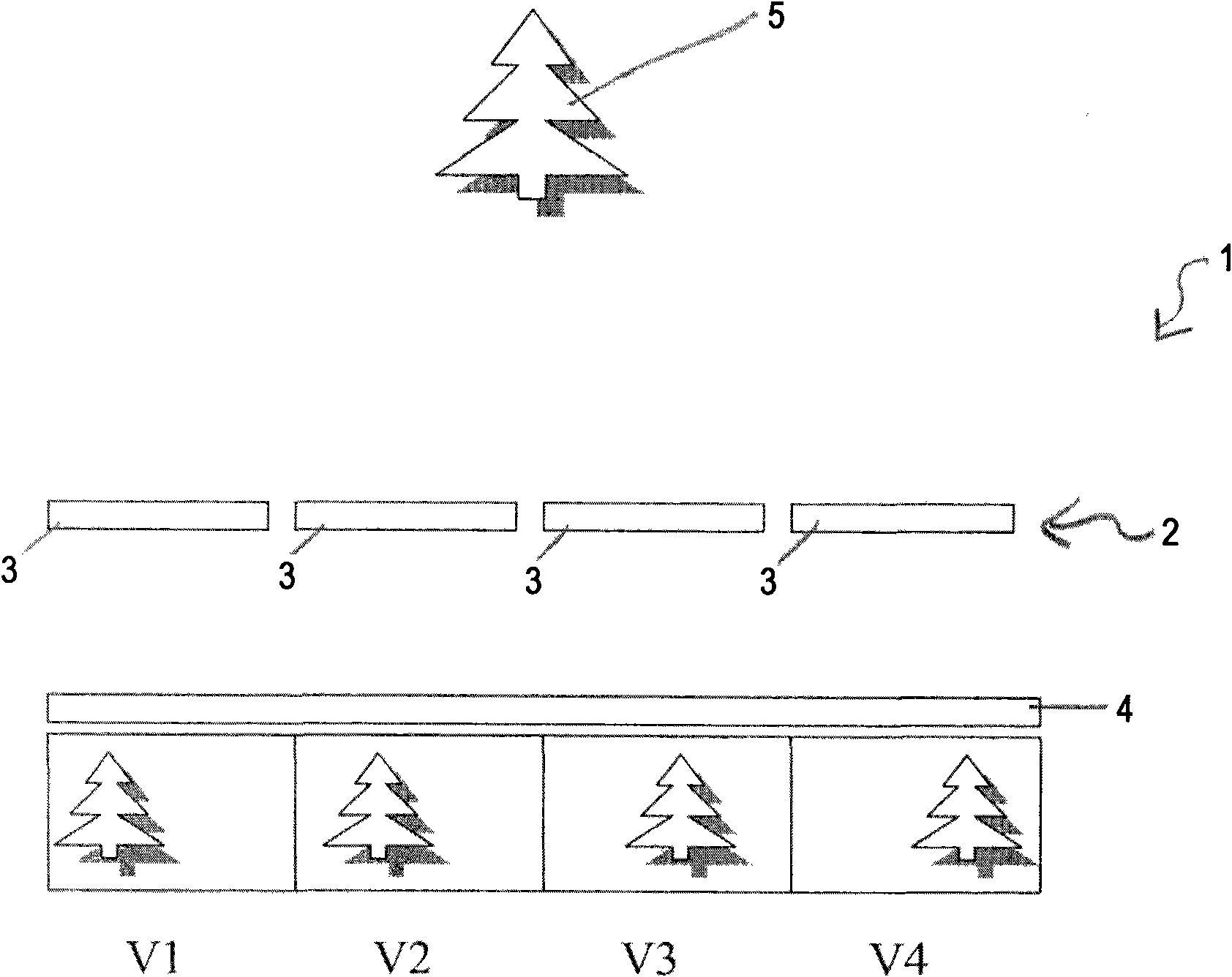
[0027] A specific type of camera known as a "light field camera" simultaneously captures multiple pictures of the same scene from slightly different perspectives. figure 1 An example of a light field camera 1 is shown. The camera 1 includes a microlens array 2 consisting of a plurality of microlenses 3 in front of a single image sensor 4 . The microlenses 3 are offset from each other so that each microlens captures a slightly different view of the scene 5 being phot...

the structure of the environmentally friendly knitted fabric provided by the present invention; figure 2 Flow chart of the yarn wrapping machine for environmentally friendly knitted fabrics and storage devices; image 3 Is the parameter map of the yarn covering machine
Login to View More

PUM

No PUM Login to View More

Abstract

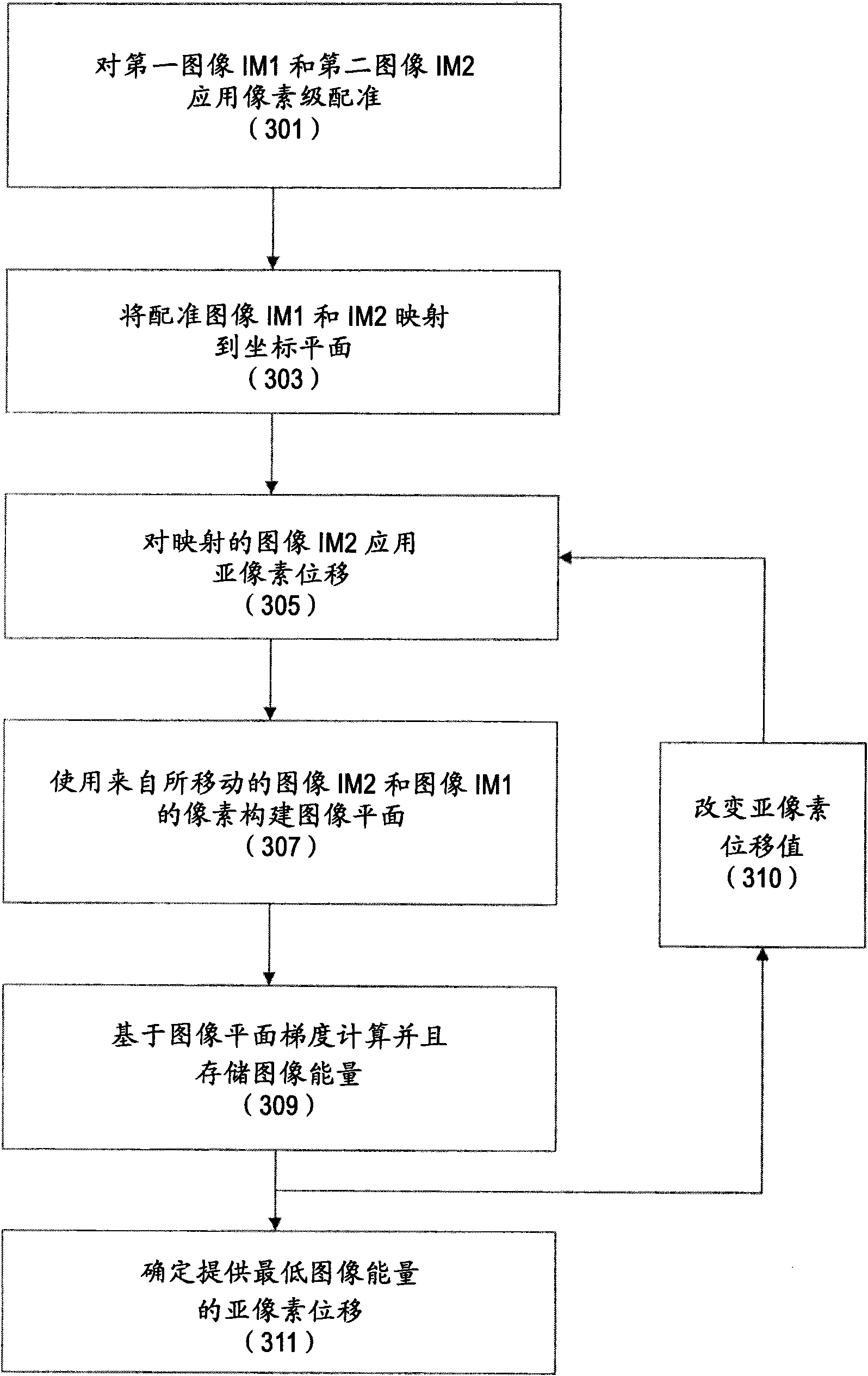
Sub pixel image alignment includes mapping first pixels from a first image and second pixels from a second image to a coordinate system and applying one or more sub-pixel shifts to the mapped first pixels. For each sub-pixel shift, an overall energy is calculated and is based on a plurality of gradients that represent changes in a channel value among the shifted first pixels and the mapped secondpixels. The sub-pixel alignment further includes determining the sub-pixel shift that provides the lowest overall energy.

Description

technical field [0001] The present invention relates to image registration technology, more particularly to a sub-pixel registration method and system. Background technique [0002] Robust image registration is one of the core problems of research in computer vision and the emerging field of computational photography (CP). Various robust image registration techniques now exist, and they are based on methods such as aligning features within an image or applying dense pixel-to-pixel correspondences. [0003] A general approach in computational photography is to take multiple photos of the same scene, each shot in a slightly different way, and then combine the images to produce a single photo. Some purposes for producing this final photo include, for example, refocusing the image or increasing the dynamic range of the photo in post-processing. In some cases, the purpose of CP is to produce a single super-resolution image based on multiple lower-resolution images. [0004] Al...

Claims

the structure of the environmentally friendly knitted fabric provided by the present invention; figure 2 Flow chart of the yarn wrapping machine for environmentally friendly knitted fabrics and storage devices; image 3 Is the parameter map of the yarn covering machine
Login to View More

Application Information

Patent Timeline
no application Login to View More
Patent Type & Authority Applications(China)
IPC IPC(8): G06T7/00
CPCG06T7/0026G06T3/4069G06T7/32
Inventor C·英特沃拉
Owner ADOBE INC
Features
  • R&D
  • Intellectual Property
  • Life Sciences
  • Materials
  • Tech Scout
Why Patsnap Eureka
  • Unparalleled Data Quality
  • Higher Quality Content
  • 60% Fewer Hallucinations
Social media
Patsnap Eureka Blog
Learn More