
Gene detection chip of OATP1B1 major gene mutation
A detection chip, an important technology, is applied in the determination/testing of microorganisms, chemical libraries, combinatorial chemistry, etc. It can solve the problems of unsystematic detection of gene chips and their technical solutions, and achieve simple and fast operation, reduce human errors, and manpower input little effect
- Summary
- Abstract
- Description
- Claims
- Application Information
AI Technical Summary
Problems solved by technology
Method used
Image

Examples
Embodiment 1
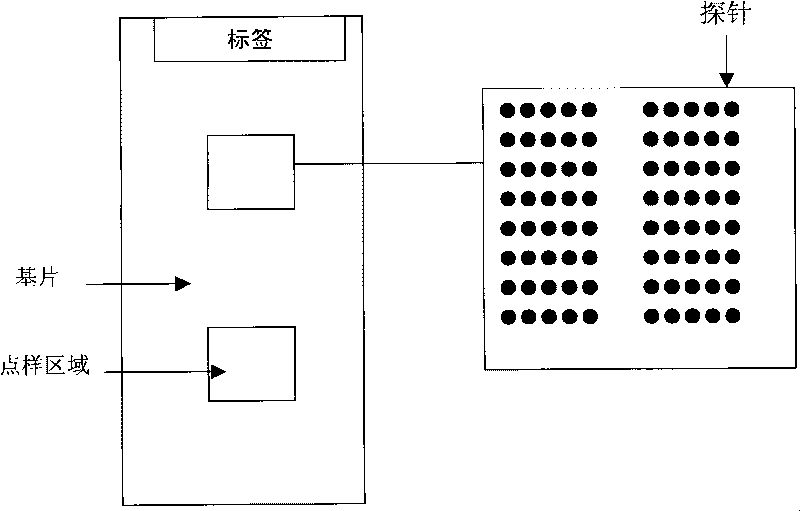
[0041] Example 1: Preparation of a chip detection system for OATP1B1 common mutation gene sites
[0042] 1. Detailed preparation process
[0043] 1.1. Substrate treatment: The substrate is made of glass medium, and the surface treatment method is aldehyde modification. The specific steps are:
[0044] 1. Selection of blank super-flat film: choose 76mm×25mm×1mm super-flat film, the error of its length and width does not exceed 0.2mm, the error of thickness does not exceed 0.1mm, no damage, no scratches on the surface;
[0045] 2. Ultra-flat sheet pretreatment: soak the ultra-flat sheet in the newly prepared potassium dichromate lotion, leave it for 7 days, wash it with deionized water, and dry it;
[0046] 3. Amination of ultra-flat slides: Prepare ethanol solutions of aminosilane with a concentration of 2%, immerse the slides in the above solutions for 15 minutes, take them out, wash them with deionized water, and dry them in the air;
[0047] 4. Aldehylation of super-flat ...
Embodiment 3
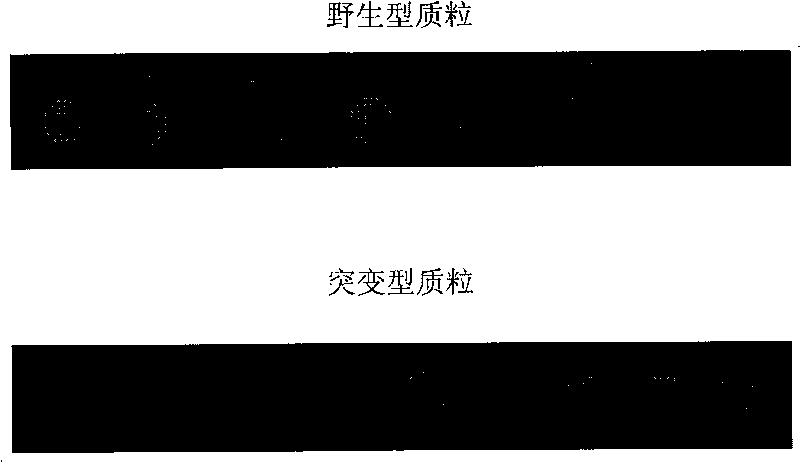
[0096] [Example 3] Comparison of hybridization effects of probes with different base numbers
[0097] In the present invention, when the probes of the sequences shown in Table 3 are actually used, a continuous 14-25 base sequence can be selected to synthesize the probe. The following experiments are designed to prove that the difference in the number of bases above does not affect the sensitivity of the results and specificity.
[0098] For the -11187G>A mutation of the OATP1B1 gene, the following mutant and normal probes of different lengths were synthesized:
[0099] Wild-type probe I (base sequence from 19th to 34th in SEQ ID NO.1, 15 bases in total)
[0100] 5'-GTATACA GTAAAAG-3'
[0101] Mutant probe I (19th to 34th base sequence of SEQ ID NO.3, 15 bases in total)
[0102] 5'-GTATACA GTAAAAG-3'
[0103] Wild-type probe II (17th to 36th base sequence of SEQ ID NO.1, 19 bases in total)
[0104] 5'-ATGTATACA GTAAAAGTG-3'
[0105] Mutant probe II (17th to 36th bas...
PUM
 Login to View More
 Abstract
Description
Claims
Application Information
 Login to View More