Light beam generator and digital holography device for hypervelocity holography

A technology for holography and photographic devices, which is applied to instruments, optics, nonlinear optics, etc., can solve the problems of complex adjustment of spectroscopic devices, difficult to accurately control the spatial azimuth angle and relative time delay of reference light, etc., and achieves simple structure and easy adjustment. , System reliability and high effect

CN101763019AInactive Publication Date: 2010-06-30SHENZHEN UNIV
0 Cites 9 Cited by

Patent Information

Authority / Receiving Office
CN · China
Patent Type
Applications(China)
Current Assignee / Owner
Publication Date
2010-06-30
Estimated Expiration
Not applicable · inactive patent

Smart Images

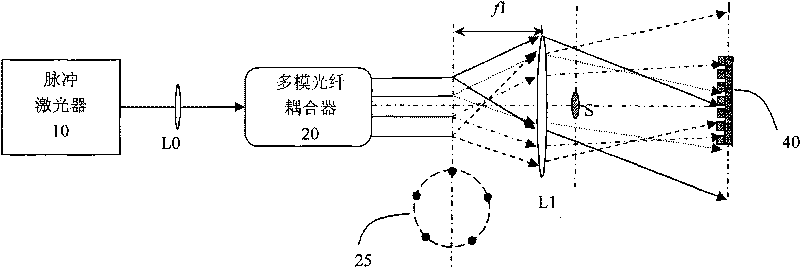
  • Figure 1
    Figure 1
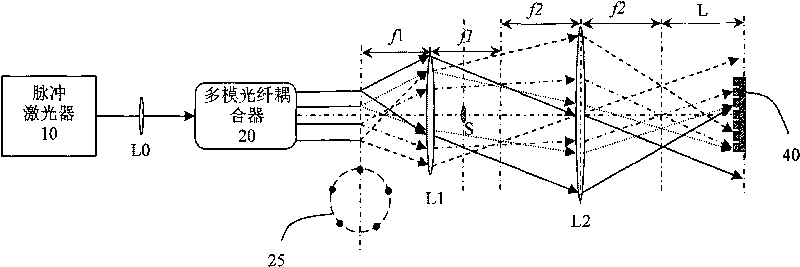
  • Figure 2
    Figure 2
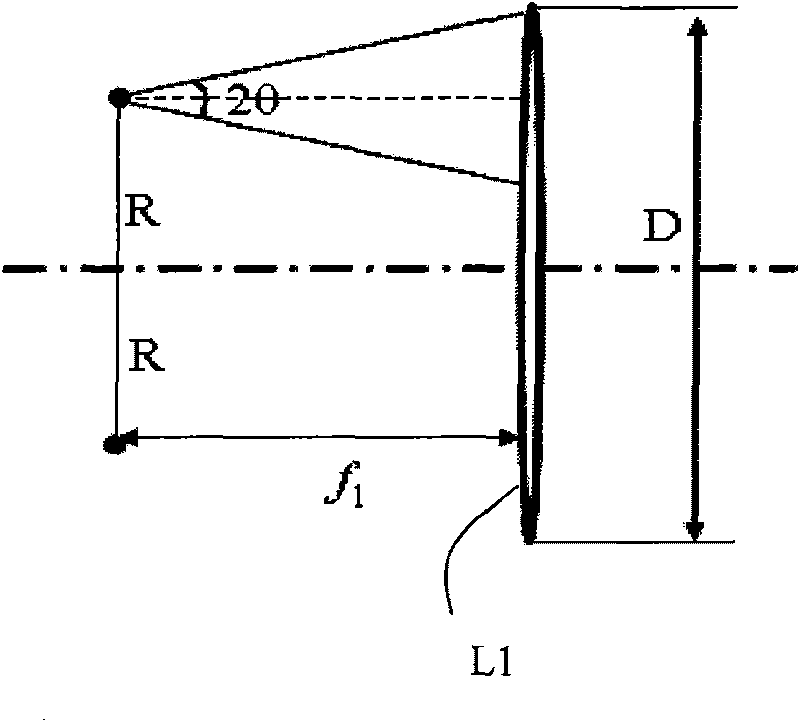
  • Figure 3
    Figure 3
Patent Text Reader

Abstract

The invention relates to a light beam generator and a digital holography device for hypervelocity holography. The light beam generator comprises a pulsed laser and a multi-mode fiber coupler, wherein the multi-mode fiber coupler comprises an odd number of output ends on the same plane, and the number of the output ends is the same as that of beam splitting laser pulses; the optical fiber length differences among all the output ends are determined on the basis of a preset relative time delay, and the positions of all the output ends on the plane are determined on the basis of a preset spatial orientation angular difference; and the arrangement of the output ends ensures that any two output ends do not form central symmetry. The digital holography device comprises the light beam generator and a subsequent optical system, wherein the subsequent optical system comprises a second lens and a photosensitive device. By implementing the invention, laser pulses having different spatial orientation angle codes and strictly controlled relative time delays can be conveniently obtained so as to form a plurality of hypervelocity holographic images, and the invention has simple and compact structure and high system stability and reliability.
Need to check novelty before this filing date? Find Prior Art

Description

Technical field

[0001] The present invention relates to laser holography, and more specifically, to a multi-frame digital holographic imaging device for extremely high-speed imaging. Background technique

[0002] Using the multi-parameter nature of holography and the parallelism of light waves, it is easy to realize the multi-frame encoding of extremely high-speed photography. Therefore, the realization of multi-frame extremely high-speed photography using the holographic principle is an important field of non-tube extremely high-speed technology, which has important academic significance and applications. prospect.

[0003] With the rapid development of ultrashort pulse laser technology and CCD technology, the use of ultrashort pulse digital holography to record and reproduce ultrafast dynamic processes has gradually shown its irreplaceable superiority. Using ultra-short pulse digital holography, the ultra-fast changing object field can be continuously exposed for multiple times ...

Examples

Embodiment Construction

[0031] In order to accurately characterize some ultra-fast processes, it is necessary to record as many sub-holograms as possible at precise time intervals at the moment of the event. An object of the present invention is to conveniently implement azimuth angle encoding to obtain as many sub-beams with different spatial angles as possible, and at the same time realize precise control of the optical delay between these beams with different spatial azimuth angles. In this way, if supplemented by ultra-short laser pulses, a "light ruler" with high time resolution and high precision sampling interval can be obtained, which can meet the need for high-precision imaging of ultra-fast changing objects.

[0032] The core of the present invention is to use a multi-mode fiber coupler to split the beam and realize the determined time delay between the object beams by controlling the optical path difference of each beam, thereby generating reference lights with accurate relative time delays an...