Negative electrode material for non-aqueous electrolyte secondary battery and non-aqueous electrolyte secondary battery using same

A non-aqueous electrolyte and secondary battery technology, applied in the direction of secondary batteries, battery electrodes, negative electrodes, etc., can solve the problems of low crystallinity of amorphous carbonaceous particles, increase of irreversible capacity of amorphous carbon particles, etc., and achieve rapid charging Effects of discharge characteristics, excellent performance, and high cycle characteristics

CN102362381BActive Publication Date: 2015-06-03MITSUBISHI RAYON CO LTD
6 Cites 3 Cited by

Patent Information

Authority / Receiving Office
CN · China
Patent Type
Patents(China)
Current Assignee / Owner
Publication Date
2015-06-03

Smart Images

  • Figure 1
    Figure 1
Patent Text Reader

Abstract

To provide a mixed carbon material used for an electrode of a nonaqueous secondary battery with excellent characteristics satisfying both rapid charge-discharge characteristics and high cycle characteristics. A negative electrode material for nonaqueous electrolyte secondary battery, comprising the following carbon material A and carbon material B: (Carbon material A) a multilayer-structure carbon material containing a graphitic particle and an amorphous carbon covering the surface of the graphitic particle, which is a carbon material where the interplanar spacing (d002) of 002 planes by the wide-angle X-ray diffraction method is 3.37 Å or less, Lc is 900 Å or more, the tap density is 0.8 g / cm 3 or more, and the Raman R value that is a ratio of the peak intensity near 1,360 cm -1 to the peak intensity near 1,580 cm -1 in the argon ion laser Raman spectrum, is from 0.25 to 0.6, (Carbon material B) a graphitic particle where the interplanar spacing (d002) of 002 planes by the wide-angle X-ray diffraction method is 3.37 Å or less, Lc is 900 Å or more, the tap density is 0.8 g / cm 3 or more, the Raman R value that is a ratio of the peak intensity near 1,360 cm -1 to the peak intensity near 1,580 cm -1 in the argon ion laser Raman spectrum, is from 0.2 to 0.5, and the average degree of circularity as determined by a flaw-type particle analyzer is 0.9 or more.
Need to check novelty before this filing date? Find Prior Art

Description

technical field

[0001] The present invention relates to a carbon material for a negative electrode of a non-aqueous electrolyte secondary battery. In addition, the present invention also relates to a negative electrode for a nonaqueous electrolyte secondary battery using the carbon material for a negative electrode, and a nonaqueous electrolyte secondary battery including the negative electrode. Background technique

[0002] A nonaqueous lithium secondary battery including a positive electrode and a negative electrode capable of occluding and releasing lithium ions, and a nonaqueous electrolyte in which lithium salts such as LiPF6 and LiBF4 are dissolved has been developed and put into practical use.

[0003] As the negative electrode material of this battery, various schemes have been proposed, but from the viewpoints of high capacity and excellent flatness of discharge voltage, artificial graphite obtained by graphitization of natural graphite, coke, etc., graphitized grap...

Examples

Embodiment 1

[0162] (Production of carbon material A)

[0163] As the raw material graphite, the following flaky graphite particles produced in nature were used: the interplanar distance (d002) of the 002 plane measured by the wide-angle X-ray diffraction method is Lc is Above, the tap density is 0.46g / cm 3 , 1360cm in the argon ion laser Raman spectrum -1 Nearby peak intensity and 1580cm -1 The ratio of nearby peak intensities, that is, the Raman R value is 0.13, the average particle size is 28.7μm, and the true density is 2.27g / cm 3 .

[0164] Using the Hybridization System manufactured by Nara Machinery Manufacturing Co., Ltd., the above-mentioned flaky graphite particles were continuously processed at a processing speed of 20 kg / hour under the condition of a rotor peripheral speed of 60 m / s and 10 minutes. The spheroidization process was performed while applying damage to the surface of the graphite particles. Then, fine powder is removed by performing classification treatment....

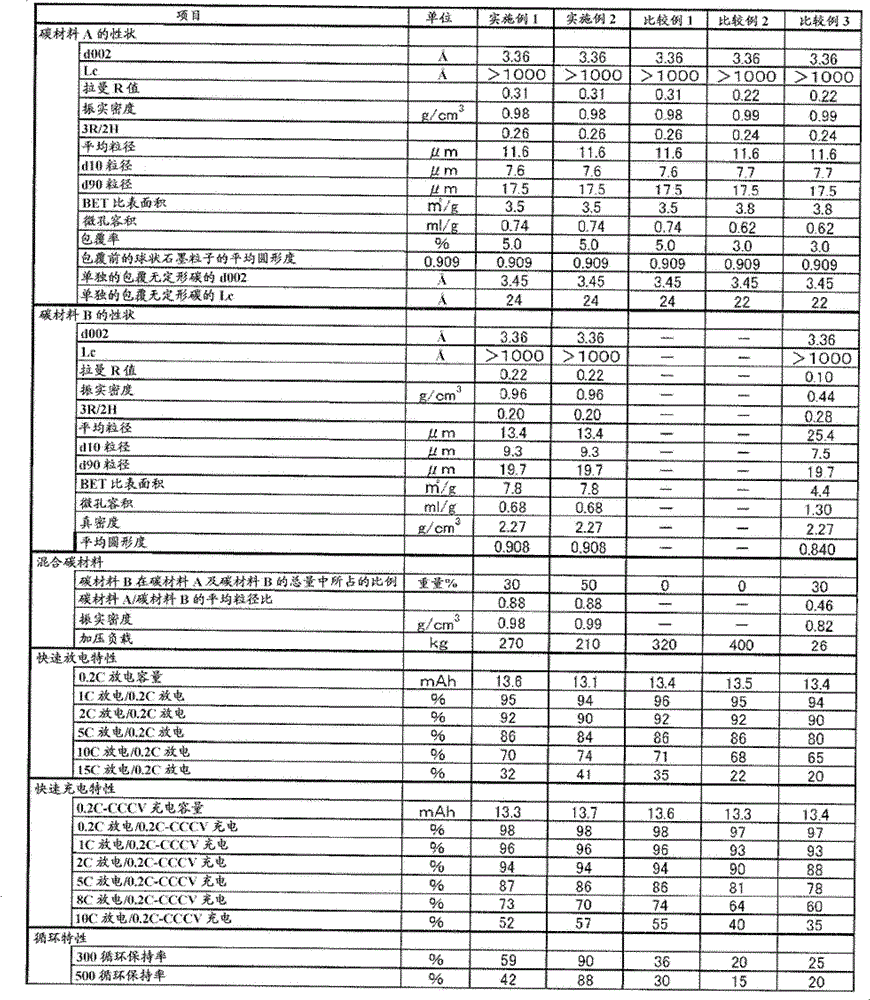
Embodiment 2

[0187] The same operation as in Example 1 was carried out except that the ratio of the carbon material B to the total amount of the carbon material A and the carbon material B was 50% by weight. The results are shown in Table 1.