Preparation method for artificial antigen of erythrosin pigment

An artificial antigen, erythrosine technology, applied in the preparation method of peptides, chemical instruments and methods, animal/human proteins, etc., to achieve the effect of concise synthesis steps

CN102408479AActive Publication Date: 2012-04-11MEIZHENG BIO TECH CO LTD
2 Cites 3 Cited by

Patent Information

Authority / Receiving Office
CN · China
Patent Type
Applications(China)
Current Assignee / Owner
Publication Date
2012-04-11

Smart Images

  • Figure 1
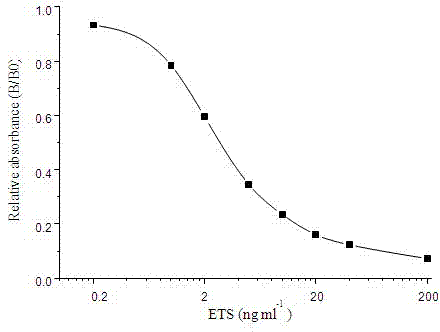
    Figure 1
  • Figure 2
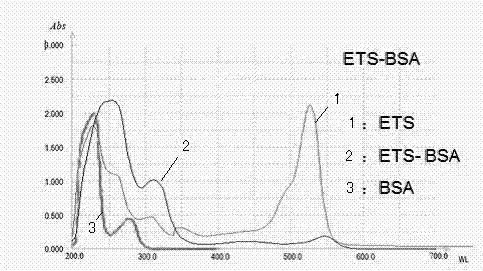
    Figure 2
  • Figure 3
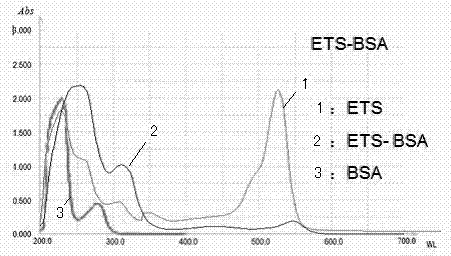
    Figure 3
Patent Text Reader

Abstract

The invention discloses a preparation method for artificial antigen of erythrosin pigment and belongs to the technical field of biochemical engineering. Erythrosin derivant ETS is used as a hapten and is conjugated with a carrier protein-BSA (Bovine Serum Albumin) through an active ester method to obtain the artificial antigen of erythrosine which is erythrosin derivant ETS-BSA; and the conjugating ratio of a conjugate is determined through an ultraviolet scanner. The preparation method for artificial antigen of erythrosin pigment can be used for successfully synthesizing the antigen of erythrosin derivant ETS, has simple and effective synthesis steps, can be completely used in immunoassay, provides necessary artificial antigen for further study of people and can satisfy the domestic study demands on the artificial antigen.
Need to check novelty before this filing date? Find Prior Art

Description

technical field

[0001] The invention discloses a method for preparing an artificial antigen of erythrosin, which belongs to the technical field of biochemical industry. Background technique

[0002] Erythrosine, the English name is: Erythrosine, and its chemical name is: spiroisobenzofuran-1(3H),9'-[9H]xanthene-3-one-3',6'-dihydroxy-2' ,4',5',7'-tetraiododisodium salt, also known as tetraiodofluorescein B, CAS No. 568-63-8, molecular formula is C 20 h 6 I 4 Na 2 o 5 . Erythrosine is a kind of synthetic pigment with bright color, which is often used in food processing products and beverages to improve its sensory properties. Food colorants can be divided into two categories: natural pigments and synthetic pigments. Synthetic pigments are widely used in the food processing industry because of their low cost, diverse tones, bright colors and strong tinting strength. Because synthetic pigments use chemical products such as benzene, toluene, and naphthalene as raw material...

Examples

Embodiment 1

[0022] (1) Preparation of hapten

[0023] Take 88mg (0.1mmol) of erythrosine and 0.11mmol of hydrochloric acid and react in the dark for 6h in an aqueous solution, centrifuge to get the precipitate and dilute it with N,N-dimethylformamide DMF, then add 0.5mL of 0.1mmol hexaaminocaproic acid and 0.15 mmol carbodiimide EDC and 0.15 mmol N-hydroxysulfosuccinimide Sulf-NHS were reacted in the dark for 24 hours, and the supernatant was collected by centrifugation to obtain the erythrosine derivative ETS.

[0024] (2) Preparation of artificial antigen

[0025] Take 0.5 mL of N,N-dimethylformamide DMF solution containing 20 mg (0.02398 mmol) of erythrosine derivative ETS into a brown vial, and then add 15.52 mg (0.06807 mmol) of N-hydroxysulfosuccinimide Sulf -NHS and 17.32mg (0.09033 mmol) carbodiimide EDC, reacted at room temperature for 8h, and it was liquid A. Dissolve 32.5mg (0.0005mmol) of bovine serum albumin BSA into 0.01M, pH7.4 phosphate PBS buffer solution, which is liquid...