
Nano hybrid of cytarabine/layered double-metal hydroxides and preparation process of nano hybrid
A nano-hybrid, layered bimetallic technology, applied in the direction of pharmaceutical formulations, drug combinations, medical preparations of non-active ingredients, etc., can solve the problem of losing anti-tumor activity, achieve good sustained-release effect, mild conditions, and easy preparation The effect of simple method
- Summary
- Abstract
- Description
- Claims
- Application Information
AI Technical Summary
Problems solved by technology
Method used
Image

Examples
Embodiment 1
[0045] Step a: 10.26g (0.040mol) Mg(NO 3 ) 2 ·6H 2 O and 7.50g (0.020mol) Al(NO 3 ) 3 9H 2 O was dissolved in 120ml deionized water.
[0046] Step b: Dissolve 0.69 g of SDS in 120 ml of deionized water.
[0047] Step c: Dissolve 2.4g of NaOH in 120ml of deionized water.
[0048] Step d: Dissolve 5.59 g of cytarabine in 50 ml of deionized water.
[0049] Step e: Add the solution of step a and the solution of step c to the solution of step b at the same time, stir and control the pH to 10, the reaction temperature is 65°C, stir and react for 24 hours; filter, wash with water until neutral, filter cake at 80°C Peptization for 24 hours to obtain SDS-modified LDHs;
[0050] f. Disperse 0.2 g of the SDS-modified LDHs solid obtained in step e into the solution in step d, mix thoroughly, and react at 65° C. for 2 days to obtain a cytarabine / LDHs nanohybrid.
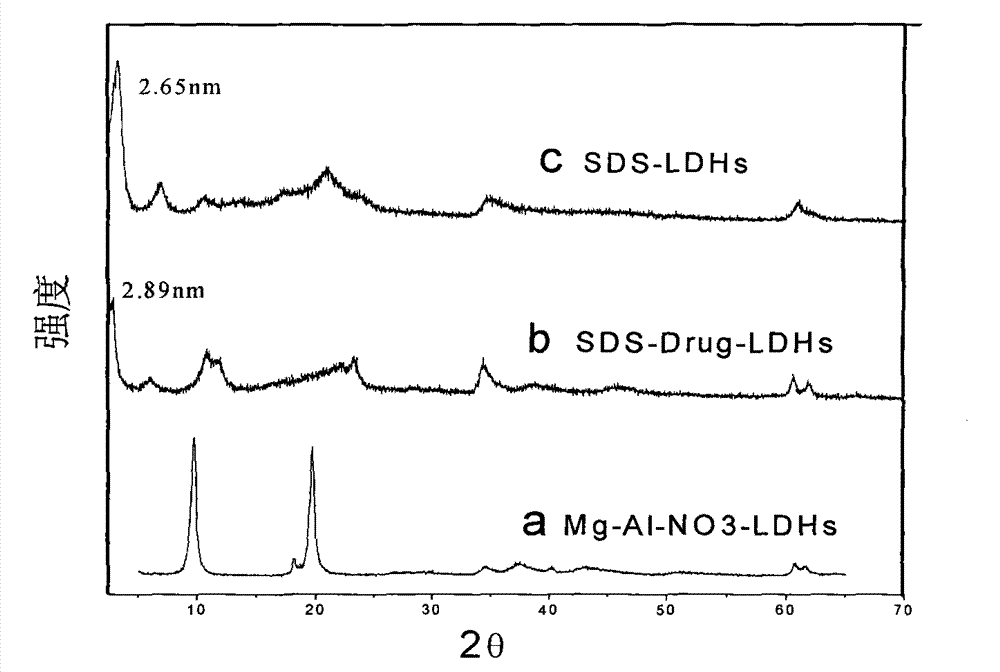
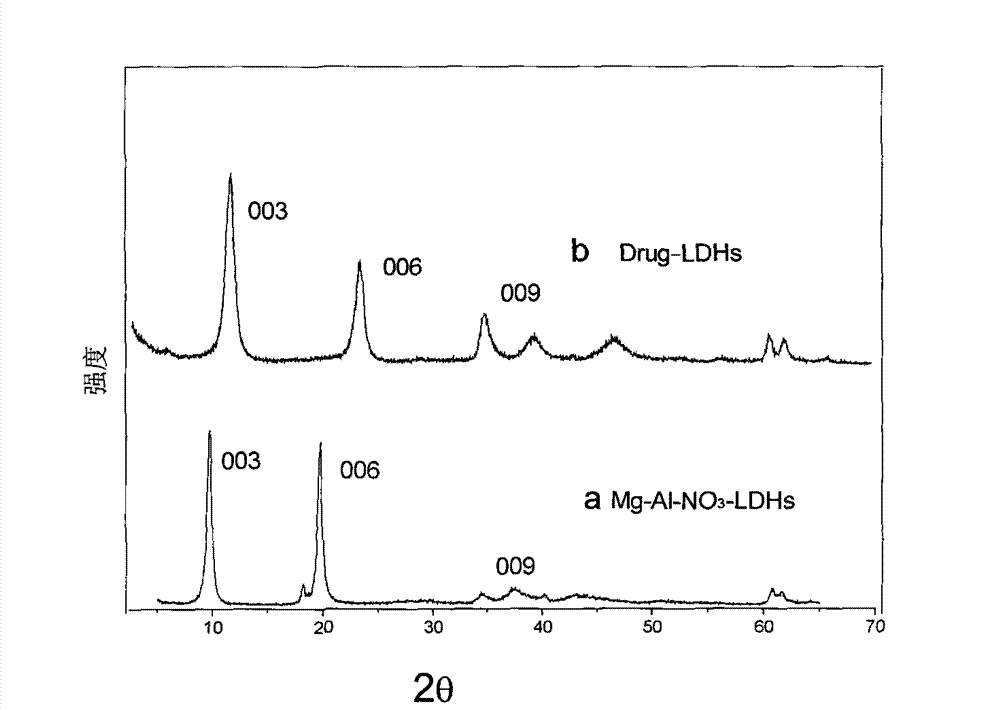
[0051] By XRD spectrum ( figure 1 ) shows that the cytarabine / LDHs nano-hybrid has a layered crystal structure, and t...
Embodiment 2
[0054] Step a: 0.030mol of Ni(NO 3 ) 2 ·6H 2 O and 0.010mol Fe(NO 3 ) 3 9H 2 O was dissolved in 40ml deionized water.
[0055] Step b: Dissolve 0.60 g of SDS in 40 ml of deionized water.
[0056] Step c: Dissolve 4.0 g of NaOH in 40 ml of deionized water.
[0057] Step d: Dissolve 11.18 g of cytarabine in 50 ml of deionized water.
[0058] Step e: Add the solution of step a and the solution of step c to the solution of step b at the same time, stir and control the pH to 11, the reaction temperature is 45°C, stir and react for 36 hours; filter, wash with water until neutral, filter cake at 80°C Peptization for 24 hours to obtain SDS-modified LDHs;
[0059] f. Disperse 0.2 g of the SDS-modified LDHs solid obtained in step e into the solution in step d, mix thoroughly, and react at 45° C. for 4 days to obtain a cytarabine / LDHs nanohybrid.
[0060] The sample was analyzed by ultraviolet spectrophotometry, and the content of cytarabine was determined to be 45.63%.
Embodiment 3
[0062] Step a: 0.010mol of ZnCl 2 ·6H 2 O and 0.010mol AlCl 3 ·6H 2 O was dissolved in 35ml deionized water.
[0063] Step b: Dissolve 0.11 g of SDS in 40 ml of deionized water.
[0064] Step c: Dissolve 1.6 g of NaOH in 40 ml of deionized water.
[0065] Step d: 2.79 g of cytarabine was dissolved in 50 ml of deionized water.
[0066] Step e: Add the solution of step a and the solution of step c to the solution of step b at the same time, stir and control the pH to 9, the reaction temperature is 20°C, stir and react for 20 hours; filter, wash with water until neutral, filter cake at 80°C Peptization for 24 hours to obtain SDS-modified LDHs;
[0067] f. Disperse 0.2 g of the SDS-modified LDHs solid obtained in step e into the solution in step d, mix thoroughly, and react at 25° C. for 3 days to obtain a cytarabine / LDHs nanohybrid.
[0068] The sample was analyzed by ultraviolet spectrophotometry, and the content of cytarabine was determined to be 1.05%.
PUM
 Login to View More
 Abstract
Description
Claims
Application Information
 Login to View More