A method of eliminating Plutella xylostella through the expansion and field release of Plutella xylostella

A technology for the wasp and diamondback moth, which is applied in the field of proliferation and field release of the wasp, can solve the problems of killing and injuring beneficial microorganisms, high cost, large killing of natural enemies, etc., and achieves the benefits of continuous control, broad development prospects, and release costs. low effect

CN103168750BInactive Publication Date: 2015-08-12INST OF AGRI ENVIRONMENT & RESOURCES YUNNAN ACAD OF AGRI SCI
2 Cites 0 Cited by

Patent Information

Authority / Receiving Office
CN · China
Patent Type
Patents(China)
Current Assignee / Owner
Publication Date
2015-08-12
Estimated Expiration
Not applicable · inactive patent

Smart Images

  • Figure 1
    Figure 1
Patent Text Reader

Abstract

The invention relates to a method of reducing amount of plutella xylostella by using cotesia plutellae. The method of reducing the amount of the plutella xylostella by using the cotesia plutellae plays a part in extinction of the plutella xylostella through eclosion, parasitism and field release of the cotesia plutellae. The method of reducing the amount of the plutella xylostella by using the cotesia plutellae has the advantages of being ecologically environment-friendly, avoiding damage of agriculture to the environment, being efficient and economical in extinction effect to the plutella xylostella, and being applicable to large-scale utilization in the agriculture.
Need to check novelty before this filing date? Find Prior Art

Description

technical field

[0001] The invention relates to a method for multiplying and releasing the Plutella xylostella in the field, in particular to a method for propagating the Plutella xylostella xylostella with larvae of the diamondback moth as hosts and releasing them to the field to eliminate the Plutella xylostella. Background technique

[0002] Diamondback moth: Lepidoptera Plutella, English name: Diamondback moth; scientific name: Plutella xylostella (L.); alias: small caterpillar, two pointed. It is a worldwide migratory pest and mainly damages Brassicaceae plants such as cabbage, purple cabbage, broccoli, mustard greens, cauliflower, cabbage, rape, and radish. Damage characteristics: The young larvae only eat the mesophyll, leaving the epidermis, forming transparent spots on the vegetable leaves, "opening the skylight", the 3rd-4th instar larvae can eat the vegetable leaves into holes and nicks, and in severe cases, the whole leaf is eaten into mesh. In the seedling sta...

Examples

Embodiment 1

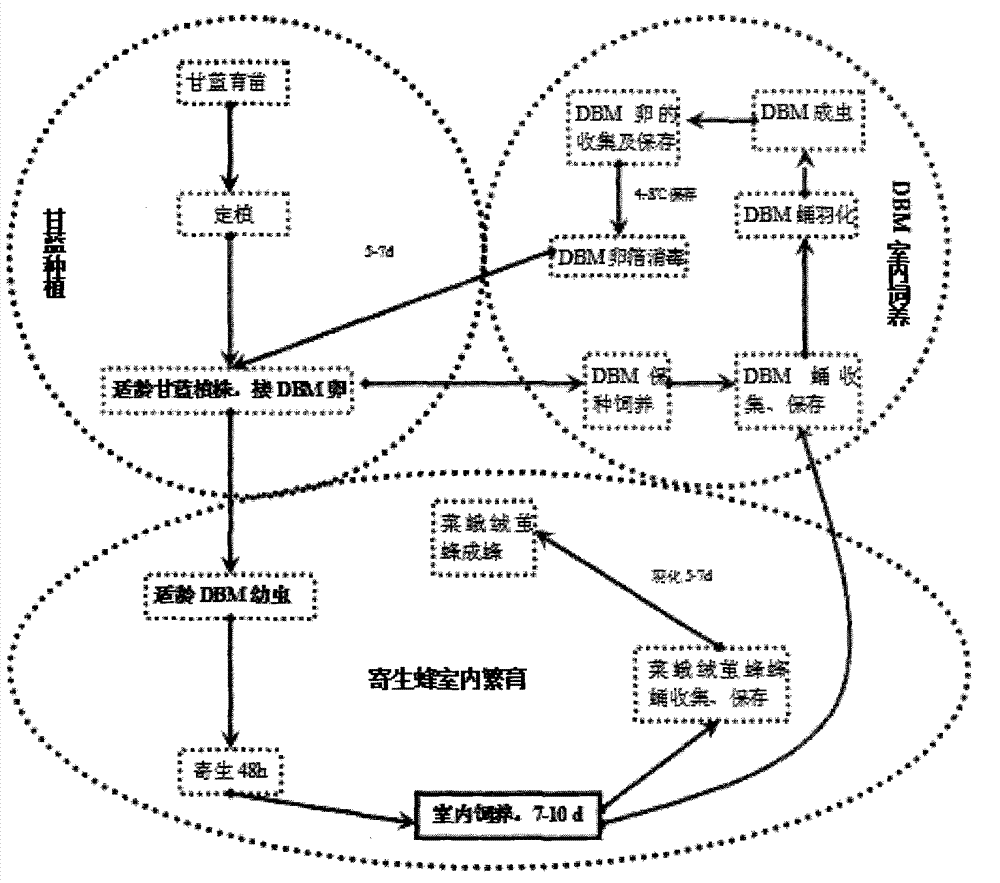
[0061] In the present embodiment, the indoor breeding of Plutella xylostella is shown in Figure 1.

[0062] 1. Materials:

[0063] Plutella xylostella: collected in the field for indoor multi-generation breeding.

[0064] Plutella xylostella: collected in the field for multi-generation breeding indoors.

[0065] 2. Instruments and equipment

[0066] 2.1 Insect room, insect rack with light source, insect cage

[0067] Insect breeding room: It is required to keep warm, moisturize, have bright and uniform light, and facilitate ventilation. The roof should have a ceiling and north-south windows. The layout of the insect rearing room should be determined according to the number of rearing. There are insect racks with light sources on both sides of the room. The size is 140×45×200cm. Each insect rack has 4 layers, and the height of each layer is 40-45cm.

[0068] Pest cage: wooden frame, size 35×35×35cm, top and bottom glass or plastic boards, and 40-mesh sand net on the other ...