
Compound bactericide and algicide
A technology of bactericidal algaecide and surfactant, applied in the direction of herbicides, algaecides, biocides, biocides, etc., can solve the problem that algae and slime have no obvious effect, the pH value of water has a great influence, and the efficacy of medicine Short duration and other problems, to achieve the effect of good slime peeling effect, wide pH value and temperature range, and long duration of drug effect
- Summary
- Abstract
- Description
- Claims
- Application Information
AI Technical Summary
Problems solved by technology
Method used
Image

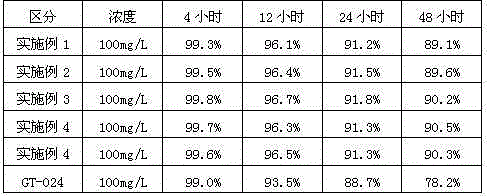
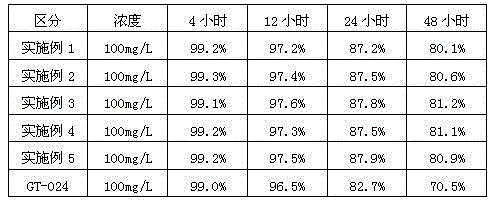
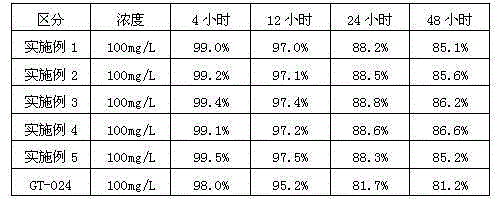
Examples
Embodiment 1
[0015] Example 1: Add 35 parts of methylisothiazolinone, 6 parts of glutaraldehyde, and 300 parts of deionized water into the preparation kettle and stir at room temperature for 12 minutes; add 10 parts of didodecyldimethylammonium chloride , Add 5 parts of diffusing agent NNO into the blending kettle, stir for 12 minutes; raise the temperature of the blending kettle to 80°C, add 15 parts of dithiocyanomethane powder, 2,2-dibromo-3-nitrilopropionamide powder Add 40 parts and 3 parts of fumed silica into the preparation kettle, and stir for 30 minutes to obtain the product.
Embodiment 2
[0016] Example 2: 20 parts of methylisothiazolinone, 12 parts of glutaraldehyde, and 200 parts of deionized water were added to the preparation kettle and stirred at room temperature for 8 minutes; 5 parts of didodecyldimethylammonium chloride , Add 3 parts of diffusing agent NNO into the blending kettle, stir for 8 minutes; raise the temperature of the blending kettle to 80°C, add 30 parts of dithiocyanomethane powder, 2,2-dibromo-3-nitrilopropionamide powder Add 30 parts and 4 parts of fumed silica into the preparation kettle, and stir for 20 minutes to obtain the product.
Embodiment 3
[0017] Example 3: 25 parts of methylisothiazolinone, 8 parts of glutaraldehyde, and 252 parts of deionized water were added to the preparation kettle and stirred at room temperature for 10 minutes; 8 parts of didodecyldimethylammonium chloride , Add 4 parts of diffusing agent NNO into the blending kettle, stir for 10 minutes; raise the temperature of the blending kettle to 80°C, add 20 parts of dithiocyanomethane powder, 2,2-dibromo-3-nitrilopropionamide powder Add 35 parts and 3 parts of fumed silica into the blending kettle and stir for 25 minutes to obtain
PUM
 Login to View More
 Abstract
Description
Claims
Application Information
 Login to View More