Key structure

A key and keycap technology, applied in electrical components, electrical switches, circuits, etc., can solve the problems of key structure volume limitation, complex bracket structure, and difficulty in applying thin keyboards, so as to save operation space and improve stability. sexual effect

CN104332339AActive Publication Date: 2015-02-04DARFON ELECTRONICS (SUZHOU) CO LTD +1
7 Cites 6 Cited by

Patent Information

Authority / Receiving Office
CN · China
Current Assignee / Owner
Publication Date
2015-02-04

Smart Images

  • Figure 1
    Figure 1
  • Figure 2
    Figure 2
  • Figure 3
    Figure 3
Patent Text Reader

Abstract

The invention relates to a key structure. The key structure comprises a base, a key cap and a sliding part mechanism arranged between the base and the key cap. The key cap and the sliding part mechanism act interactively to enable the key cap to move vertically relative to the base. The sliding part mechanism is in moving connection with the key cap through a sliding part containing a magnetic portion and interacts with a magnetic portion arranged on the base to generate magnetic attraction force which serves as the return force for the return of the key cap. The sliding part mechanism can also be in moving connection with the key cap through two relatively moving sliding parts, each of which comprises a magnetic portion. The two magnetic portions interact with each other to generate magnetic force to serve as the return force for the return of the key cap. Further, the key cap can be forced to descend by moving the sliding part, so that the key structure can be stored conveniently. According to the key structure, both the key cap actuation stability and enough press feedback feel are provided, and the dilemma of current keyboard design in the prior art is overcome effectively.
Need to check novelty before this filing date? Find Prior Art

Description

technical field

[0001] The present invention relates to a key structure, in particular to a mechanical key structure. Background technique

[0002] The general button structure usually provides a mechanism for the keycap to move up and down through a cross-connected bracket, and an elastic member (such as a silicone knob) is provided under the keycap to provide a restoring force for the keycap to drive the keycap back to its original position. (i.e. position when not pressed). The bracket and the elastic member are usually configured in a compact manner to reduce the space required for the button structure. However, since the bracket is cross-connected and the silicone round protrusions are disposed therebetween, the bracket structure has a certain structural complexity. In addition, the silicone knob needs to have a considerable structural volume to provide the user with sufficient pressing feedback (ie, the reaction force felt by the user when pressing), so that the requi...

Examples

Embodiment Construction

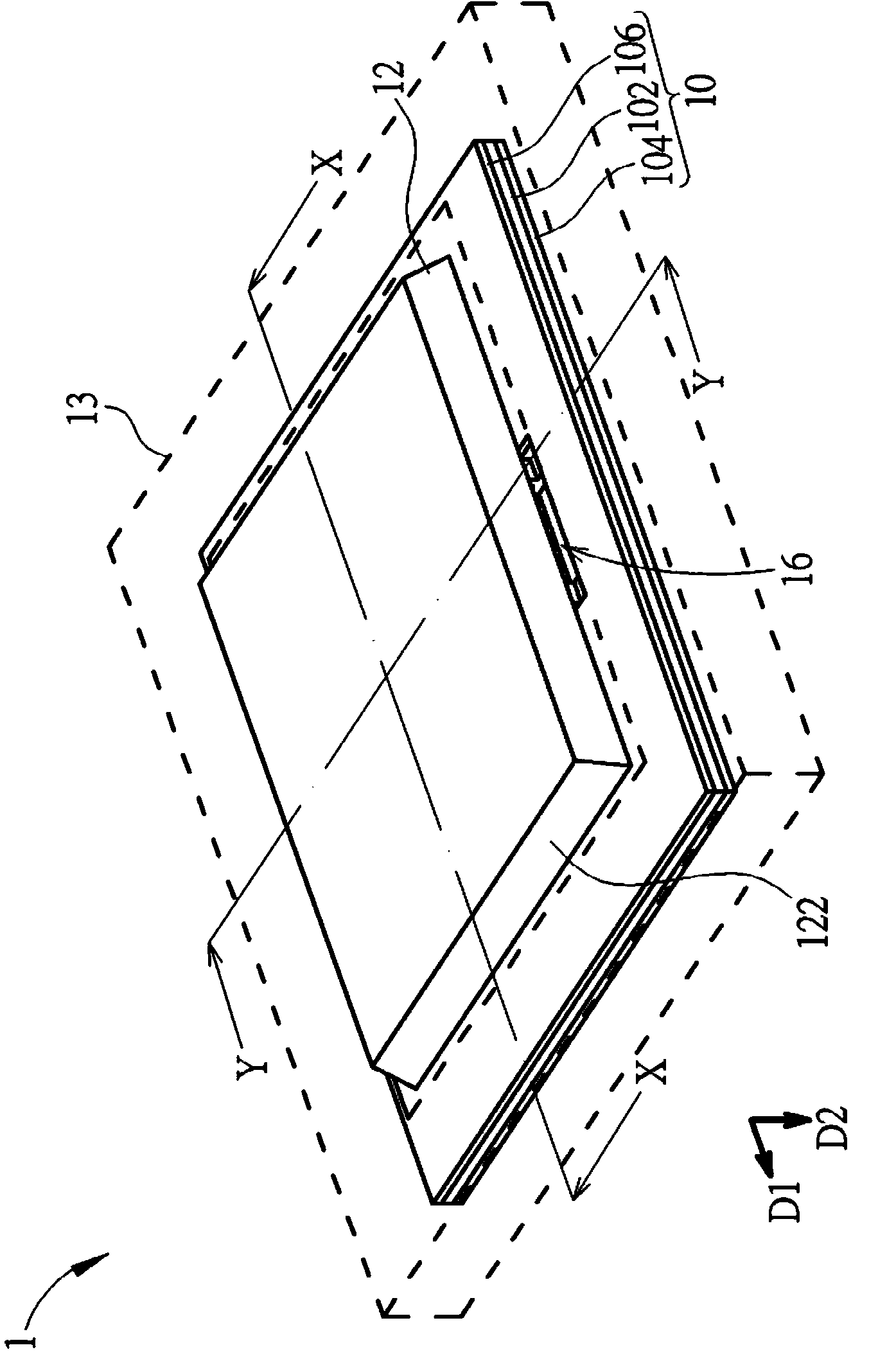
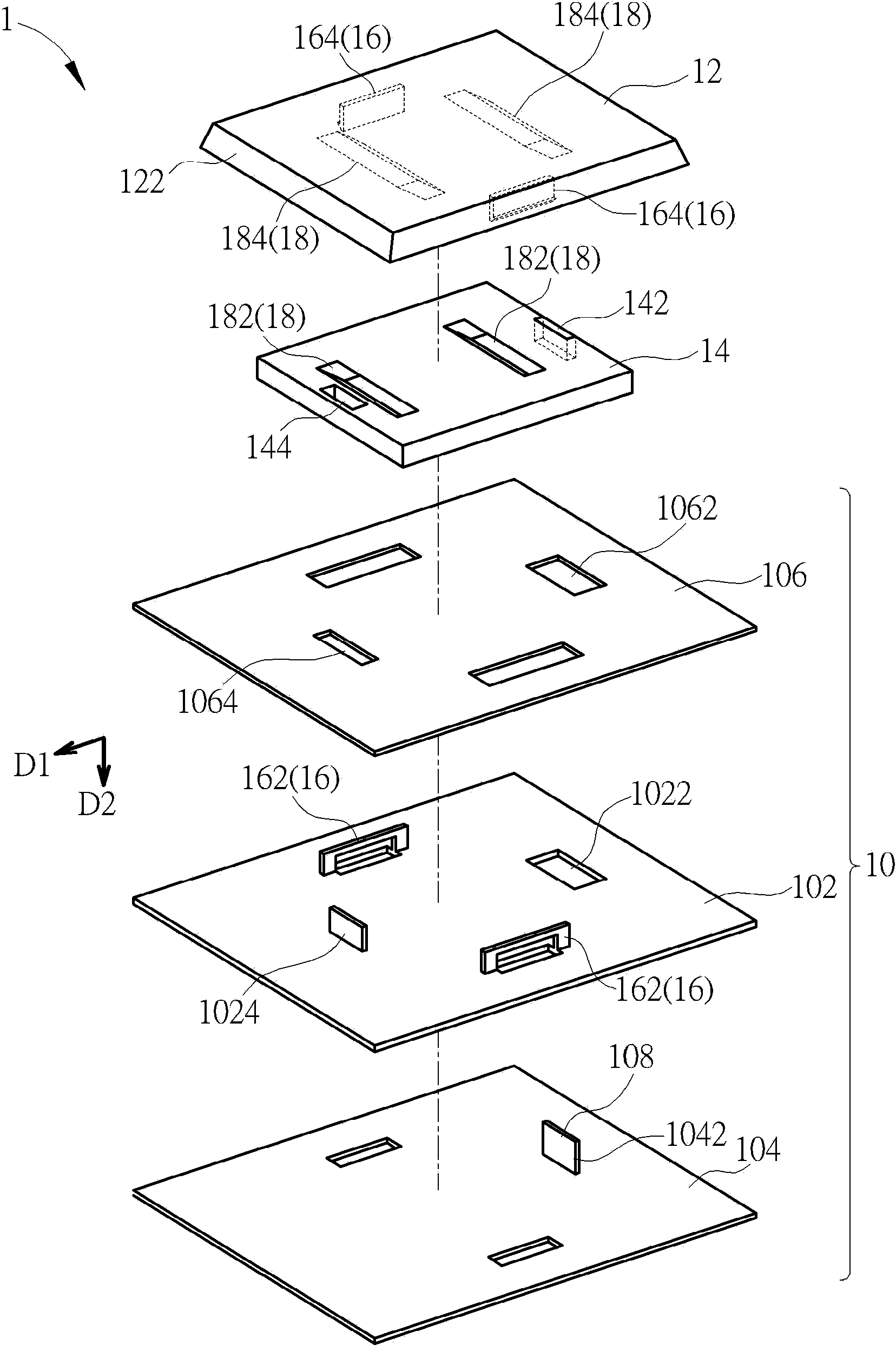
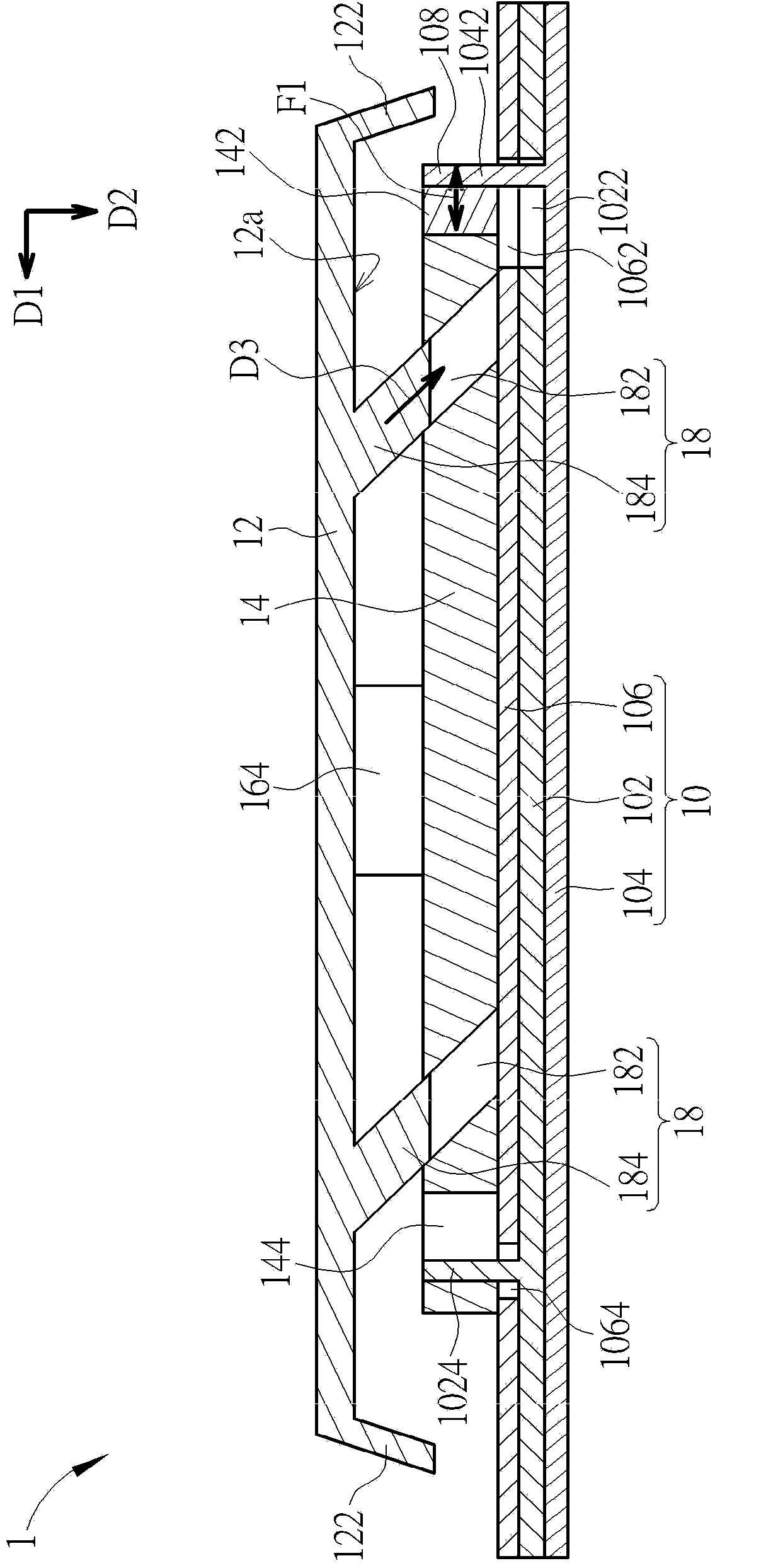
[0036] see Figure 1 to Figure 3 . figure 1 It is a schematic diagram of the key structure 1 according to the first embodiment of the present invention, figure 2 is the exploded view of key structure 1, image 3 For key structure 1 edge figure 1Sectional view of midline X-X. The key structure 1 includes a base 10, a keycap 12, a slider 14, a guide mechanism 16 and a transmission mechanism 18, the keycap 12 is arranged on the base 10, and the slider 14 is slidably arranged between the base 10 and the keycap 12 The guiding mechanism 16 is used to guide the keycap 12 to move relative to the base 10 in a limited manner, and the transmission mechanism 18 is used to drive the movement of the slider 14 and the keycap 12 to each other. Further, in this embodiment, the base 10 includes a bottom plate 102, a movable part 104 and a thin film circuit board 106. The bottom plate 102 is generally made of metal and is mainly used for structural support. The keycap 12 is arranged on the ...