Unlock instant, AI-driven research and patent intelligence for your innovation.

A method for reducing the influence of intermodulation interference on terminal receiving signals

A technology of intermodulation interference and terminal reception, which is applied in the field of reducing the influence of intermodulation interference on terminal receiving signals, and can solve the problems of strong terminal interference and irresistible non-linearity of McWiLL terminal hardware, achieving remarkable results, synchronous head-to-load interference ratio and The effect of improving the signal-to-noise ratio of business time slots

Inactive Publication Date: 2016-12-28
BEIJING XINWEI TELECOM TECH
View PDF6 Cites 0 Cited by
  • Summary
  • Abstract
  • Description
  • Claims
  • Application Information

AI Technical Summary

Problems solved by technology

Let a=0.2, b=0, then 2f1-f2∈[1800.5,1801.5], the out-of-band interference is intermodulated to the in-band, and the interference to the terminal is relatively strong, and the nonlinearity of the McWiLL terminal hardware cannot resist this strong interference

Method used

the structure of the environmentally friendly knitted fabric provided by the present invention; figure 2 Flow chart of the yarn wrapping machine for environmentally friendly knitted fabrics and storage devices; image 3 Is the parameter map of the yarn covering machine
View more

Image

Smart Image Click on the blue labels to locate them in the text.
Viewing Examples
Smart Image
  • A method for reducing the influence of intermodulation interference on terminal receiving signals
  • A method for reducing the influence of intermodulation interference on terminal receiving signals
  • A method for reducing the influence of intermodulation interference on terminal receiving signals

Examples

Experimental program
Comparison scheme
Effect test

Embodiment 1

[0022] Embodiment 1: Anti-intermodulation interference during synchronization maintenance

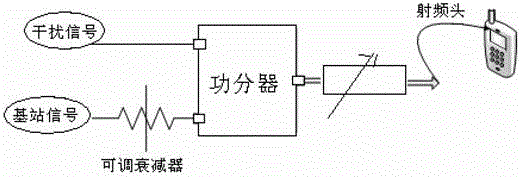
[0023] In this embodiment, the simulation of the intermodulation interference of the GSM signal to the McWiLL signal is taken as an example, as figure 2 As shown, one side of the power divider is connected to the McWiLL base station signal and GSM interference signal, and the other side is connected to the McWiLL terminal through the radio frequency head, and the GSM interference signal is added during the TDD synchronization maintenance process of the terminal. Among them, the center frequency of the McWiLL base station signal is 1800M, and only one subcarrier group is opened (that is, the bandwidth is 1MHz); the center frequency of the GSM interference signal is 1806.5MHz, and the bandwidth is 5MHz, which is generated by the signal generator. Then, the third-order intermodulation product of the GSM interference signal will fall within the 1M frequency band of the McWiLL base station ...

Embodiment 2

[0034] Embodiment 2: Anti-intermodulation interference during synchronization

[0035] This embodiment is based on the first embodiment, assuming that the terminal is out of sync and performs resynchronization. Then first turn on the low noise amplifier, and scan all the frequency points fixedly for three laps. When scanning the second lap, turn off the low noise amplifier to obtain synchronization. If the terminal is synchronized in the second lap, it is considered that there is intermodulation interference at this time. The terminal enters the working state of anti-interference interference; otherwise, it enters the normal working state.

the structure of the environmentally friendly knitted fabric provided by the present invention; figure 2 Flow chart of the yarn wrapping machine for environmentally friendly knitted fabrics and storage devices; image 3 Is the parameter map of the yarn covering machine
Login to View More

PUM

No PUM Login to View More

Abstract

The invention provides a method for lowering the influence of cross modulation interference on a terminal receiving signal. The method comprises the following steps: in a terminal synchronization keeping process, performing state transition under the following condition: in an ordinary working state, turning on a low-noise amplifier, detecting whether cross modulation interference exists, and if so, entering an anti-cross modulation interference state; in the anti-cross modulation interference working state, turning off the low-noise amplifier, detecting whether cross modulation interference exists, and if not, returning to the ordinary state; when the low-noise amplifier is turned off by a terminal, compensating for a reception simulation gain in order to keep the energy of a sampled signal reaching a baseband stable and constant. After adoption of the method, the anti-cross modulation interference state can be entered rapidly when cross modulation interference exists. As proved by testing and verification, a remarkable anti-cross modulation interference effect is achieved in the presence of cross modulation interference.

Description

technical field [0001] The invention relates to the field of wireless communication, in particular to a method for reducing the influence of intermodulation interference on terminal received signals. Background technique [0002] When two or more different frequency signals act on a nonlinear circuit, they will modulate each other to generate a new frequency signal output. If the frequency falls within the working channel bandwidth of the receiver, it will constitute interference to the receiver, which we call It is intermodulation interference, which will not improve with the improvement of the performance of the receiving filter, and is more harmful in the field of communication. [0003] Taking the mutual modulation of two frequency signals f1 and f2 as an example, the new frequency signals generated are: second-order intermodulation products: f1+f2, f1-f2, third-order intermodulation products: 2f1+f2, 2f1-f2, f1 +2f2, f1-2f2, and higher-order intermodulation products, t...

Claims

the structure of the environmentally friendly knitted fabric provided by the present invention; figure 2 Flow chart of the yarn wrapping machine for environmentally friendly knitted fabrics and storage devices; image 3 Is the parameter map of the yarn covering machine
Login to View More

Application Information

Patent Timeline
no application Login to View More
Patent Type & Authority Patents(China)
IPC IPC(8): H04B1/10
Inventor 冯翀黄其华窦璐
Owner BEIJING XINWEI TELECOM TECH