A kind of synthetic method of cyclic polylactone polymer
A technology for cyclic lactones and polymers, which is applied in the field of catalytic synthesis of cyclic polylactone polymers, which can solve the problems of air humidity sensitivity and harsh synthesis conditions, and achieve the effect of wide application range, stable and reliable reaction process operation
- Summary
- Abstract
- Description
- Claims
- Application Information
AI Technical Summary
Problems solved by technology
Method used
Image

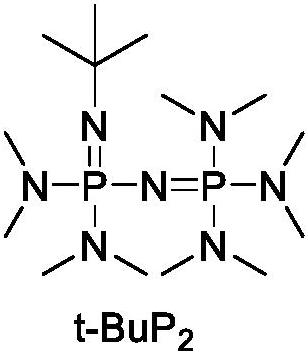
Examples
Embodiment 1
[0028] β-butyrolactone (2.5mmol, 100equiv.), Cu(C 6 f 5 ) 2 (30 μmol, 1.2 equiv.) was added to a polymerization tube with 5 mL of dichloromethane, and stirred evenly. t-BuP 2 (25 μmol, 1 equiv.) was added to the reaction system to start the polymerization reaction, the polymerization reaction was carried out at room temperature, and the whole system was under the protection of argon. used during the reaction 1 H NMR detects the monomer content, when the monomer in the body system is completely consumed, add HCl / Et 2 O solution (2 mol / L, 0.05 mmol, 2 equiv.) was used to terminate the reaction. The dichloromethane was spun off with a rotary evaporator to obtain the crude product. Use toluene to separate out the complexes and metal salts in the crude product, filter off the solid impurities, and then spin off the toluene. Finally, the product was redissolved in a small amount of CH 2 Cl 2 Then, the mixed liquid was added into the cold methanol solution, and the polymer w...
Embodiment 2
[0030] δ-valerolactone (0.75mmol, 30equiv.), Cu(C 6 f 5 ) 2 (30 μmol, 1.2 equiv.) was added into a polymerization tube with 2 mL of dichloromethane, and stirred evenly. t-BuP 2 (25 μmol, 1 equiv.) was added to the reaction system to start the polymerization reaction, the polymerization reaction was carried out at room temperature, and the whole system was under the protection of argon. used during the reaction 1 H NMR detects the monomer content, when the monomer in the body system is completely consumed, add HCl / Et 2 O solution (2 mol / L, 0.05 mmol, 2 equiv.) was used to terminate the reaction. The dichloromethane was spun off with a rotary evaporator to obtain the crude product. Use toluene to separate out the complexes and metal salts in the crude product, filter off the solid impurities, and then spin off the toluene. Finally, the product was dissolved in a small amount of CH 2 Cl 2 Then, the mixed liquid was added into the cold methanol solution, and the polymer w...
Embodiment 3
[0032] ε-caprolactone (1.75mmol, 70equiv.), Cu(C 6 f 5 ) 2 (37.5 μmol, 1.5 equiv.) was added to a polymerization tube with 4 mL of dichloromethane, and stirred evenly. t-BuP 2 (25 μmol, 1 equiv.) was added to the reaction system to start the polymerization reaction, the polymerization reaction was carried out at room temperature, and the whole system was under the protection of argon. used during the reaction 1 H NMR detects the monomer content, when the monomer in the body system is completely consumed, add HCl / Et 2O solution (2 mol / L, 0.05 mmol, 2 equiv.) was used to terminate the reaction. The dichloromethane was spun off with a rotary evaporator to obtain the crude product. Use toluene to separate out the complexes and metal salts in the crude product, filter off the solid impurities, and then spin off the toluene. Finally, the product was dissolved in a small amount of CH 2 Cl 2 Then, the mixed liquid was added into the cold methanol solution, and the polymer was...
PUM
 Login to View More
 Abstract
Description
Claims
Application Information
 Login to View More