
Method for non-destructive monitoring condition of algae identification and algae proliferation
A technology of algae and algae, which is applied in the field of spectral imaging technology and spectral identification, can solve the problems of accurate and non-destructive monitoring of algae reproduction, and achieve the effect of accurate and fast detection, high accuracy and multiple information
- Summary
- Abstract
- Description
- Claims
- Application Information
AI Technical Summary
Problems solved by technology
Method used
Image

Examples
Embodiment 1
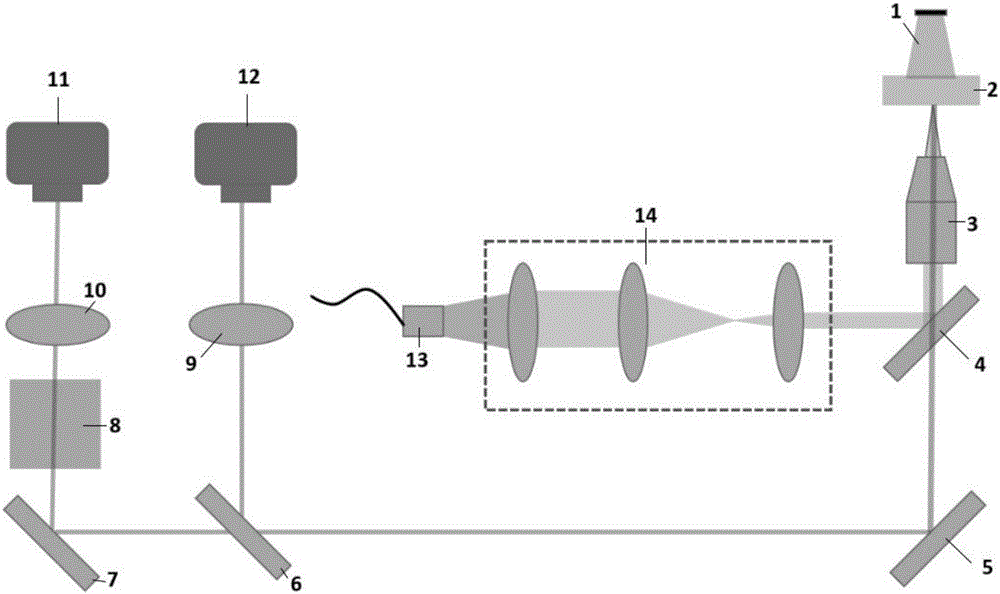
[0078] As an implementation example, in the present invention, Chlorella and Nannochloropsis are used as monitoring samples and cultured in the water body of a petri dish. These two types of algae are similar in appearance and small in size, so it is difficult to identify them using a conventional microscope, and they contain less fluorescent substances. Therefore, this implementation case uses light transmission spectral imaging for testing.
[0079]The illumination source 1 selected in this implementation case is a high-pressure xenon lamp, and the VariSpecTM liquid crystal filter 400-720nm produced by CRi Company is used for filtering. In addition, a dichroic mirror 4 with high reflection (99.2% reflectance) for wavelengths below 400 nm and anti-reflection (99.8% transmittance) for wavelengths above 400 nm is selected. The grayscale imaging device 11 and the color imaging device 12 respectively select a grayscale CCD and a color CCD.
[0080] The semi-transparent and semi-...
PUM
 Login to View More
 Abstract
Description
Claims
Application Information
 Login to View More