Oxidation treatment method of 7*** series aluminum alloy

An oxidation treatment, aluminum alloy technology, used in anodizing, electrolytic coatings, surface reaction electrolytic coatings, etc., can solve problems such as uneven distribution, and achieve the effect of reducing dissolution, strong adhesion, and small pore size

CN106868565AActive Publication Date: 2017-06-20GUANGDONG EVERWIN PRECISION TECH
9 Cites 2 Cited by

Patent Information

Authority / Receiving Office
CN · China
Patent Type
Applications(China)
Current Assignee / Owner
Publication Date
2017-06-20

Smart Images

  • Figure 1
    Figure 1
  • Figure 2
    Figure 2
  • Figure 3
    Figure 3
Patent Text Reader

Abstract

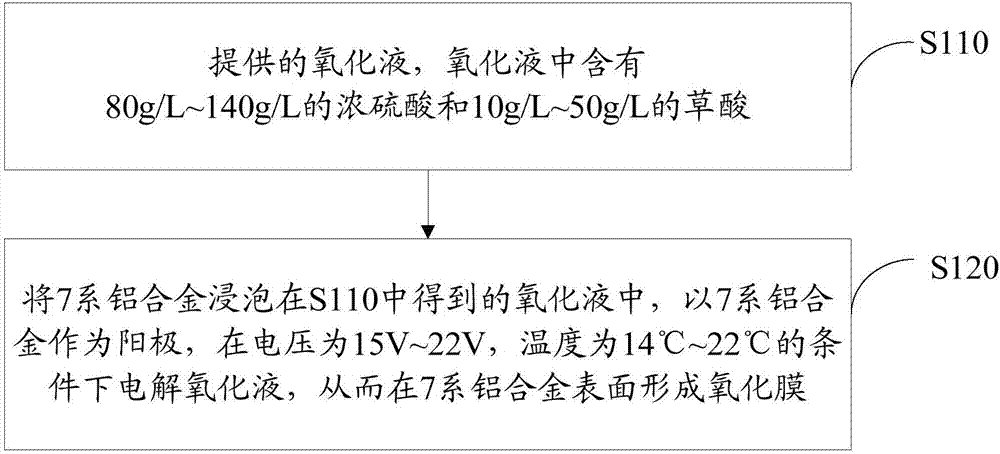
The invention discloses an oxidation treatment method of 7*** series aluminum alloy. An oxidation solution per liter contains 80-140 g of concentrated sulfuric acid and 10-50 g of oxalic acid, specifically, and the proportion of the concentrated sulfuric acid to the oxalic acid is appropriate; while the oxidation solution is electrolyzed into an oxidation film under the conditions that the voltage is 15-22 V and the temperature is 14-22 DEG C, oxalate ions and sulfate ions in the oxidation solution produce competitive adsorption, sulfate radicals are primarily adsorbed at the bottoms of micropores of the oxidation film, and oxalate is primarily adsorbed at walls of the micropores of the oxidation film. As the dissolution effect of oxalic acid to the oxidation film is poorer than that of sulfuric acid, dissolution of the walls of the micropores is reduced, the formed oxidation film is small in pore diameter and compact, the micropores are distributed evenly, accordingly, the quality distribution and adhesive force distribution of different positions of the oxidation film are uniform, and the oxidation film is high in adhesive force and not prone to falling off.
Need to check novelty before this filing date? Find Prior Art

Description

technical field

[0001] The invention relates to the technical field of oxidation treatment, in particular to an oxidation treatment method for a 7-series aluminum alloy. Background technique

[0002] In recent years, metal alloys have been used more and more in the fields of electronic products such as mobile phone casings, computer casings, and frames. These alloy products, such as aluminum alloys, magnesium alloys or titanium alloys, are generally anodized to form an anodized film with better wear resistance on the surface.

[0003] Compared with the more commonly used 6-series aluminum alloys (mainly doped with magnesium and silicon), 7-series aluminum alloys (mainly doped with zinc) have higher hardness and strength. As the material for the casing and middle frame of electronic products, 7-series aluminum alloy has the advantages of light weight and less bending and deformation, and is being favored by more and more electronic product manufacturers.

[0004] However, w...

Examples

Embodiment 1

[0043] Soak the 7-series aluminum alloy in the oxidation solution, which contains 120g / L concentrated sulfuric acid, 15g / L oxalic acid and the balance deionized water. The oxidation solution was electrolyzed for 60 minutes under the conditions of a constant voltage of 18V and a constant temperature of 15°C to form an oxide film on the surface of the 7 series aluminum alloy.

Embodiment 2

[0045] Soak the 7-series aluminum alloy in the oxidation solution, which contains 80g / L concentrated sulfuric acid, 10g / L oxalic acid and the balance deionized water. Under the conditions of a constant voltage of 15V and a constant temperature of 14°C, the oxidation solution was electrolyzed for 80 minutes to form an oxide film on the surface of the 7-series aluminum alloy.

Embodiment 3

[0047] Soak the 7-series aluminum alloy in the oxidation solution, which contains 140g / L concentrated sulfuric acid, 50g / L oxalic acid and the rest deionized water. Under the conditions of a constant voltage of 22V and a constant temperature of 22°C, the oxidation solution was electrolyzed for 40 minutes to form an oxide film on the surface of the 7-series aluminum alloy.