
Soil improvement method of ecological tea garden
A soil improvement and tea garden technology, applied in the fields of soil preparation methods, applications, agricultural machinery and tools, etc., can solve the problems of insufficient attention, fluctuation, and decline in tea production
- Summary
- Abstract
- Description
- Claims
- Application Information
AI Technical Summary
Problems solved by technology
Method used
Image



Examples
Embodiment 1
[0031] A method for building an ecological young tea garden, comprising the following steps:
[0032] a. In October 2013, a piece of mountain land to be reclaimed was selected in Tianzhu Mountain, Qianshan County, Anhui Province, with sufficient sunlight, close to water sources, no environmental pollution, and far away from industrial and living areas. This is the basis for building an ecological tea garden, and the water source is the mountain Spring water is used for automatic irrigation, away from pollution;
[0033] b. Land consolidation
[0034] Manually remove the larger shrubs and leave the smaller herbaceous plants. At the same time, the slopes are flattened to form a terraced field, and the terraced fields are placed for 2 years. During this period, the terraced fields are regularly turned over, and the terraced fields are turned over. Soil depth is 20-30cm;
[0035] c. Plant leguminous green manure
[0036] During the terrace placement period, a certain amount of ...
Embodiment 2
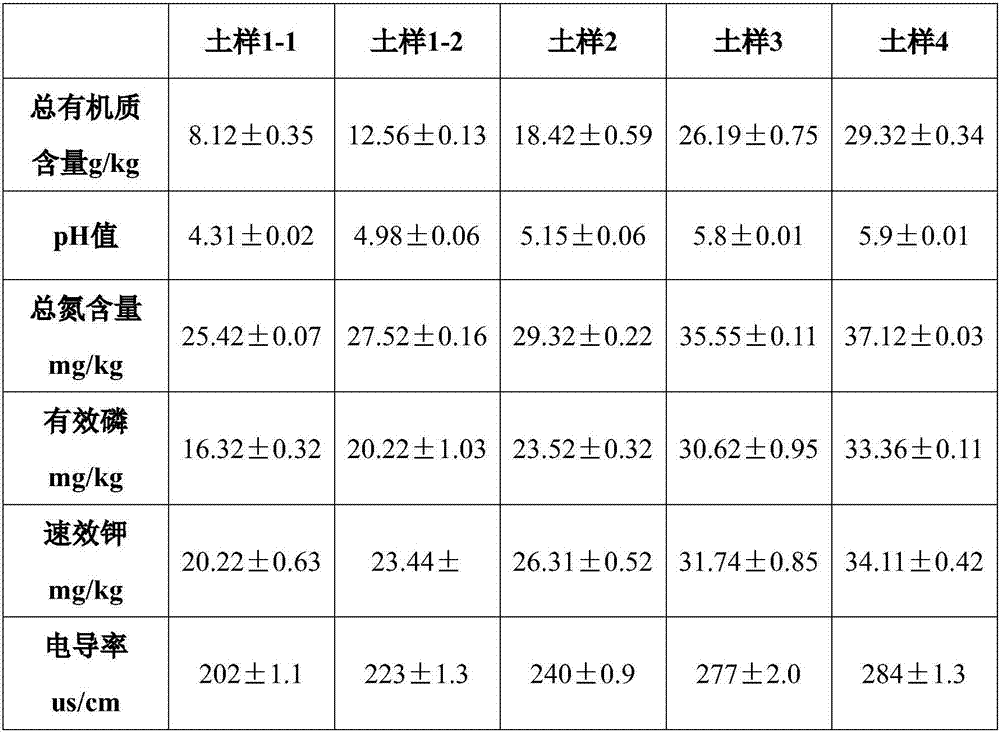
[0044] After the terraces were placed for several years, after operations such as fertilization and soil turning, the changes in parameters such as soil organic matter and pH value of the terraces are shown in Table 1;
[0045] Table 1 Total organic matter and water-soluble organic matter content of soil samples at different times after terrace reclamation
[0046]
[0047] Note: Soil sample 1-1 is the soil sample in October 2013 without fertilization and soil turning after terrace reclamation; soil sample 1-2 is the soil sample in October 2013 after fertilization and soil turning after terrace reclamation; soil Sample 2 is the soil sample in October 2014 after fertilization and soil turning after terrace reclamation; soil sample 3 is the soil sample in October 2015 after fertilization and soil turning after terrace reclamation; soil sample 4 is fertilization after terrace reclamation Soil samples were taken in October 2016 during operations such as digging and digging.
...
Embodiment 3
[0051] Before planting leguminous green manure crops, soak the seeds in 0.01-0.05% humic acid solution for 1 hour, then put them in a constant temperature box, keep a certain humidity, observe the germination rate of leguminous green manure crops, repeat three times for a certain concentration, and the seeds will germinate The rate is shown in Table 2;
[0052] Table 2 Germination rate of leguminous green manure crop seeds soaked in different concentrations of humic acid
[0053]
[0054] As can be seen from Table 2, when the humic acid solution concentration was 0.04%, it had the most obvious impact on the seed germination rate of legume green manure crops, and the germination rate reached 89%. After soaking like this, the germination rate of leguminous green manure crops was improved, and then Increase nitrogen fixation efficiency of legume green manure.
PUM
 Login to View More
 Abstract
Description
Claims
Application Information
 Login to View More