
Microfluidic chip for study of tumor single cell invasion and epithelial-mesenchymal transition
A microfluidic chip, single-cell technology, applied in laboratory containers, specific-purpose bioreactors/fermenters, biochemical instruments, etc., can solve the problem of lack of high-throughput detection methods, and improve the success of experiments. efficiency and reliability, reducing operating steps, simplifying the effect of operating steps
- Summary
- Abstract
- Description
- Claims
- Application Information
AI Technical Summary
Problems solved by technology
Method used
Image

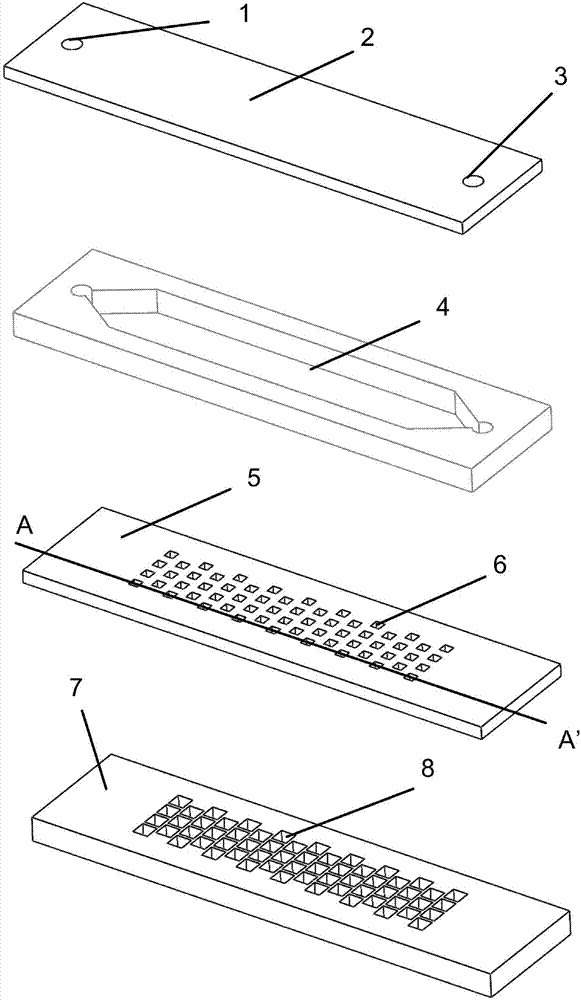
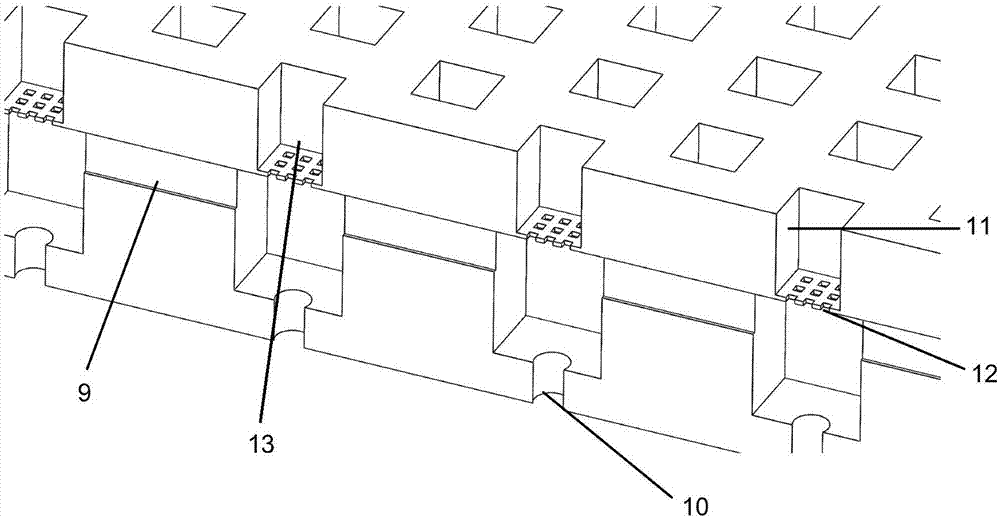
Examples
Embodiment 1
[0036] Example 1 Microfluidic chip for studying tumor single cell invasion and epithelial-mesenchymal transition and its preparation method
[0037] The microfluidic chip provided in this embodiment includes a four-layer structure stacked together and sealed with each other, from top to bottom are the top cover, the microfluidic channel layer, the substrate with a sorting array, and the cavity with a cavity. The base plate, the sorting unit on the base plate and the cavity on the base plate are arranged oppositely; the sorting unit has a square micro-well on the base plate for obtaining a single cell; the square micro-well vertically penetrates the base plate . The bottom of the square microwell is a square bottom plate provided with several smaller microholes, and the square bottom plate is connected with the substrate as a whole. The specific structure is:
[0038] 1. Top cover and fluid channel
[0039] When identifying cells, light needs to pass through the top cover, so...
Embodiment 2
[0074] The microfluidic chip provided in this embodiment includes a four-layer structure stacked together and sealed with each other, from top to bottom are the top cover, the microfluidic channel layer, the substrate with a sorting array, and the cavity with a cavity. The base plate, the sorting unit on the base plate and the cavity on the base plate are arranged oppositely; the sorting unit has a square micro-well on the base plate for obtaining a single cell; the square micro-well vertically penetrates the base plate . The bottom of the square microwell is a square bottom plate provided with several smaller microholes, and the square bottom plate is connected with the substrate as a whole.
[0075] 1. Top cover and fluid channel
[0076] The top cover is provided with a sample inlet and a sample outlet; the microfluidic channel layer is provided with a flow channel, and the flow channel has a long strip shape with a wide middle section and narrower ends at both ends, and th...
PUM
 Login to View More
 Abstract
Description
Claims
Application Information
 Login to View More