Urban household garbage sorting and charring comprehensive treatment resource recovery method

A municipal solid waste and resource recovery technology, which is applied in the resource recovery field of municipal solid waste sorting and carbonization comprehensive treatment, can solve the problems of low recycling rate, low degree of automation, and low sorting efficiency, and achieve high degree of automation, The effect of less manual direct participation and high sorting efficiency

CN107497831AInactive Publication Date: 2017-12-22李新方
2 Cites 31 Cited by

Patent Information

Authority / Receiving Office
CN · China
Current Assignee / Owner
Publication Date
2017-12-22
Estimated Expiration
Not applicable · inactive patent

Smart Images

  • Figure 1
    Figure 1
Patent Text Reader

Abstract

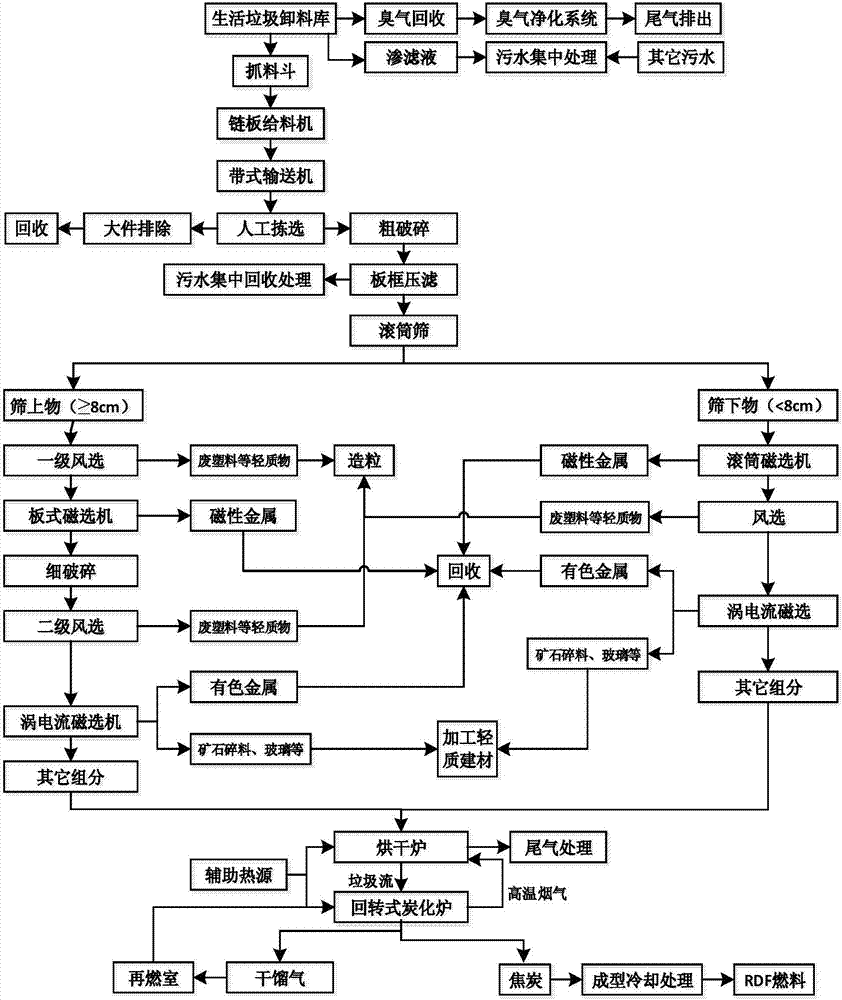
A urban household garbage sorting and charring comprehensive treatment resource recovery method comprises the first step of garbage sorting treatment, wherein original household garbage is subjected to uniform feeding, manual large garbage sorting, coarse crushing, plate-frame pressure filtering, rolling cylinder screening, full-closed mechanical selecting by winnowing, plate-type magnetic separator treating, eddy current magnetic separator treating and fine crushing process treatment; the second step of garbage drying treatment; the third step of garbage charring treatment, wherein a rotary charring furnace is adopted, and garbage charring is carried out in a normal-pressure low-temperature and low-oxygen atmosphere so that solid carbon can be prepared; the fourth step of coke forming and cooling treatment; the fifth step of bad smell purifying treatment, wherein bad smell generated in a household garbage discharging warehouse and bad smell generated in all treatment process links are collected to a bad smell purifying system through a negative pressure induced draught system; and the sixth step of waste water purifying treatment. The urban household garbage sorting and charring comprehensive treatment resource recovery method is relatively high in automation degree, sorting efficiency and recovery utilization rate and has more sorting functions.
Need to check novelty before this filing date? Find Prior Art

Description

technical field

[0001] The invention belongs to the technical field of urban solid waste resource treatment, and in particular relates to a resource recovery method for comprehensive treatment of municipal solid waste sorting and carbonization. Background technique

[0002] The annual output of urban waste in my country is close to 200 million tons, and the average annual waste generation per person is about 300kg, ranking third in the world after the United States and Russia, and has basically been growing at an annual rate of 8%-10% in recent years. How to dispose of these increasingly large quantities of domestic waste, which is continuously produced, has become a serious social and environmental problem.

[0003] my country's municipal solid waste treatment technologies are mainly sanitary landfill, incineration and composting. Sanitary landfill is the earliest and most widely used final disposal method. The advantage of the sanitary landfill treatment method is low in...

Examples

Embodiment Construction

[0050] The present invention will be further described below in conjunction with the accompanying drawings.

[0051] refer to figure 1 , a resource recovery method for municipal solid waste sorting and carbonization comprehensive treatment, comprising the following steps:

[0052] Step 1. Garbage sorting and processing

[0053] For primary domestic waste, it adopts uniform feeding, manual sorting of bulky waste, coarse crushing (bagged waste is automatically broken), plate and frame filter press, drum screen, fully enclosed mechanized winnowing, plate magnetic separator, eddy current magnetic separation After processing by machine, fine crushing and other processes, municipal solid waste is sorted into: organic matter, inorganic matter, recyclable combustibles, non-recyclable combustibles and metals. Organic matter and non-recyclable combustible waste are pyrolyzed and carbonized to prepare RDF fuel; inorganic waste mainly includes masonry, muck, glass, ceramics, etc., which...