Check patentability & draft patents in minutes with Patsnap Eureka AI!

Compressive sensing of light transport matrix

A compressed sensing and optical transmission technology, applied in 3D image processing, image data processing, image data processing, etc., can solve the problems of difficult processing and storage tasks, restricting the efficient use of optical transmission matrices, etc.

Active Publication Date: 2019-06-07
SIEMENS HEALTHCARE GMBH
View PDF4 Cites 2 Cited by
  • Summary
  • Abstract
  • Description
  • Claims
  • Application Information

AI Technical Summary

Problems solved by technology

Such a large size makes tasks such as processing and storage intractable from a computational perspective
This limits the ability to efficiently utilize light transport matrices in applications such as medical imaging applications

Method used

the structure of the environmentally friendly knitted fabric provided by the present invention; figure 2 Flow chart of the yarn wrapping machine for environmentally friendly knitted fabrics and storage devices; image 3 Is the parameter map of the yarn covering machine
View more

Image

Smart Image Click on the blue labels to locate them in the text.
Viewing Examples
Smart Image
  • Compressive sensing of light transport matrix
  • Compressive sensing of light transport matrix
  • Compressive sensing of light transport matrix

Examples

Experimental program
Comparison scheme
Effect test

Embodiment Construction

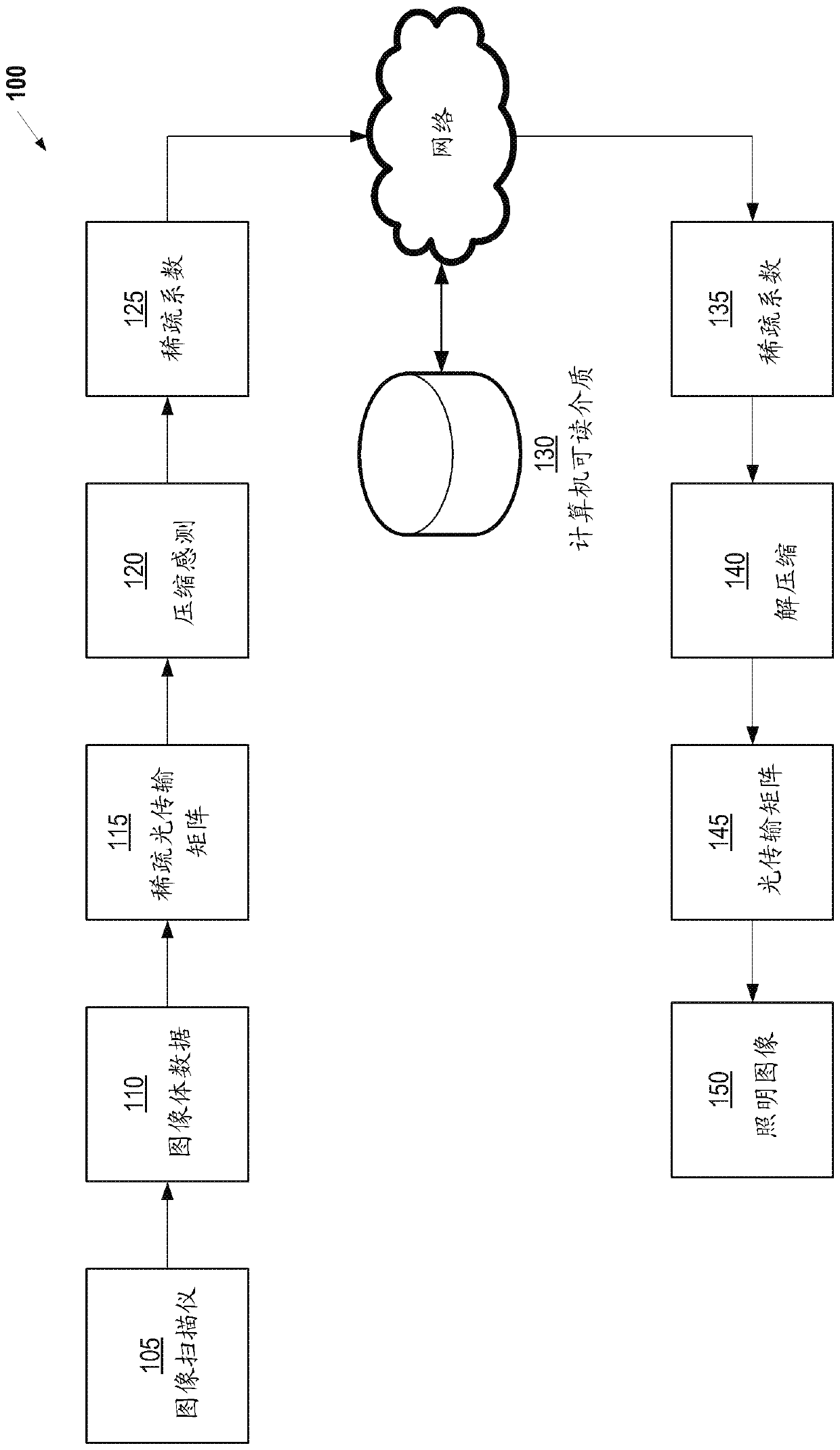
[0018] The following disclosure describes the present invention based on several embodiments related to methods, systems and devices related to compressed sensing (CS) of optical transmission matrices. The optical transmission matrix is ​​a very large matrix. Its size is defined by all possible combinations of points and their relationship. But with the help of CS, and in some embodiments with the aid of other basic observations in the rendering (ie, rapid decline in visibility between points, sparsity of visibility signal frequencies), the size of the matrix can be significantly reduced. Therefore, CS can be used to reconstruct the optical transmission matrix from a small amount of samples. After reconstructing the matrix, any given two points and their visibility to each other can be known in advance. Therefore, there will be no need to explore the space. Without exploration, only large contribution samples can be detected, and noise-free images can be generated.

[0019] f...

the structure of the environmentally friendly knitted fabric provided by the present invention; figure 2 Flow chart of the yarn wrapping machine for environmentally friendly knitted fabrics and storage devices; image 3 Is the parameter map of the yarn covering machine
Login to View More

PUM

No PUM Login to View More

Abstract

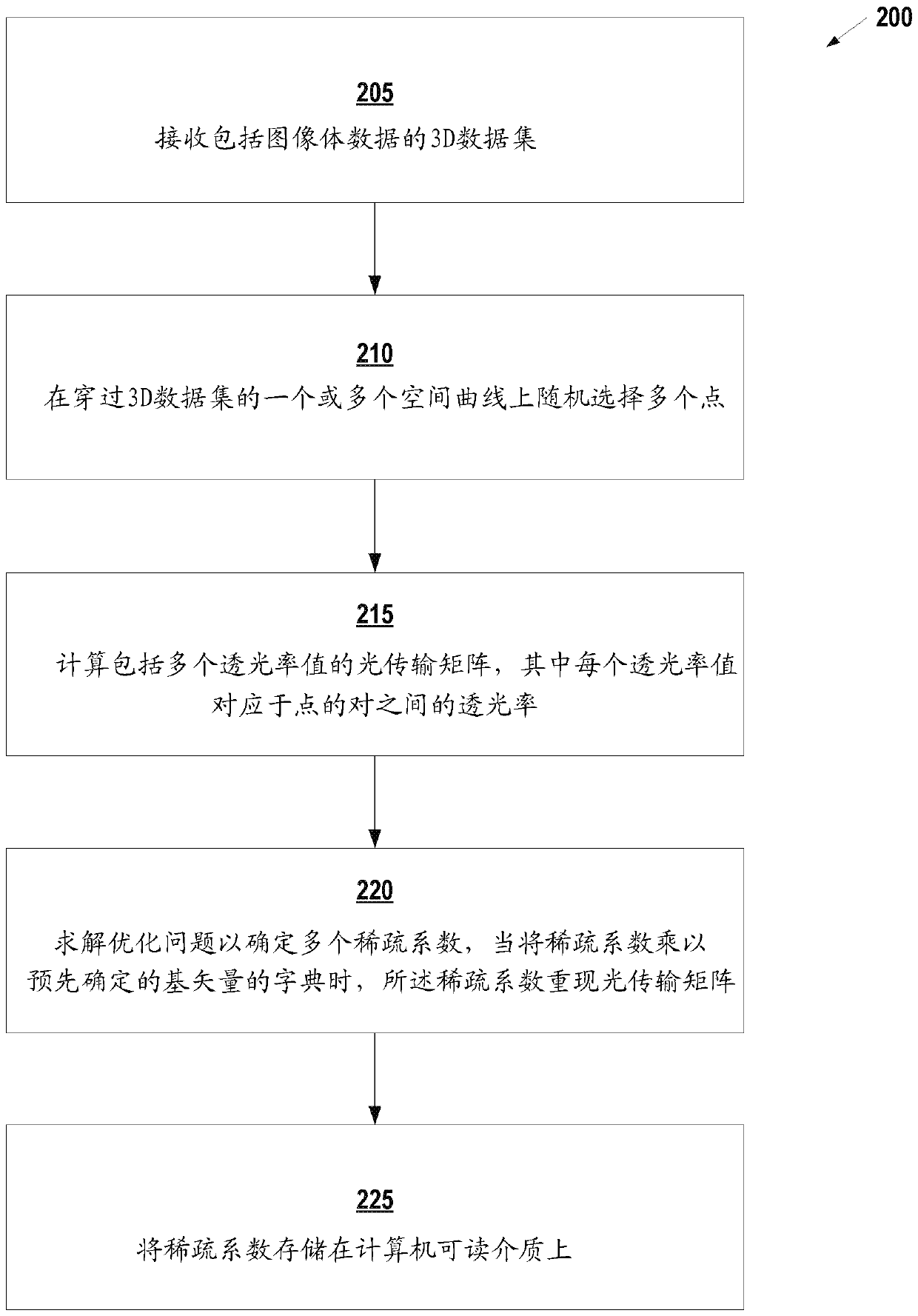
The invention relates to the compressive sensing of a light transport matrix. A computer-implemented method for performing compressive sensing of light transport matrix includes receiving a 3D datasetcomprising image volume data and randomly selecting a plurality of points on a space curve traversing the 3D dataset. A light transport matrix comprising a plurality of light transmittance values iscalculated. Each light transmittance value corresponds to light transmittance between a pair of points included in the plurality of points. An optimization problem is solved to determine a plurality of sparse coefficients which reproduce the light transport matrix when the sparse coefficients are multiplied by a predetermined dictionary of basis vectors. Once determined, the sparse coefficients are stored on a computer-readable medium.

Description

Technical field [0001] The present invention generally relates to methods, systems and devices for using compressed sensing technology in the calculation of optical transmission matrices. The techniques described herein can be applied to, for example, 3D medical imaging applications. Background technique [0002] Generating images that are obvious and physically plausible is an important task for users to understand the data more deeply. In order for the computer to generate such images, the interaction of light materials must be considered. Those interactions are calculated through the mathematical and physical basis set by the optical transmission algorithm. Because it is impossible to calculate all interactions, different mathematical methods are used by conventional techniques. [0003] A popular method for calculating light interaction is to use Monte Carlo (MC) statistical methods. The MC method can calculate complex phenomena, but the artifacts of these algorithms appear...

Claims

the structure of the environmentally friendly knitted fabric provided by the present invention; figure 2 Flow chart of the yarn wrapping machine for environmentally friendly knitted fabrics and storage devices; image 3 Is the parameter map of the yarn covering machine
Login to View More

Application Information

Patent Timeline
no application Login to View More
Patent Type & Authority Applications(China)
IPC IPC(8): G06T15/50G06T15/08G06T7/136G06T1/00G06T1/20
CPCH03M7/3062G06T15/06G06T15/08G06T2210/41G06T15/506G06T7/136G06T2207/20G06T1/0007G06T2207/10028G06T1/20
Inventor A.比尔吉利
Owner SIEMENS HEALTHCARE GMBH
Features
  • R&D
  • Intellectual Property
  • Life Sciences
  • Materials
  • Tech Scout
Why Patsnap Eureka
  • Unparalleled Data Quality
  • Higher Quality Content
  • 60% Fewer Hallucinations
Social media
Patsnap Eureka Blog
Learn More