Check patentability & draft patents in minutes with Patsnap Eureka AI!

Polyol polyester and polyhydroxy alkane blends with polar polymers

A technology of polar polymers and branched hydroxyalkanes, which can be used in building components, transportation and packaging, chemical instruments and methods, etc., and can solve the problems of reducing the quality of the surface material layer and being volatile

Active Publication Date: 2020-08-28
TRINSEO EURO GMBH
View PDF8 Cites 0 Cited by
  • Summary
  • Abstract
  • Description
  • Claims
  • Application Information

AI Technical Summary

Problems solved by technology

However, commonly used lubricants (e.g., stearic acid and stearyl alcohol) are volatile at normal processing temperatures (200°C to 240°C)
Additionally, at levels that increase gloss (>2%), these additives tend to leave waxy residues and deposits in processing equipment (calibrators, molds, etc.) that degrade the quality of the facestock layer (smoothness and uniformity)

Method used

the structure of the environmentally friendly knitted fabric provided by the present invention; figure 2 Flow chart of the yarn wrapping machine for environmentally friendly knitted fabrics and storage devices; image 3 Is the parameter map of the yarn covering machine
View more

Image

Smart Image Click on the blue labels to locate them in the text.
Viewing Examples
Smart Image
  • Polyol polyester and polyhydroxy alkane blends with polar polymers
  • Polyol polyester and polyhydroxy alkane blends with polar polymers
  • Polyol polyester and polyhydroxy alkane blends with polar polymers

Examples

Experimental program
Comparison scheme
Effect test

Embodiment 1

[0136] Example 1: Surface Layer Blend:

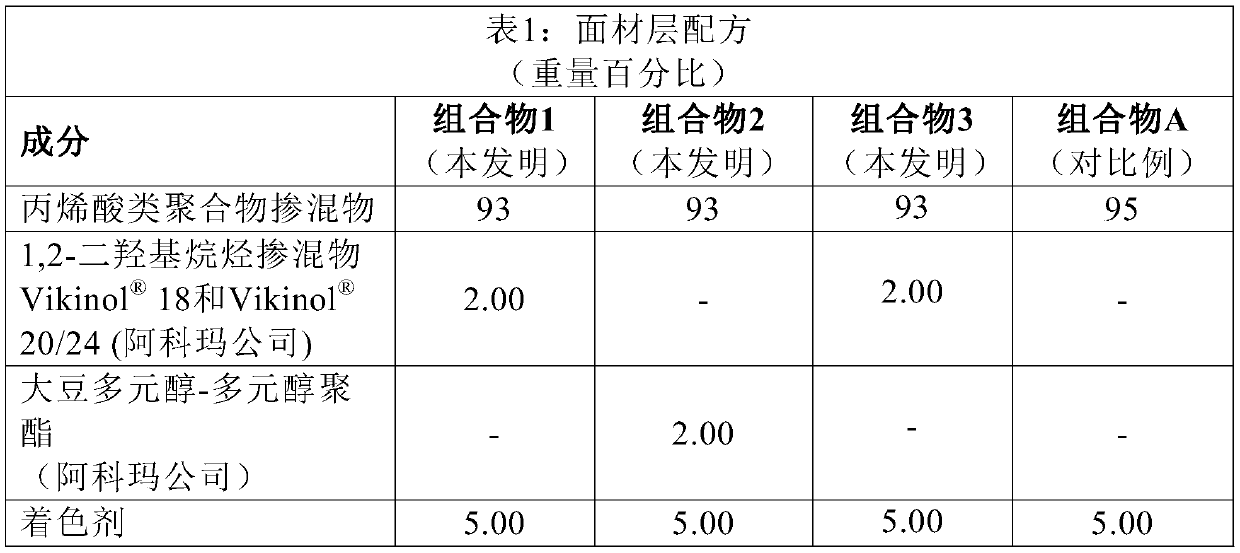
[0137] The following facesheet polymer blends were prepared, each blend containing a different gloss improving additive in accordance with the present invention. A comparative polymer blend without the gloss improving additive was also prepared.

[0138] These facestock formulations are shown in Table 1.

[0139]

[0140] These acrylic blend cap layer formulations were melted by melting the components shown in Table 1 above in a twin screw extruder operating at 300-425 revolutions per minute (RPM) and using the extruder temperature profile shown in Table 2. Blend to prepare.

[0141]

Embodiment 2

[0142] Example 2: Composite Structure :

[0143] The acrylic lidding stock blend prepared according to Example 1 was coextruded on a PVC substrate using a custom 1"x4" die and two extruders: a substrate layer extruder and a facestock layer extrusion machine.

[0144] The PVC substrate extruder was a single screw extruder operating at 9 revolutions per minute (RPM) and had a barrel temperature profile of 168°C (feed end) to 182°C (die end).

[0145] The acrylic blend facestock layer extruder was a single screw extruder and had a barrel temperature profile of 170°C (feed) to 210°C (die end). The coextrusion die temperature for the profiles was set at 165°C to 200°C.

[0146] For each facestock composition prepared according to Example 1, gloss and impact measurements were performed on final profiles prepared at 165°C and 200°C die temperatures.

[0147] The results are shown in Table 3 below, the facestock layer thickness was 0.006" to 0.007", and the total part thickness w...

Embodiment 3

[0150] Example 3: Decomposition Temperature of Blends Containing Gloss Improvement Additives

[0151] The thermal decomposition temperature is a convenient method of determining the thermal operating window for plastic extrusion because it provides a guide to the temperature at which extrusion can occur before it begins to degrade.

[0152] The thermal decomposition temperatures of facestock layer blend Composition 1 and Composition A prepared according to Example 1 were measured and compared. The results are shown in Table 4 below.

[0153]

[0154] From these results it is clear that the addition of polyol polyester increases the decomposition temperature of the acrylic face stock by about 10°C. As noted above, this effect also serves to broaden the processing temperature range of these materials so that improved gloss can be obtained by extruding at higher temperatures without degrading the polymer. It is also important that, as expected, the addition of polyol does ...

the structure of the environmentally friendly knitted fabric provided by the present invention; figure 2 Flow chart of the yarn wrapping machine for environmentally friendly knitted fabrics and storage devices; image 3 Is the parameter map of the yarn covering machine
Login to View More

PUM

PropertyMeasurementUnit
hydroxyl valueaaaaaaaaaa
thicknessaaaaaaaaaa
thicknessaaaaaaaaaa
Login to View More

Abstract

Compounds that can be produced by a ring-opening reaction of epoxidized alkanes or epoxidized fatty acid esters having a molecular weight greater than 200 grams per mole are blended with polar polymers to improve the gloss of the polar polymers. These compounds include at least one polar functional group and are blended with polar polymers, or blends comprising at least one polar polymer, in orderto improve the gloss of these polymers, such that they have suitable gloss right out of the manufacturing operation without the need for further painting or lamination steps. These compounds may alsoimprove the impact strength of the polar polymers. Also disclosed are composite structures wherein an outer cap layer is made from the polar polymer blended with the gloss improving additive.

Description

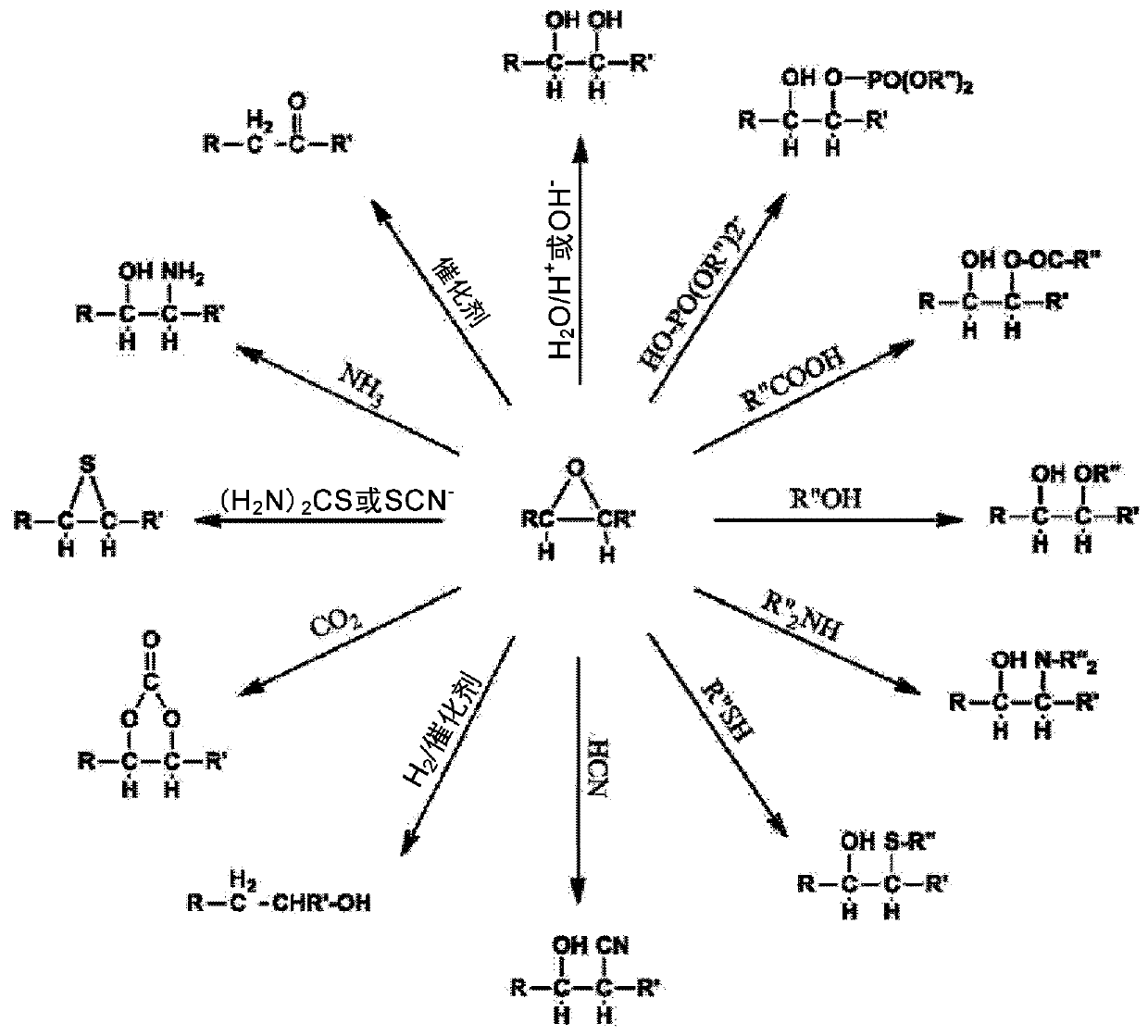
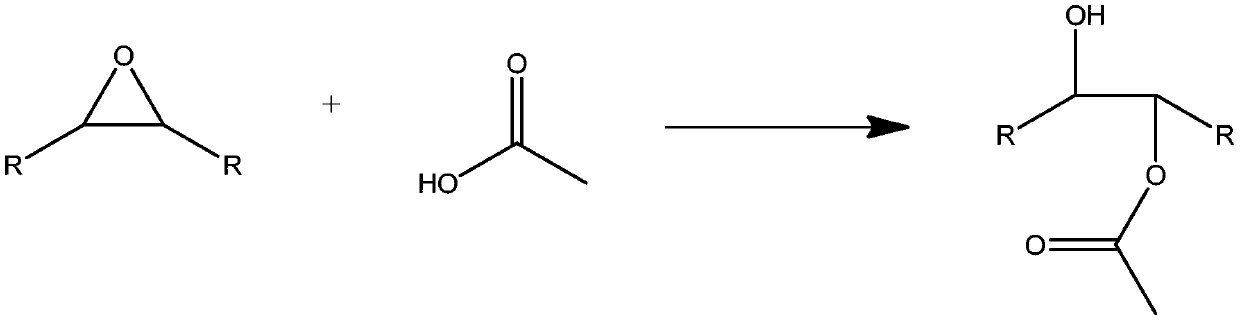
[0001] field of invention [0002] Compounds producible by ring-opening reactions of epoxidized alkanes or epoxidized fatty acid esters having a weight average molecular weight greater than 200 grams per mole are blended with polar polymers to improve the gloss of the polar polymers. These compounds include at least one, preferably at least two, polar functional groups per molecule, and are blended with polar polymers, or blends containing at least one polar polymer, to improve the gloss of these polymers, thereby These polymers are given a suitable gloss right at the time of the manufacturing operation without further painting or laminating steps. These compounds also improve, or at least do not reduce, the impact strength of polar polymers. Preferred compounds are polyhydroxy (eg, dihydroxy) alkanes and / or polyol polyesters which may be prepared by ring opening reactions of corresponding epoxidized compounds. Blends of these polar polymers with polyol polyesters and / or dihyd...

Claims

the structure of the environmentally friendly knitted fabric provided by the present invention; figure 2 Flow chart of the yarn wrapping machine for environmentally friendly knitted fabrics and storage devices; image 3 Is the parameter map of the yarn covering machine
Login to View More

Application Information

Patent Timeline
no application Login to View More
Patent Type & Authority Applications(China)
IPC IPC(8): C08L33/04C08L91/06B32B27/06
CPCC08L91/06C08K5/0008C08K5/101C08K5/521C08K5/17C08K5/156C08K5/07C08K5/45B32B27/36B32B2274/00B32B2605/08B32B2250/05B32B27/065B32B27/18B32B2307/558B32B2250/40B32B2307/732B32B7/12B32B2266/0235B32B27/308B32B27/40B32B2250/02B32B2264/104B32B2260/046B32B2605/18B32B21/08B32B27/38B32B27/32B32B27/302B32B2260/026B32B27/365B32B5/18B32B2264/025B32B2419/00B32B2270/00B32B2307/406B32B27/304B32B2262/062B32B27/08B32B2250/24C08L101/02C08K5/05C08L91/00C08L33/06B32B2305/72C08K5/053C08L33/12C08L33/20
Inventor 王敬涵C·波内特A·佩特森
Owner TRINSEO EURO GMBH
Features
  • R&D
  • Intellectual Property
  • Life Sciences
  • Materials
  • Tech Scout
Why Patsnap Eureka
  • Unparalleled Data Quality
  • Higher Quality Content
  • 60% Fewer Hallucinations
Social media
Patsnap Eureka Blog
Learn More