Check patentability & draft patents in minutes with Patsnap Eureka AI!

Orderly charging and discharging method of electric bus based on time-of-use electricity price

A technology of electric public transport and time-of-use electricity pricing, applied in electric vehicle charging technology, electric vehicles, battery/fuel cell control devices, etc., to achieve the effects of reducing charging costs, improving reliability, and reducing losses

Pending Publication Date: 2020-09-04
SHANGHAI DIANJI UNIV
View PDF5 Cites 4 Cited by
  • Summary
  • Abstract
  • Description
  • Claims
  • Application Information

AI Technical Summary

Problems solved by technology

[0005] Aiming at the defects in the prior art, the object of the present invention is to provide an orderly charging and discharging method for electric buses based on the time-of-use electricity price. The problem with the charging method of the car

Method used

the structure of the environmentally friendly knitted fabric provided by the present invention; figure 2 Flow chart of the yarn wrapping machine for environmentally friendly knitted fabrics and storage devices; image 3 Is the parameter map of the yarn covering machine
View more

Image

Smart Image Click on the blue labels to locate them in the text.
Viewing Examples
Smart Image
  • Orderly charging and discharging method of electric bus based on time-of-use electricity price
  • Orderly charging and discharging method of electric bus based on time-of-use electricity price
  • Orderly charging and discharging method of electric bus based on time-of-use electricity price

Examples

Experimental program
Comparison scheme
Effect test

Embodiment Construction

[0057]The present invention will be described in detail below in conjunction with specific embodiments. The following examples will help those skilled in the art to further understand the present invention, but do not limit the present invention in any form. It should be noted that those skilled in the art can make several changes and improvements without departing from the concept of the present invention. These all belong to the protection scope of the present invention.

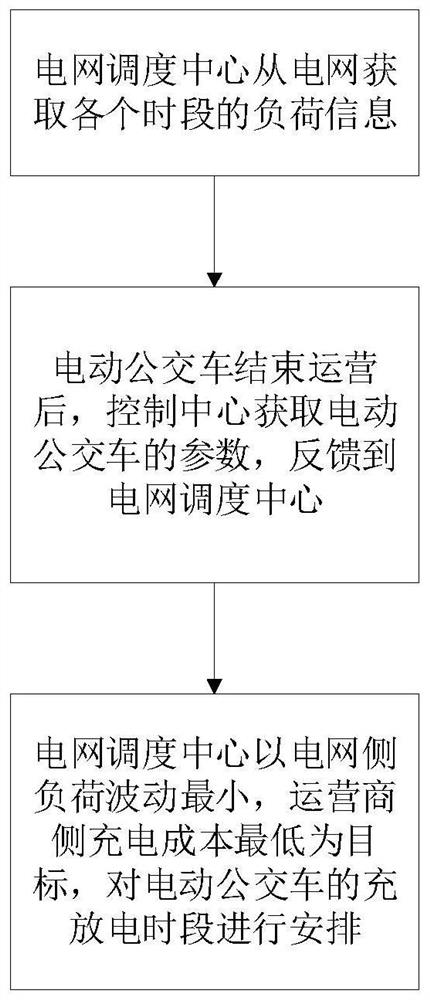
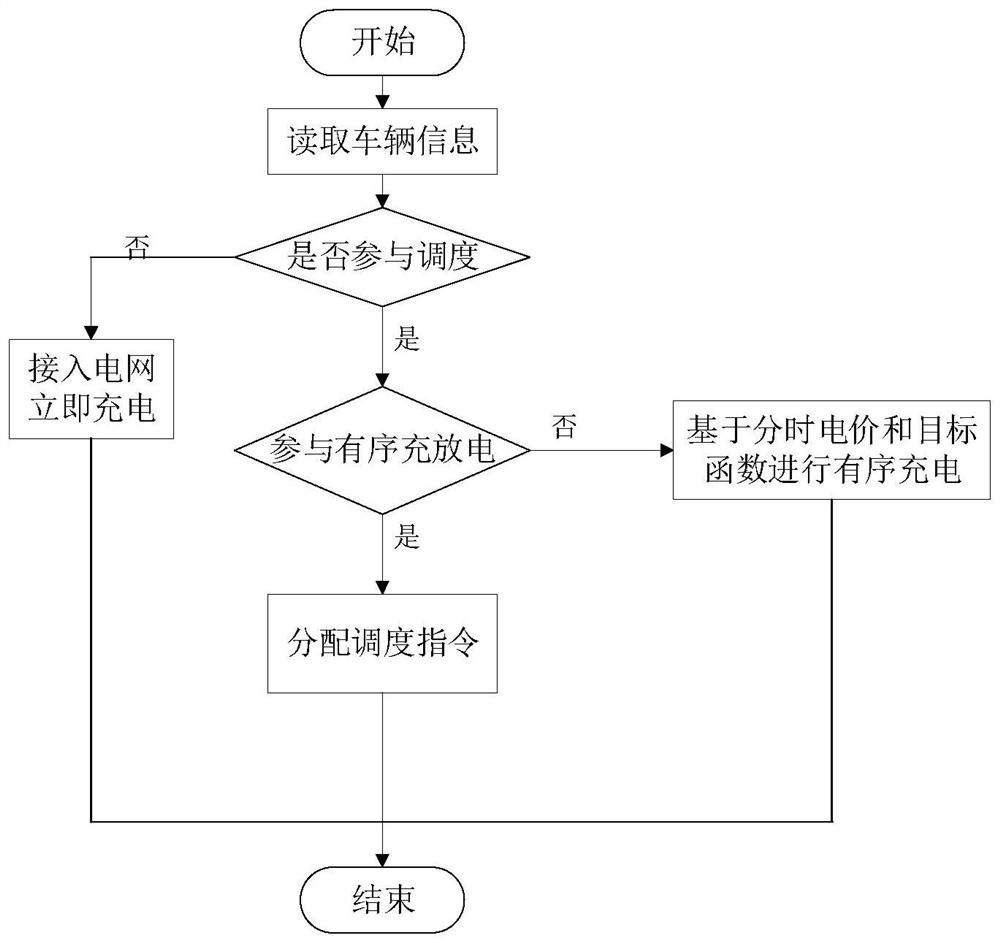
[0058] Such as figure 1 , 2 As shown, the present invention provides a method for orderly charging and discharging electric buses based on time-of-use electricity price, which comprises the following steps:

[0059] (S1) Obtain the electricity load data of each time period in the local area from the power grid; for the convenience of calculation, divide the whole day into 48 time periods, each time period is 30 minutes, and each time period corresponds to one piece of data.

[0060] (S2) Determine the ...

the structure of the environmentally friendly knitted fabric provided by the present invention; figure 2 Flow chart of the yarn wrapping machine for environmentally friendly knitted fabrics and storage devices; image 3 Is the parameter map of the yarn covering machine
Login to View More

PUM

No PUM Login to View More

Abstract

The invention provides an orderly charging and discharging method of an electric bus based on a time-of-use electricity price. The method comprises the following steps: acquiring electrical load dataof each time period of a local area from a power grid; judging a charging type of each electric bus, wherein the charging type includes the type of not accepting charging and discharging scheduling, the type of accepting ordered charging scheduling and the type of accepting ordered charging and discharging scheduling; on a power grid side, taking a minimum load wave crest and valley difference asa target function; at an electric bus operator side, taking minimum electric bus charging cost as the target function; and establishing an optimization model by taking a battery capacity, operation time and charging and discharging power of the electric bus as constraint conditions, and obtaining the optimal charging and discharging time and power by solving the model. According to the method, thepeak-valley difference of the power grid load can be adjusted, losses of the power grid caused by disordered charging of the load are reduced, and reliability of power grid operation is further improved. Based on a time-of-use electricity price policy, the electric bus is controlled to carry out orderly charging and discharging so that charging cost is reduced.

Description

technical field [0001] The invention relates to the field of public transportation, in particular to an orderly charging and discharging method for an electric bus based on a time-of-use electricity price. Background technique [0002] With the increasing awareness of environmental protection, the application of electric vehicles has become more and more extensive. Compared with private cars, buses have fixed driving routes, departure times and strong travel rules, and have lower requirements for cruising range. Therefore, many cities will use electric buses to replace existing fuel buses. [0003] In the prior art, electric buses are usually charged uniformly after operation. This charging method that does not consider the grid load has the following disadvantages: [0004] First, the existing technology does not give full play to the advantages of electric buses as a distributed power supply, and does not consider the regulation of the grid while integrating the electric ...

Claims

the structure of the environmentally friendly knitted fabric provided by the present invention; figure 2 Flow chart of the yarn wrapping machine for environmentally friendly knitted fabrics and storage devices; image 3 Is the parameter map of the yarn covering machine
Login to View More

Application Information

Patent Timeline
no application Login to View More
IPC IPC(8): B60L53/64B60L53/63B60L58/12B60L53/62
CPCB60L53/64B60L53/63B60L58/12B60L53/62Y02T10/70Y02T10/7072Y02T90/12
Inventor 曹伟曾宪文高桂革
Owner SHANGHAI DIANJI UNIV
Features
  • R&D
  • Intellectual Property
  • Life Sciences
  • Materials
  • Tech Scout
Why Patsnap Eureka
  • Unparalleled Data Quality
  • Higher Quality Content
  • 60% Fewer Hallucinations
Social media
Patsnap Eureka Blog
Learn More