Supercharge Your Innovation With Domain-Expert AI Agents!

A detection cr 2 o 7 2- The polyfluorene fluorescent sensor and its application

A fluorescent sensor and polyfluorene technology, which is applied in the field of chemical sensors, can solve the problem of less work reports of fluorescent sensors, and achieve the effects of good application prospects, high anti-interference ability and high sensitivity

Active Publication Date: 2022-05-10
JIANGXI SCI & TECH NORMAL UNIV
View PDF3 Cites 0 Cited by
  • Summary
  • Abstract
  • Description
  • Claims
  • Application Information

AI Technical Summary

Problems solved by technology

Unfortunately, the application of Cr 2 o 7 2- There are still relatively few related work reports on fluorescent sensors.

Method used

the structure of the environmentally friendly knitted fabric provided by the present invention; figure 2 Flow chart of the yarn wrapping machine for environmentally friendly knitted fabrics and storage devices; image 3 Is the parameter map of the yarn covering machine
View more

Image

Smart Image Click on the blue labels to locate them in the text.
Viewing Examples
Smart Image
  • A detection cr  <sub>2</sub> o  <sub>7</sub>  <sup>2-</sup> The polyfluorene fluorescent sensor and its application
  • A detection cr  <sub>2</sub> o  <sub>7</sub>  <sup>2-</sup> The polyfluorene fluorescent sensor and its application
  • A detection cr  <sub>2</sub> o  <sub>7</sub>  <sup>2-</sup> The polyfluorene fluorescent sensor and its application

Examples

Experimental program
Comparison scheme
Effect test

Embodiment 1

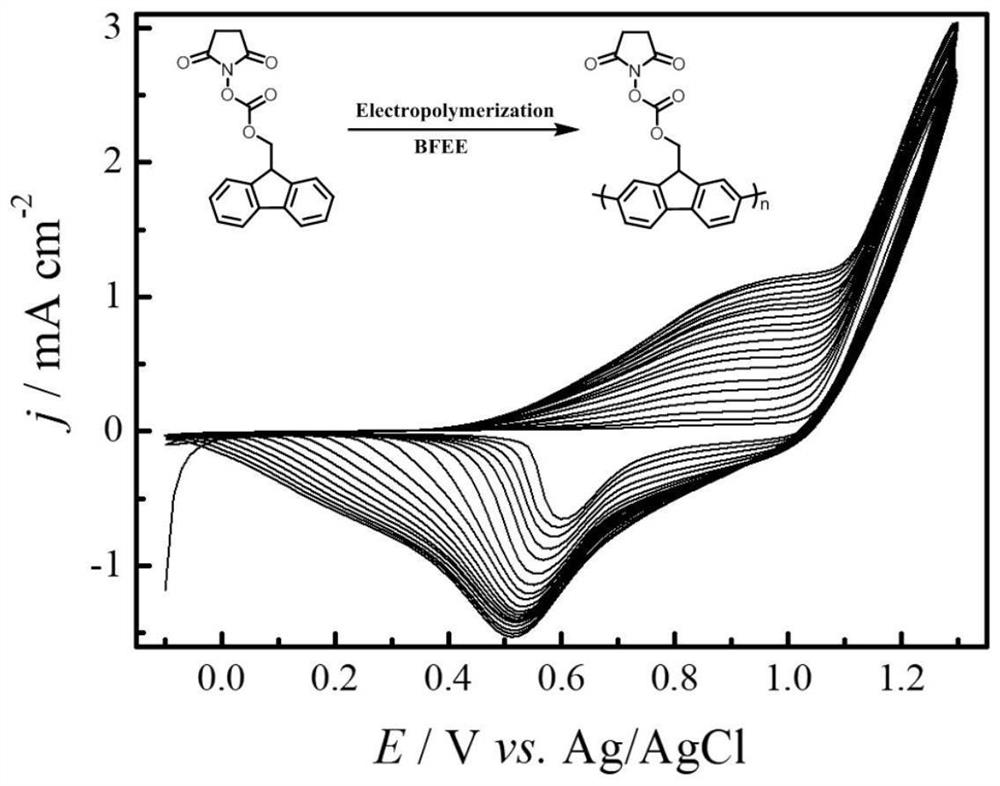
[0035] Embodiment 1: Preparation of P(Fmoc-Osu)

[0036]The concentration of the monomer Fmoc-Osu is 0.01moL / L, and the electrochemical polymerization is carried out in pure BFEE solution (5mL), nitrogen gas is passed for 15 minutes, the polymerization potential is 1.26V, the polymerization time is 6 hours, and the temperature is 25 degrees Celsius. There is no need to stir during the polymerization. After completion, the product is rinsed with anhydrous ether and dried in a vacuum oven at 50°C for 12 hours to obtain P(Fmoc-Osu).

Embodiment 2

[0037] Embodiment 2: the optical property of P (Fmoc-Osu)

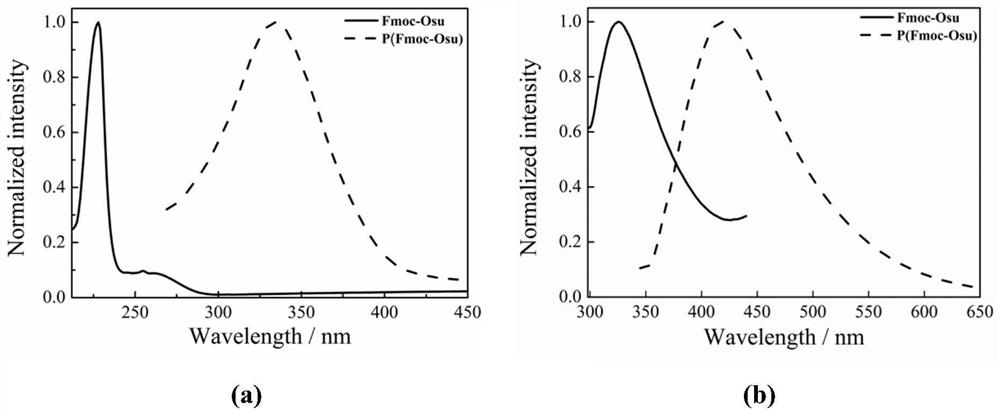
[0038] Since the P(Fmoc-Osu) prepared in Example 1 is only partially dissolved in water and ethanol, for further application, we choose DMSO-PBS (pH=7.0) (v / v=1:99) mixed solution as the detection system, The absorption spectrum and fluorescence spectrum of the monomer Fmoc-Osu and the polymer P(Fmoc-Osu) prepared in Example 1 were tested.

[0039] Depend on figure 2 It can be seen that under the excitation of 255nm and 335nm, the Fmoc-Osu monomer and the polymer prepared in Example 1 have maximum emission peaks at 325nm and 420nm, respectively. The red shift of the peak position in the absorption spectrum and emission spectrum of the polymer prepared in Example 1 indicates that the conjugated chain length of P(Fmoc-Osu) prepared in Example 1 increases.

Embodiment 3

[0040] Example 3: Selectivity Study

[0041] In order to evaluate the sensor for Cr 2 o 7 2- Selectivity experiments of some representative anions and some amino acids were studied.

[0042] Depend on image 3 It can be seen that in the presence of various anions and cations (0.4mM) in the DMSO / PBS (1:99, v / v) solution, the fluorescence of P(Fmoc-Osu) (22μM) prepared in Example 1 was quenched efficiency.

[0043] Depend on Figure 4 It can be seen that the addition of Cr in the presence of various amino acids (0.4mM) in DMSO / PBS (1:99, v / v) solution 2 o 7 2- , the fluorescence intensity of P(Fmoc-Osu) prepared in Example 1.

[0044] Therefore, it can be seen that the P(Fmoc-Osu) prepared in Example 1 has no effect on some representative anions (Fmoc-Osu) - ,CNO - ,HS - ,CH 3 COO - , SO 4 2- , SO 3 2- , HCO 3 2- ,NO 2- ,Br - ,CO 3 2- ,S 2 o 3 2 -, PO 4 3- ,SCN - and HSO 3 - ), cations (Sr 2+ , Ga 3+ ,Pd 2+ ,Hg 2+ , Ba 2+ ,K + ,Cr 3+ ,Al 3...

the structure of the environmentally friendly knitted fabric provided by the present invention; figure 2 Flow chart of the yarn wrapping machine for environmentally friendly knitted fabrics and storage devices; image 3 Is the parameter map of the yarn covering machine
Login to View More

PUM

No PUM Login to View More

Abstract

The invention discloses a method for detecting Cr 2 o 7 2‑ The polyfluorene fluorescent sensor and its application. The polyfluorene fluorescent sensor of the present invention is made of a polyfluorene fluorescent compound, which is dissolved in a solvent system of DMSO / PBS (1:99, v / v) and used directly as a homogeneous fluorescent sensor. The chemical name of polyfluorene fluorescent compound is poly(9-fluorenylmethyl-N-succinimide carbonate), which is obtained by electrochemical polymerization of monomer Fmoc-Osu in pure BFEE solution. The high sensitivity of the polyfluorene fluorescent sensor of the present invention can detect Cr in an ultra-trace amount 2 o 7 2‑ . The polyfluorene fluorescent sensor of the invention has wide applications, and has good application prospects in the fields of farmland detection, food samples and the like.

Description

technical field [0001] The invention relates to the technical field of chemical sensors, in particular to an ultrasensitive polyfluorene fluorescent sensor and its application for detecting dichromate ions in farmland environments. Background technique [0002] With the development of the economy and the improvement of people's living conditions, the pollution of heavy metals in farmland is increasing day by day, which is related to human health and has attracted great attention from all over the world. In the farmland environment, such as water and soil pollution will affect the growth of crops, reduce the quality and yield of crops. Moreover, heavy metal ions will enter the food chain through the accumulation of crops, causing harm to the health of animals and humans. Compared with other heavy metal ions, hexavalent chromium is widely used in our daily life, and due to its good water solubility in the whole pH range, the resulting pollution is more common. Therefore, the...

Claims

the structure of the environmentally friendly knitted fabric provided by the present invention; figure 2 Flow chart of the yarn wrapping machine for environmentally friendly knitted fabrics and storage devices; image 3 Is the parameter map of the yarn covering machine
Login to View More

Application Information

Patent Timeline
no application Login to View More
Patent Type & Authority Patents(China)
IPC IPC(8): C08G61/02C09K11/06G01N21/64
CPCC08G61/02G01N21/643C09K11/06G01N2021/6432C09K2211/1466C09K2211/1416C08G2261/11C08G2261/3142C08G2261/94C08G2261/522C08G2261/44C08G2261/143
Inventor 张革段学民李斐高玉芝李慧
Owner JIANGXI SCI & TECH NORMAL UNIV
Features
  • R&D
  • Intellectual Property
  • Life Sciences
  • Materials
  • Tech Scout
Why Patsnap Eureka
  • Unparalleled Data Quality
  • Higher Quality Content
  • 60% Fewer Hallucinations
Social media
Patsnap Eureka Blog
Learn More