
Multi-pollutant collaborative advanced treatment system for hazardous waste incineration flue gas
A technology for incinerating flue gas and hazardous waste, applied in the direction of incinerators, combustion methods, combustion types, etc., can solve the problems of large footprint, shortened service life of catalysts, high emission requirements, etc., achieve safe and reliable operation costs, and reduce NOx The effect of generating and reducing the flue gas temperature
- Summary
- Abstract
- Description
- Claims
- Application Information
AI Technical Summary
Problems solved by technology
Method used
Image

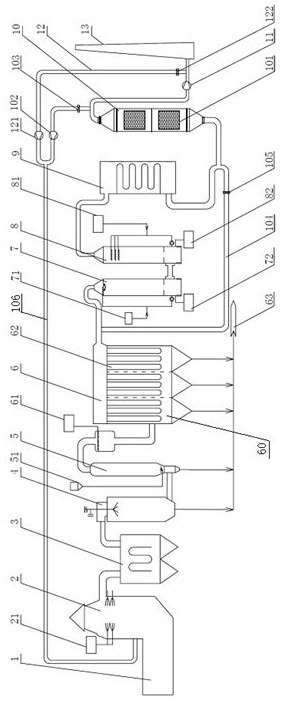
Examples
Embodiment 1
[0038] Hazardous waste is incinerated in the rotary kiln 1, and when the high-temperature flue gas produced enters the secondary combustion chamber 2, ammonia water is injected into the flue gas through the SNCR denitrification device 21 as a denitrification reducing agent, so that the NOx in the flue gas is at 850-1150°C In the temperature window, there is a reduction reaction with ammonia water, and the flue gas after denitrification enters the waste heat boiler 3 for waste heat recovery and cooling. The 550-600°C flue gas discharged from the flue gas outlet of the waste heat boiler 3 enters the quenching tower 4 and cools down to 300°C within 1 second in the quenching tower. Slaked lime is sprayed in the gas as a deacidification agent to remove part of the acid gas. The unreacted deacidification agent is discharged out of the dry deacidification system 5 synchronously with the flue gas, and is synchronized with the ammonia reducing agent sprayed through the ammonia injectio...
PUM
 Login to View More
 Abstract
Description
Claims
Application Information
 Login to View More